Boveedy Presbyterian Church and Cemetery lies in the civil parish of Tamlaght O'Crilly, near Kilrea in County Londonderry.
Construction
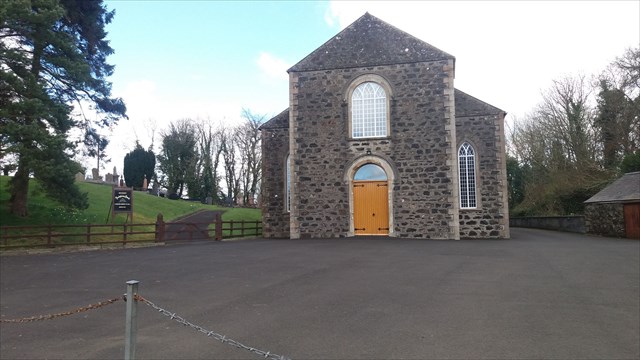
Boveedy Presbyterian Church is a plain ‘hall’ church with projecting front bay. This has a rounded arch doorway with hood-mould and triple lancet rounded arch window above. One lancet window either side of projecting section on gable of main hall. Lancet windows on sides.
Primary Stone Type: Basalt
Secondary Stone Type: Barony Glen Sandstone
The sandstone used as building stone in this area (often referred to as ‘Dungiven Sandstone’ in historical literature) is of the Carboniferous Sandstone and Conglomerate Formation (Roe Valley Group) which was formed around 350 million years ago. It was used widely in the 19th Century, through this region and is recorded as being used on many buildings in Derry City including the Guild Hall.
The Roe Valley Group (Barony Glen Formation and Inishcarn Formation) crops out on the West side of White Mountain and Mullaghmore and along the South side of Lough Foyle. A range of large quarries were once operational in and around Altmover Glen, just outside Dungiven and these are now all disused and overgrown. Both Barony Glen and Inishcarn Formations also crop out in the Draperstown area and the sandstone was known to be quarried at the Forge Bridge Quarry near Draperstown.
The Barony Glen Sandstone used as building stone in this area is very variable although sandstone from the quarries near Dungiven and those near Draperstown are sometimes distinguishable. The stone has a vast range of colours buff, white, yellow to pink. Individual blocks can be uniform in colour and texture or exhibit a variety of hues and bedding. Individual pebbles and beds of coarser material are often visible in blocks.
The sandstone from this area performs well as a building stone in rural areas. Stone faces generally show granular disintegration, differential weathering along bedding planes and occasional pitting of stone surfaces
History
Source: Annals and Statistics of the United Presbyterian Church, by William Mackelvie (Edinburgh: Oliphant & Company, and Andrew Elliot; Glasgow: David Robertson; 1873), pp. 375-6. Transcribed by A. Kilpatrick.
BOVEEDY.
At an early period in the history of Secession, there were representatives of the principle in Boveedy. For a long time the congregation held fast the doctrine "that any alliance with or dependence upon the kingdoms of this world is unworthy of the Church of Christ, and a violation of her duty to Him." During the ministry of Adam Boyle, ordained 1782, and who laboured there for more than fifty years, the Regium Donum was accepted first by his son, and then by the father himself. Mr Boyle had been a student of John Brown of Haddington. He was greatly respected by his people; and though they were opposed to the Donum, their dissatisfaction with their minister's acceptance of the grant did not assume any decided shape. They took care, however, on appointing his successor, to call one opposed to the Donum, who was soon translated to another charge. The congregation then applied to the Associate Presbytery, having been defeated in their overtures to have a minister of their own heart from the Presbytery of Ahoghill. The Rev. James Fleming of Cullybackey was sent to preach to them on Sabbath, 30th July 1845, from which the cause may henceforth be dated. For a time the congregation received supply every alternate Sabbath; and after they obtained a settled pastor, his labours were divided between Boveedy and Knockcloughgorm, 12 miles distant, so that sermon continued to be given at Boveedy each alternate Sabbath till 1832.
In 1847, the church, capable of holding 250, and costing £102, 4s. 10-½d., was erected, but without seats for the worshippers. It was opened on the 5th September 1847, by Rev. David Thomas of Mauchline.
1st Minister.——JAMES FITZPATRICK, from Killaig. Ordained pastor of Boveedy and Knockcloughgorm in 1846. Became sole pastor of Knockcloughgorm in 1862.
The congregation then called Messrs C. Squair, James Graham, and James B. Whyte.
2d Minister.——JAMES CLARK BALDERSTON, from Paisley (Oakshaw Street). Ordained 12th January 1865. Translated to West Kilbride, May 1868.
3d Minister.——WALTER BUCHAN, formerly of Sixtowns. Inducted 23d June 1868.