Background Information
Believe it or not, Flagpole Hill was once underwater. During early parts of the Paleozoic Era, Pennsylvania was swallowed by a shallow sea, home to many organisms. As the water receded, boggy swamps made way for more plant life to thrive. By the Triassic and Jurassic periods, PA even had dinosaur activity, as evidenced by some fossils in the southeastern part of the state. The timeline below highlights the different periods of our geologic history and the types of organisms that lived during those years: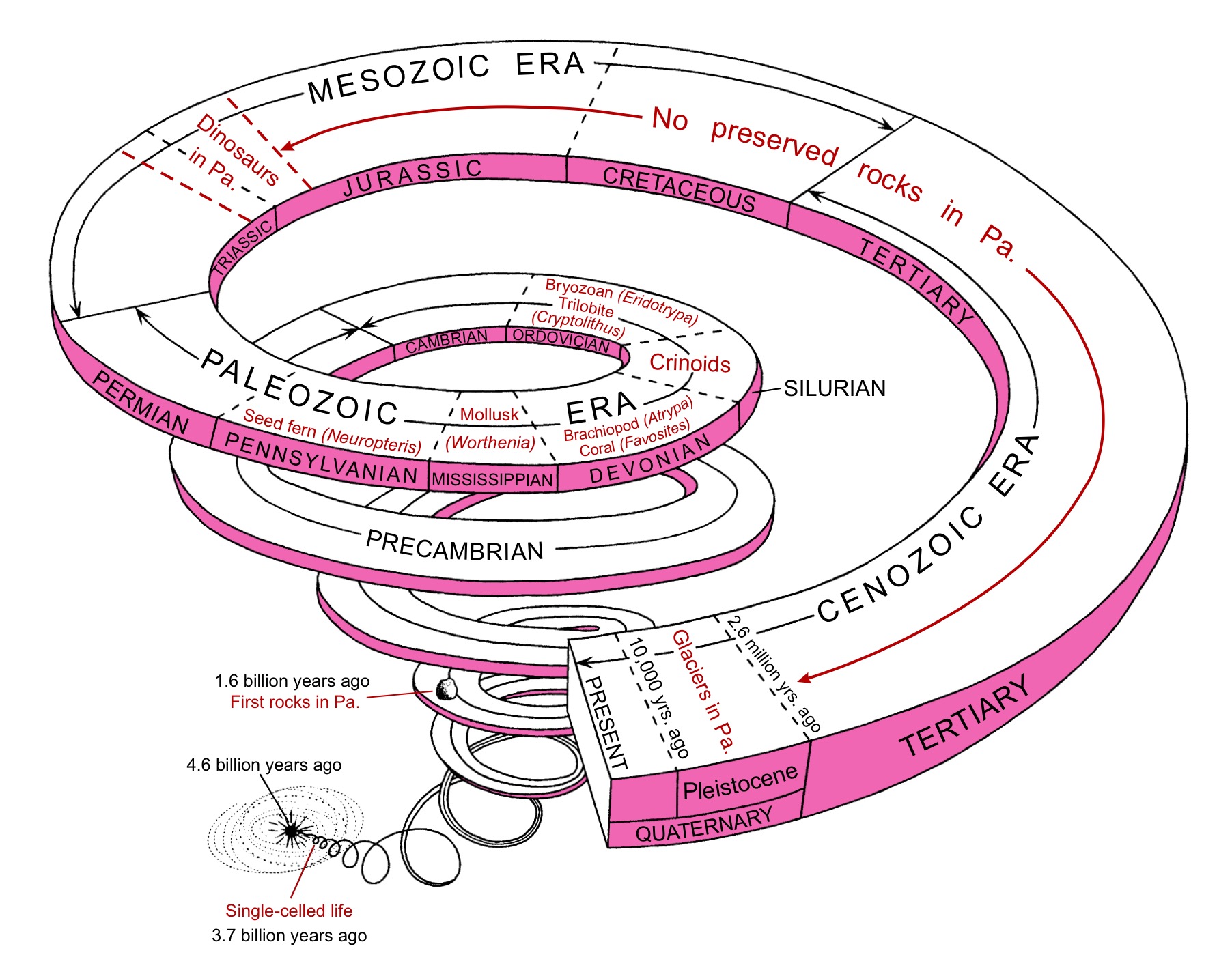
How are fossils formed?
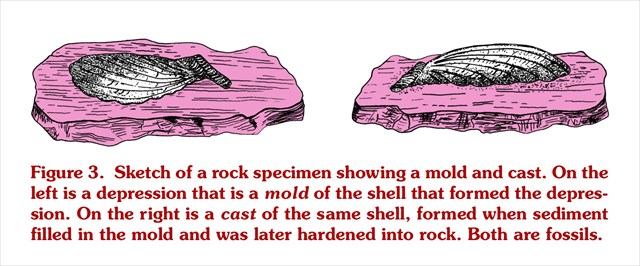
The average organism has an easier chance winning the Powerball than becoming a fossil. It is estimated that only one in every million organisms becomes fossilized. Bogs, mudpits, and ocean floors are great fossil environments because they preserve the lifeform, while millions of years of pressure encase it into a sedimentary rock. The hard parts of fossils are commonly dissolved after they have been buried in sediment, leaving an open space in their place. This space becomes a mold of the fossil. If the mold becomes filled with more sediment, which is then preserved in the original shape of the fossil, a cast of the fossil is formed.
Common Fossils found in Pennsylvania
Brachiopods
Brachiopods belong to the phylum Brachiopoda and, together with plants, are among the most common fossils found in Pennsylvania rocks. Brachiopods are similar in appearance to bivalves (see below). Both brachiopods and bivalves have two shells, or valves. In most bivalves, the valves are the same size and shape; they are thus mirror images of each other. The two valves of a brachiopod differ in size and shape and are not mirror images of each other. Perhaps the easiest way to tell a bivalve from a brachiopod is to divide them into two equal parts.
Bivalves
Bivalves, or pelecypods, as they are sometimes called, are common animals found in present-day fresh and marine waters. You know them mostly as mussels, scallops, and oysters; all or parts of their bodies can be food for us. Bivalve fossils have many shapes, sizes, and different types of ornamentation.
Gastropods
The class Gastropoda contains the animals we call snails and slugs, among others. Snails are mollusks that carry on their backs coiled, unchambered shells. Gastropod shells vary greatly in shape and size. If you have the opportunity to collect gastropod shells from the seashore, you will notice great differences among them. The snail animal carries the shell on its back with the peaked part pointing to the rear, or to the rear and upward. It retracts itself into the shell when disturbed. Some genera possess a piece of shell that fits over the opening like a door. Snails live in nearly all earth environments, from dry land to fresh water to seawater. Those living on land have developed lungs, and those living underwater use gills to obtain oxygen.
Arthropods
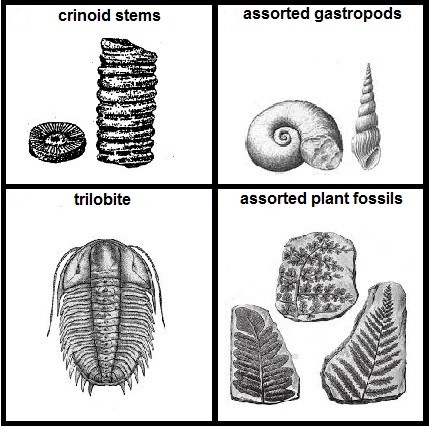
Arthropods are a phylum of animals with jointed legs and a segmented body. Common arthropods today include many crustaceans (crabs, prawns, etc.) and insects (scorpions, centipedes, etc.). Another arthropod that you may have heard of is the trilobite, PA's state fossil. Trilobites were seafaring animals that sort of resemble the modern horseshoe crab. Trilobites went extinct about 200 million years ago, but their fossils can still be found in PA.
Echinoderms
You probably know them more as starfish, sea urchins, and sea cucumbers, but the phylum Echinodermata also includes a class of organisms called Crinoidea, which are also referred to as sea lilies. Crinoids have a long stem that connect it to its flower-like body. These stems can often be found in fossils throughout PA.
Ferns and other flora
Later on in geologic history, we can find a wealth of evidence of ferns, trees, and other flora that thrived in bogs and swamps that eventually transformed into carboniferous coal and shale. Ancient ferns, in particular, yield a very nice fossil that usually contrasts well against its rock host. Petrified wood is also present in the form of fossils. There is a really nice earthcache (GC68V21) in Wilkes-Barre that showcases an awesome sample of petrified wood encased in anthracite coal.
Okay, okay: Now how about that smiley?
To claim credit for this earthcache, you must visit the site at the posted coordinates. Once there, you should find an abundant supply of fossil samples. We suggest bringing along a magnifying glass for added visibility of the fossils. Additionally, you must answer the questions below by sending us a message.
1.) Describe the type of rock in which the fossils are found. What are some of the physical characteristics (texture, hardness, color, etc.) of the rock? Given the environment in which these organisms lived, what do you think this rock used to be?
2.) Are the majority of the fossils you discovered casts or molds?
3.) What are some of the organisms you found in your fossil samples? Be sure to list as many as you can.
4.) Given your answers for #3, in which geologic era would most of these organisms most likely be found?
5.) Look around; there is a row of boulder-sized rocks nearby. Approximately how far away are they from GZ?
Photos, while optional, are encouraged in your logs!
Works Cited
Hoskins, D. M. (1999). Common Fossils of Pennsylvania [Pamphlet]. Harrisburg, PA: Pennsylvania Geological Survey.
Neuendorf, K. K., Mehl, J. P., & Jackson, J. A. (2011). Glossary of Geology. Alexandria, VA: American Geological Institute.