 .. Versioni në gjuhën shqipe
Apollonia është vendi më i madh arkeologjik në Shqipëri. Ky qytet i njohur antik u themelua rreth vitit 600 pes dhe ishte i pari që mbajnë emrin e Perëndisë Apollonit. Ajo u bë, në kohët romake, një qendër e madhe kulturore famshëm për shkollën e filozofisë. Në vlerësimin e mbështetjen e tij në luftën kundër Pompeit, Caesar ka fituar statusin e "qytetit të lirë". Ai dërgoi nipin e tij Octavian, të ardhmen perandorit Augustus, shkollimin e tij atje. Imponuar eshtrat e këtij prosperitetit të lashtë për të zbuluar: muret e jashtme, (shekujt e gjashtë dhe të pestë pas Krishtit), portikë, tempuj, Odeon, Biblioteka, hark triumfal, monumentit apo bouleuterion Agonothètes, palestër, shtëpi, tavernë burim, teatër ...
 English version
Apollonia is the biggest archeological site of Albania. This antique famous city was established) towards 600 BC and was the first one to bear the name of the God Apollo. It became, in the roman time, a big cultural center very reputed for its school of philosophy. As a recognition for its support during the war against Pumped, it obtained from Caesar the status of " free city ". He sent his nephew Octave, future Emperor Augustus, to perfect his education there. Impressive vestiges of this classic art prosperity are to be discovered : outer walls, (5th and VIth centuries AD), porticoes), temples, odéon, library, triumphal arch, bouleutérion or monument of Agonothètes, gymnasium, houses, inn, fountain, theater…
 Version Française
Apollonia est le plus grand site archéologique d’Albanie. Cette célèbre cité antique fut fondée vers 600 avant J.-C. et fut la première à porter le nom du Dieu Apollon. Elle devint, à l’époque romaine, un grand centre culturel célèbre pour son école de philosophie. En remerciement de son soutien lors de la guerre contre Pompée, elle obtint de César le statut de « ville libre ». Il envoya son neveu Octave, le futur empereur Auguste, y parfaire son éducation. D’imposants vestiges de cette antique prospérité sont à découvrir : murs d’enceintes, (Ve et VIe siècles de notre ère), portiques, temples, odéon, bibliothèque, arc de triomphe, bouleutérion ou monument des Agonothètes, gymnase, maisons, taverne, fontaine, théâtre…
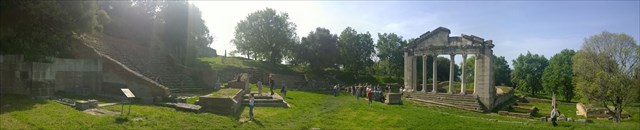
QUENDRA MONUMENTALE / MONUMENTAL CENTER / CENTRE MONUMENTAL
Quendra monumentale u nxorr në dritë nga arkeologu francez Leon Rey në vitet 30 të shek.XX ; restaurimet e kryera nga Instituti i Monumenteve të Kulturës në vitet 1970-1980 i kanë dhënë asaj pamjen e sotme.
The monumental center was excavated by the French archaeologist Leon Rey in the 1930s ; restoration works carried out during the years 1970-1980 by the Institute Monuments in Tirana gave it its present apperance.
Le centre monumental a été fouillé par l'archéologue français Léon Rey dans les années 30 du XXe sicècle ; les restaurations réalisées dans les années 1970-1980 par l'Instittu des Monuments de Tirana lui ont donné son aspect actuel.
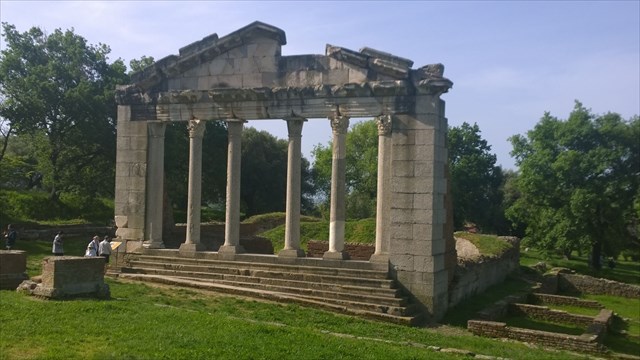
MONUMENTI I AGONOTETEVE / BOULEUTERION/ BOULEUTERION
Ky është monumenti më madhështor i qendrës monumentale dhe një nga simbolet e arkeologjisë shqiptare. Ndërtesa vendosur Këshilli i Qytetit (në Boulée) që prania e stadium mund të strehojë rreth njëqind e gjashtëdhjetë njerëz, të bëjë një asamble e ndërtimit, ku identifikimi i saj si bouleuterion ndërtesës ku u takua me autoritetet komunale ..
This is the most imposing monument of the monumental center and one of the symbols of Albanian archaelology. The building housed the City Council (the Boulée) since the presence of bleachers can accomodate about one hundred and sixty people, make a building assembly, where its identification as bouleterion the building where met the municipal authorities..
C'est le monument le plus imposant du centre monumental et un des symboles de l'archéologie en Albanie. Le bâtiment abritait le conseil de la ville (la Boulée) puisque la présence des gradins, pouvant accueillir environ cent soixante personnes, en font un bâtiment de réunion, d'où son identification comem bouleutérion, édifice où se réunissaient les autorités municipales.
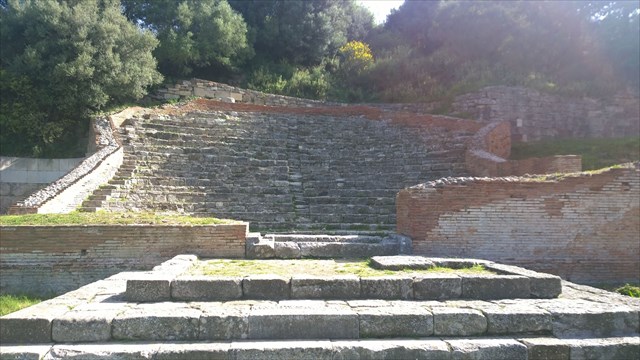
ODEONI / ODEON/ L'ODEON
Zbuluar nga L. Rey në vitin 1932, gërmimet e tij ka përfunduar në vitin 1978 dhe ka rezultuar në punën e restaurimit në mes të 1984 dhe 1987 nën drejtimin e G. Pani dhe L. Papajani.
Discovered by L. Rey in 1932, its excavation was completed in 1978 and resulted in restoration work between 1984 and 1987 under the direction of G. Pani and L. Papajani.
Découvert par L. Rey en 1932, sa fouille n'a été achevée qu'en 1978 et a donné lieu à des travaux de restauration entre 1984 et 1987 sous la direction de G. Pari et L. Papajani.
GEOCACHE
Geocache është e vendosur jashtë vendit për parkim vizitorët. Shih spoiler foto. Ajo përmban një log-libër, por nuk ka laps. Mos harroni të sjellë tuaj. Falemnderit.
The geocache is located outside the site on the visitors' parking. See spoiler picture. It contains a log-book but no pen. Think about bringing your own. Thanks.
La geocache se situe à l'extérieur du site sur le parking visiteurs. Voir la photo spoiler. Elle contient un log-book mais pas de crayon. Pensez à apporter le vôtre. Merci.