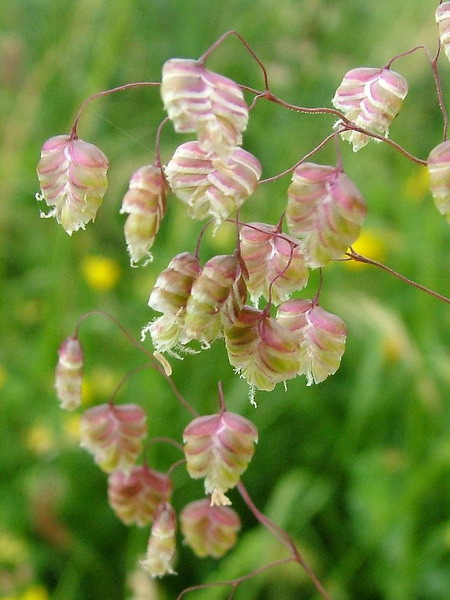
We couldn't have a series of caches up this hill without including a grass, this one is my favourite with its unique scale shaped heads as it gently rustles in the breeze and well worth seeking out.
Quaking grass - Briza Media – although Quaking grass is often found on dry light soils, it is quite adaptable and can be grown on other soil types such as clay and also in sun or shade. Quaking grass is a low growing species with reddish flowers that appear from June to August. Briza is a genus of annual and perennial grasses in the family Poaceae, comprising of around twelve species. It is native to north temperate regions. Widespread in Britain and the Scottish lowlands.
Quaking grass has lots of local names such as Shivery shaky grass, Totter Grass, Dothery Dock, Wigwams, Wiggle waggle, Joey jingles, Shivery shakes, Wibbly wobbly, Doddering dillies, Wagwonts and Toddling Grass - so take your pick what you decide to call it.
Grasslands are important for wildlife. We all love to see lovely grasslands filled with a variety of plantlife, the flowering plants , the meadows grazed. Lowland meadows provide a rich wildlife habitat . The hedgerows, bright with spring blossom, provide excellent bird nesting and the nearby grasslands provide seeds and berries. In turn insects butterflies flutter through the grasses, kestrels hover overhead hunting for mice, badgers make tracks through the grasses, sounds idyllic, even when wet and soggy from traipsing through in the rain for that ever ellusive cache.
Less than 15,000 hectares of unimproved neutral grassland remains in the UK, but the one characteristic shared by traditionally managed lowland meadows is the high number of herbs and grasses – they can frequently boast up to 30 grasses and 100 or more wildflower species. Grasses include quaking-grass, sweet vernal-grass, crested dog's-tail and red fescue. Bees and butterflies, such as meadow brown, common blue and the rare marsh fritillary, are among the hundreds of insects which probe the grassland flowers for nectar. In turn these insects provide food for bats, swallows that visit us each year and many declining farmland birds, including the skylark, whose numbers have more than halved over the last 25 years.