Keep an eye on the logs, as that is where I'll post if there's going to be a trip out from one of the islands. Normally, due to having boatmen friends, (hello Dave, Ryan, Mark, Andy, etc.) I'll know of any trips by about 9am. Trips normally depart at 10:15 from St Marys or early afternoon from St Agnes. An opportunity not to be missed, and one to be done early in your holiday if possible, as bad weather can stop trips running for a very long time as the swell dies down.
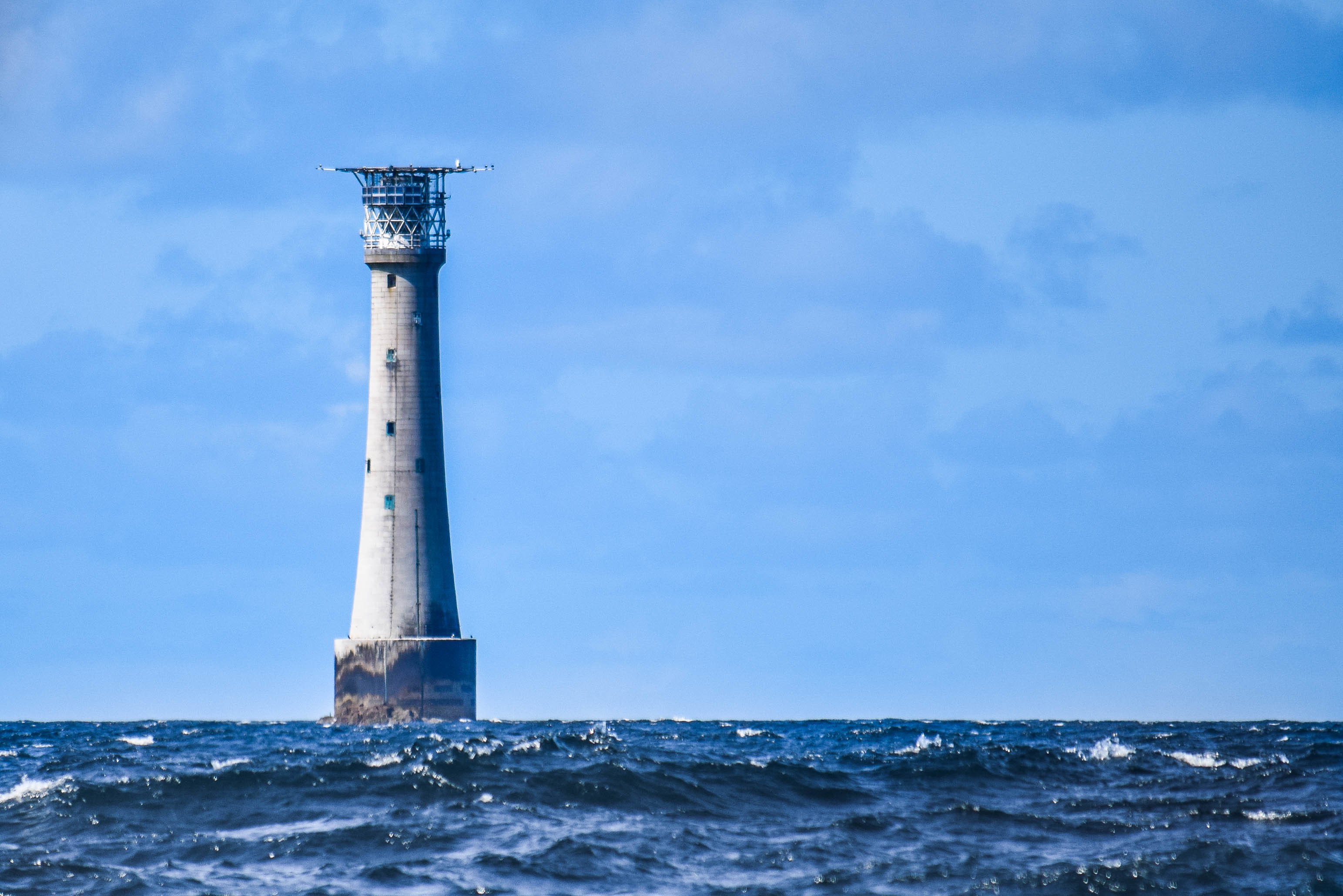
This is an Earthcache at Bishop Rock Lighthouse, the most Southwesterly point of the British Isles. This is therefore the most Southwesterly cache in the UK too.
It is difficult to get here - the D/T rating will tell you that, and so will I! You will have to travel on one of the tripper boats from St Mary's or one of the off islands to get here, and these trips may not be running particularly often, as it depends on sea states. They always leave St Mary's at 1015, however it is best to ring the various boat companies to find out details, and whether they are running the trip or not. There are ways and means of chartering your own boat but this too depends on sea states.
It is possible to do this in your own canoe from St Mary's or St Agnes, however I would NOT recommend it...!
LOGGING TASKS:
1) Describe the difference in the colour of the rock on the East and West sides of the lighthouse. Explain the difference in colour and how it links with the descriptions of weathering and erosion below.
2) The main tower is built of granite. Explain, linking to the descriptions below, whether this is a suitable or unsuitable rock and why. Please refer to what you can actually see at GZ on the lighthouse.
3) Estimate the height of the base layer of granite.
OPTIONAL TASK:
Take a picture of either yourself/GPS at the lighthouse, or the mode of transport that took you to the cache. Do not post pictures that could give away answers to other questions.
Unless you particularly want your log deleted, please do not put the answers in your online log. Instead please email them to me through my profile. Your answers act as a proof of your visit, please ensure you send them within 24 hours of logging a find so your log doesn't risk being deleted.
Weathering is the process of decomposing, breaking up, or changing the color of rocks. Weathering may be caused by the action of water, air, chemicals, plants, or animals. Chemical weathering involves chemical changes in the minerals of the rock, or on the surface of the rock, that make the rock change its shape or color. Carbon dioxide, oxygen, water, and acids may all cause chemical weathering. Mechanical weathering is the process of breaking a large rock into smaller pieces without changing the minerals in the rock. Mechanical weathering may be caused by frost, ice, plant roots, running water, or heat from the sun.
The main physical Weathering process on beaches and rocks in the sea is salt-crystal growth. Wind carries salt spray onto rocks, where it is absorbed into small pores and cracks within the rocks. There the water evaporates and the salt crystallises, creating pressure and often breaking down the rock. In some places calcium carbonate is able to bind together other sediments to form beachrock and in warmer areas dunerock. Wind erosion is also a form of erosion, dust and sand is carried around in the air and slowly erodes rock, this happens in a similar way in the sea were the salt and sand is washed up onto the rocks.
Erosion is a key part of the Rock Cycle. It is responsible for forming much of the interesting landscape that is around us. It is also a major problem as people live in areas in large numbers and get used to the environment being in a certain way. People can do things to increase erosion or slow it down.
Water causes much erosion. When it fall as acid rain, it can dissolve rocks that are sensitive to acid. Marble & limestone weather when exposed to the rain. When the rain falls very heavily, as in monsoons, then flooding can happen. Rivers with a lot or rushing water can cause mud slides and erode river banks. The action of waves on a beach causes much erosion. The waves pound on the rocks & over time, cliffs and buildings crumble. That is why you will often find sand & little pebbles on beaches. Rushing water, like what you find in strong waves on the shores of oceans, roll smaller rocks around which can erode larger rocks by crashing against them.
Granite, which the lighthouse is built of, is the best-known igneous rock. Many people recognize granite because it is the most common igneous rock found at Earth's surface and because granite is used to make many objects that we encounter in daily life. These include counter tops, floor tiles, paving stone, curbing, stair treads, building veneer and cemetery monuments. Granite is used all around us! Being an igneous rock, granite is very hard and durable. It's hard because it formed as hot liquid stone, and so the molecules inside it are all jumbled up any which way, instead of lying in layers as in sedimentary rocks like limestone or slate.
NOBODY EXCEPT YOURSELF IS RESPONSIBLE IF YOU FALL OUT OF YOUR CANOE, BOAT OR SELECTED MODE OF TRANSPORT AND DROWN. PLEASE DON'T DO THAT THOUGH.
If you do I'm not explaining the situation to your pets.