Gilt of Cain
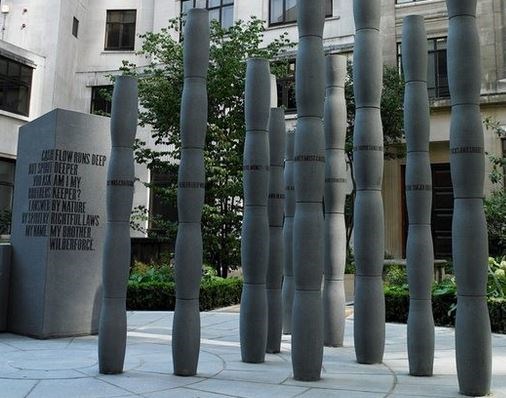
Futurecity were appointed by the City of London and Black British Heritage to curate a permanent sculpture to commemorate the 2007 bicentenary of the abolition of the transatlantic slave trade.. The artwork is sited at Fen Court in the City of London, significant because of its proximity to St Mary Woolnoth Church – where anti-slavery campaigner William Wilberforce was inspired by the Rev John Newton’s powerful anti-slavery sermons.
(More information further down. BUT first the earth lesson.)

Lets learn more about the Igneous Rocks and the Granite:
Igneous Rocks
Igneous rocks form by direct crystallization of minerals from a molten magma. When this magma cools slowly beneath the surface of the Earth, coarse-grained intrusive (plutonic) rocks crystallize: extrusive (volcanic and pyroclastic) rocks which crystallize quickly after the magma erupts at the earth's surface are typically very fine-grained. If the melt cools too quickly for crystals to grow, the result is a 'glass'.
Igneous rocks are classified according to their silica (SiO2) content. Expressed as a percentage of silica, four categories of igneous rocks exist; acid* (>66%), intermediate (52-66%), basic (44-52%) and ultrabasic (<44%).
*Not to be confused with acidity in the sense of pH.
Granite
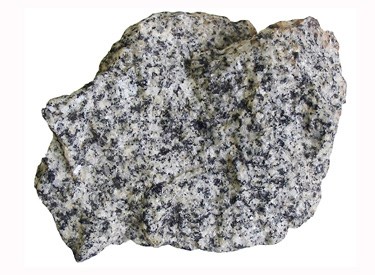
Granite, which makes up 70–80% of Earth’s crust , is an igneous rock formed of interlocking crystals of quartz , feldspar , mica, and other minerals in lesser quantities. Large masses of granite are a major ingredient of mountain ranges. Granite is a plutonic rock, meaning that it forms deep underground. Slow cooling gives atoms time to migrate to the surfaces of growing crystals, resulting in a coarse or mottled crystalline structure easily visible to the naked eye.
Geologists have debated rival theories of granite's origin for over 150 years. The two theories most favored today are the magmatic theory and the hypermetamorphic theory. Supporters of the magmatic theory observe that granite is strongly associated with mountain ranges, which in turn tend to follow continental edges where one plate is being subducted (wedged under another). Tens of kilometers beneath the continental edge, the pressure and friction caused by subduction are sufficient to melt large amounts of rock. This melted rock or magma ascends toward the surface as large globules or plutons, each containing many cubic kilometers of magma. Apluton does not emerge suddenly onto the surface but remains trapped underground, where it cools slowly and may be repeatedly injected from beneath with pulses of fresh magma. To become surface rock, a solidified pluton must finally be uplifted to the surface and stripped bare by erosion.
The ultrametamorphic theory, in contrast, argues that granite is not formed from raw magma but consists of sedimentary rock thoroughly melted and re-crystallized. Most geologists now argue that granites can be formed by magmatism, ultrametamorphosis, or a combination of both.
Until recently, geologists thought that plutons of granitic magma would require millions of years to ascend to the surface. However, laboratory experiments with melted rock has shown that granitic magma is thin and runny enough (i.e., of low viscosity) to squirt rapidly upward to the surface through small cracks in the crust. Granite plutons may thus be created in 1,000–100,000 years, rather than in the millions of years previously thought. The precise origin and process of granite formation continues to be a subject of active research.
Colour: colourless grains, also mottled in white, pink or red, some grey or dark grains.
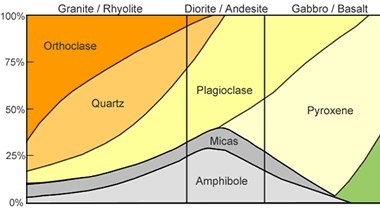
Mineralogy: essential quartz, alkali feldspar and plagioclase in variable amounts, usually with hornblende and/or biotite; muscovite may occur.
Classification: acid plutonic igneous rock.
Occurrence: intrusive, most commonly occurring in batholiths.
Texture: coarse to very coarse-grained; usually granular; may be porphyritic with well-shaped phenocrysts (large crystals) of feldspar; sometimes foliated; coarse intergrowths of quartz and feldspars can form a raphic texture.
Structure: commonly contain xenoliths, may contain cavities (druses) into which well-formed crystals project; may be associated with much late-stage mineralization.
To log this cache.
To get to log this cache you will have to visit and answer the questions which are related to the coordinates given the earthcache.
When answers are collected, send them to CO for verification.
As I own about 50 earthcaches there are MANY mails/messages to answer back on, and I will not always be able to answer right-back, BUT I READ ALL SENT ANSWERS AND LOGS, so if anything is not correct or need an upgrade, you will indeed hear back from me.
Thanks for your understanding, and for picking one of my caches.
You can log immediately answers are sent CO. If there are any questions about your answers CO will contact you.
Logs without answers to CO or with pending questions from CO will be deleted without any further notice.
Please do not include pictures in your log that may answer the questions.
Questions
1. Answer the questions under by visiting the Coordinates.
A. Can you see any of the three mineral materials in the stone at gz (mentioned in the text), and what are they?
B. Why is granite a common stone used for monuments?
C. Look at the black and shiny spots in the granite. What are they, and what type of rock does it typically occur in?
D. Look at several of the rectangular crystals in the stone. Measure their length, average their size and then tell if the rock is coarse, medium, or fine grained, by using the following scale:
- coarse crystals over 5mm in length,
- medium crystals between 1-5 mm in length
- fine crystal less than 1mm in length . (Answer can be found at GZ)
2. Take a photo of yourself, the group or your GPS when logging the cache.
Without revealing any answers!
(It’s voluntary to post a photo in your online log)
Gilt of Cain - Monument
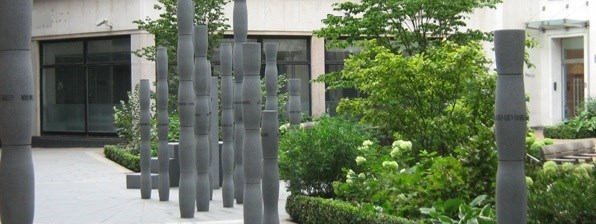
‘The Gilt of Cain’ was unveiled in 2008 to commemorate the abolition of the slave trade. The site is significant: Fen Court in the City of London is the site of a church which had strong connections with the abolitionist movement in the 18th and 19th centuries.
The Rev John Newton, the slave trader who became a vicar and ardent abolitionist, served as the Rector of St.Mary Woolnorth which stood on this site.
The sculptor Michael Visocchi worked with the poet Lemn Sissay to create a sculpture made up of columns and a podium. The columns represent sugar cane and the podium could be taken for a pulpit or a slave auction block. The work is grey granite with carved words taken from the Lemn Sissay poem ‘Gilt of Cain’.
{On a nearby information board:}
Gilt of Cain by Michael Visocchi & Lemn Sissay
The sculpture commemorates the abolition of the transatlantic slave trade in 1807, which began the process of the emancipation of slaves throughout the British Empire. Fen Court is the site of a churchyard formerly of St Gabriel’s Fenchurch St and now in the Parish of St Edmund the King and St Mary Woolnoth, Lombard St. The latter has a strong historical connection with the abolitionist movement of the 18th and 19th centuries.
The granite sculpture is composed of a group of columns surrounding a podium. The podium calls to mind an ecclesiastical pulpit or slave auctioneer’s stance, whilst the columns evoke stems of sugar cane and are positioned to suggest an anonymous crowd or congregation gathered to listen to a speaker.
The artwork is the result of a collaboration between sculptor Michael Visocchi and poet Lemn Sissay. Extracts from Lemn Sissay’s poem, ‘Gilt of Cain’, are engraved into the granite. The poem skilfully weaves the coded language of the City’s stock exchange trading floor with biblical Old Testament references.
The Gilt of Cain
By Lemn Sissay, 2007
Here is the ask price on the closed position,
history is no inherent acquisition
for here the Technical Correction upon the act,
a merger of truth and in actual fact
on the spot, on the money – the spread.
The dealer lied when the dealer said
the bull was charging the bear was dead,
the market must calculate per capita, not head.
And great traders acting in concert, arms rise
as the actuals frought on the sea of franchise
thrown overboard into the exchange to drown
in distressed brokers disconsolate frown.
In Accounting liquidity is a mounting morbidity
but raising the arms with such rigid rapidity…
Oh the reaping the raping rapacious fluidity.
the violence the vicious and vexed volatility.
The roaring trade floor rises above crashing waves:
the traders buy ships, beneath the slaves.
Sway machete back, sway machete again
cut back the Sugar Rush, Cain.
The whipsaw it’s all and the whip saw it all
The rising market and the cargo fall
Who’ll enter “Jerusalem” make the margin call for Abel?
Who will kick over the stall and turn the table?
Cain gathers cane as gilt-gift to his land
But whose sword of truth shall not sleep in hand?
Who shall unlock the stocks and share?
Break the bond the bind unbound - lay bare
The Truth. Cash flow runs deep but spirit deeper
You ask Am I my brothers keeper?
I answer by nature by spirit by rightful laws
My name, my brother, Wilberforce.
{lines from the poem are inscribed on elements of the monument.}
