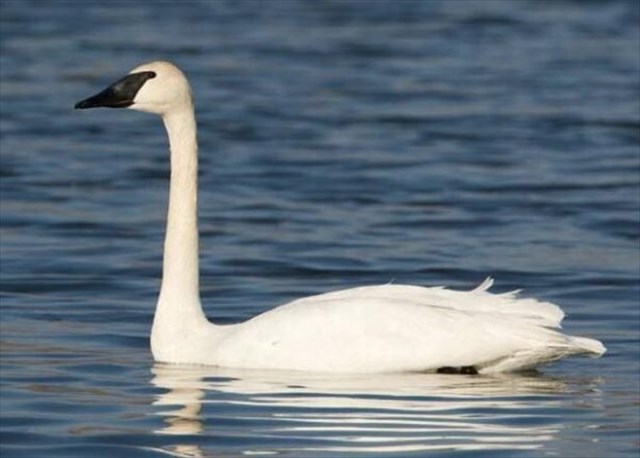
Trumpeter Swans (Cygnus buccinator) are our biggest native waterfowl, stretching to 6 feet in length, an almost 8 foot wingspan, and weighing between 25-35 pounds. Adult Trumpeter Swans are entirely white with a black bill and black legs. Immatures are gray-brown. They breed in open habitats near shallow water bodies, often nesting on beaver dams and muskrat houses. They winter on estuaries, large lakes, and rivers that remain at least partially ice-free year-round. Trumpeter Swans forage in fairly shallow water, reaching under the surface to eat aquatic vegetation, and at times tipping up in the manner of a dabbling duck. They also visit agricultural fields to eat spilled or leftover grains and crops.
Starting in the 1600s, market hunters and feather collectors had decimated Trumpeter Swan populations by the late 1800s. Swan feathers adorned fashionable hats, women used swan skins as powder puffs, and the birds’ long flight feathers were coveted for writing quills. By 1933, only 66 trumpeter swans remained in the continental United States, mainly in remote parts of the Rocky Mountains and Alaska. Aggressive conservation helped the species recover by the early 2000s.
When placing the Common Gallinule cache (GC6GMNV),. I noticed a Trumpeter Swan just to the north. When I came by a week later, the swan was still there, so I decided to place a cache for it. The GPS was really bouncing around, so I took the average of 6 readings. Because of this, I'm making it a 2.5 difficulty. It may be easier if your GPS isn't acting up. The container is a large camouflaged plastic container with a log and some small trade items. You need to bring your own writing instrument. There is plenty of parking on the wide shoulder of the road.