Puzzle caches take a lot of time to create and maintain, so if you would like me to continue placing quality caches, please don't leave generic logs like "TFTC" or "I found it at 12:00". Logs like this are rude to the cache owner and show a lack of appreciation. Thanks
퍼즐 캐시는 만들고 유지하는 데 많은 시간을 필요로하기 때문에 계속해서 고품질 캐시를 배치하려면 "TFTC"또는 "12:00에 찾았습니다"와 같은 일반 로그를 남기지 마십시오. 이와 같은 로그는 캐시 소유자에게 무례하고 감사의 부족을 보여줍니다. 감사합니다
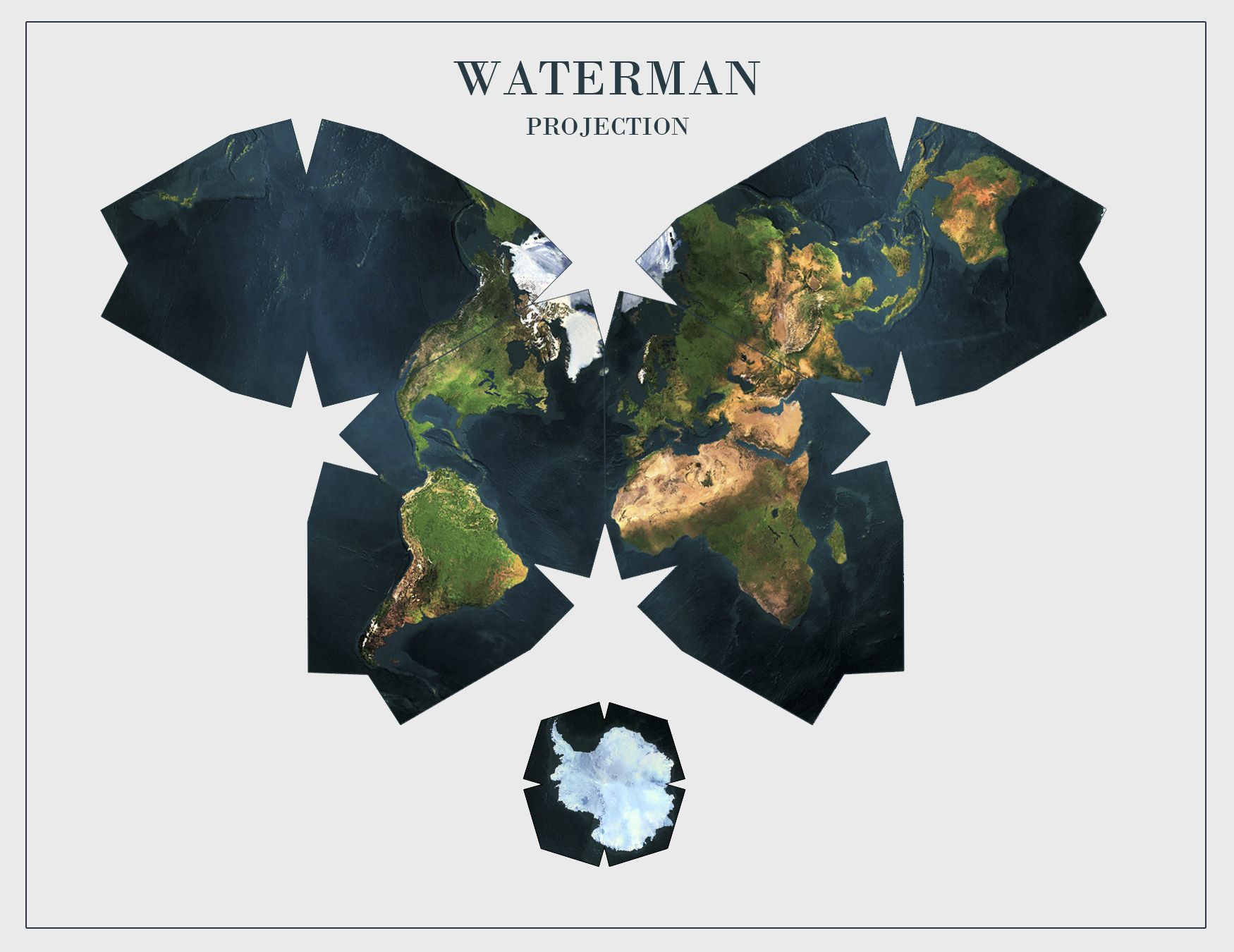
The Waterman "Butterfly" World Map is a map arrangement created by Steve Waterman. Waterman first published a map in this arrangement in 1996. The arrangement is an unfolding of a globe treated as a truncatedoctahedron, evoking the butterfly map principle first developed by Bernard J.S. Cahill (1866–1944) in 1909. Cahill and Waterman maps can be shown in various profiles, typically linked at the north Pacific or north Atlanticoceans.
As Cahill was an architect, his approach tended toward forms that could be demonstrated physically, such as by his flattenable rubber-ball map. Waterman, on the other hand, derived his design from his work on close-packing of spheres. This involves connecting the sphere centers from cubic closest-packed spheres into a corresponding convex hull, as demonstrated in the accompanying graphics. These illustrate the W5 sphere cluster, W5 convex hull, and two Waterman projections from the W5 convex hull.
To project the polyhedron to the plane, straight lines are used to define each 5 × 5 section onto this convex hull. According to annotations on modern versions of the map, the projection divides the equator equally amongst the meridians.The two methods yield very similar results. Parallels of latitude are drawn as three straight-line sections in each octant: from pole to fold-line; from fold-line to longest line parallel to equator; and then to the equator. The longest line parallel to the equator also has equal-length delineations. Waterman chose a specific Waterman polyhedron and central meridian to minimize interrupting major land masses.
Like Buckminster Fuller's 1943 Dymaxion Projection, an octahedral butterfly map can show all the continents uninterrupted if its octants are divided at a suitable meridian (in this case 20°W) and are joined, for example, at the North Atlantic, as in the 1996 version.

You can validate your puzzle solution with certitude.