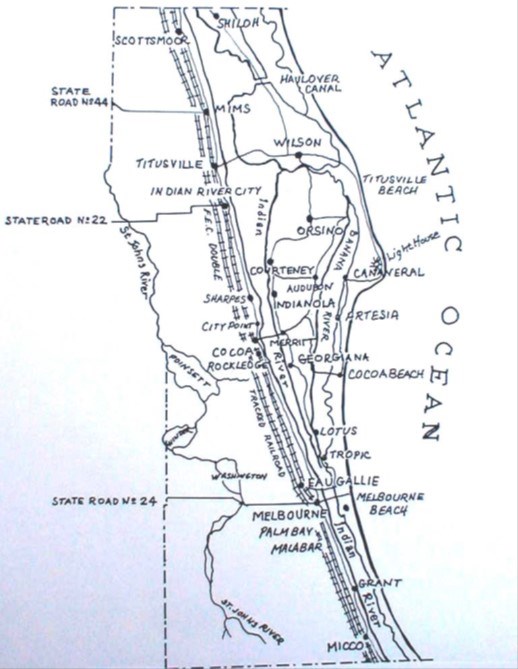
Henry M. Flagler (originally an oil man) had formed the Rockefeller, Andrews and Flagler Oil Refinery with John D. Rockefeller and Samuel Andrews in 1868, which later emerged as a joint-stock corporation named Standard Oil. By 1877, Standard Oil was considered the biggest and wealthiest industrial company in the world. But in Florida, development was slow. In 1878, for example, St. Augustine – the oldest city in the nation – was a city of great potential with no one to harness it. On a personal trip to the city, Flagler found it charming and realized that it would be home to his next big venture. Giving up his New York Standard Oil job in 1885, he came back to St. Augustine to fix what he thought were the two main problems: hotels and transportation. After successfully building the Ponce De Leon Hotel, he moved on to creating railways, which began the Florida East Coast lineage. Flagler bought the Jacksonville, St. Augustine, Halifax, and Indian River Railroads which (after several name changes) would become the Florida East Coast Railway (FECR) in September of 1895.[1] As the railroad progressed, many other small communities received small depots, and a number of towns received spur lines that veered toward wharfs on the Indian River Lagoon. The track reached Titusville in January of 1893. By July of that same year, Eau Gallie's spur was completed and receiving pineapples for shipment to Jacksonville.[2] FECR founded most of the east coast of Florida, including West Palm Beach, Palm Beach and, by 1896, Miami. Between 1904 and 1912, FECR was responsible for one of the greatest railroad engineering and construction feats in the history of the US; the fabled Key West Extension, which opened with Flagler's triumphant entry into the island city on January 22, 1912. By 1913, when Flagler died, FECR connected the entire east coast of Florida from Jacksonville to Key West.[1]
[2]
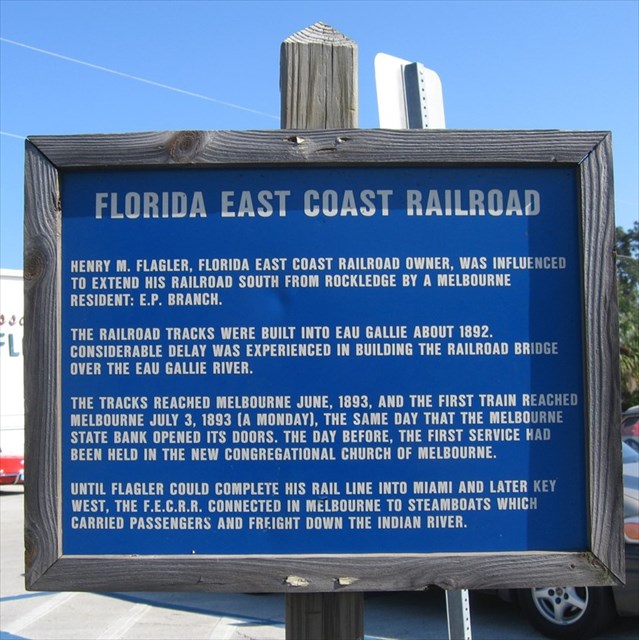
In the late 1800's, much of Melbourne's commercial activity was conducted in wooden buildings clustered along Front Street, located just north of Melbourne Harbor. Several piers jutted into the Lagoon to receive goods and travelers. Even in the evenings, the downtown activities lit up the shoreline as the steamboat "Rockledge" arrived with passengers. In fact, one of the earliest commercial areas in Melbourne was located along Front Street at the lagoon edge; but today, it is just a forgotten memory.[3] By March of 1894, Flagler had completed his track along the Lagoon; a total of 115 miles. Today, after over 100 years, only a small portion of the FECR’s original route remains as a reminder of the jungle passage trekked by the first iron horse in Brevard.[2]
[5]
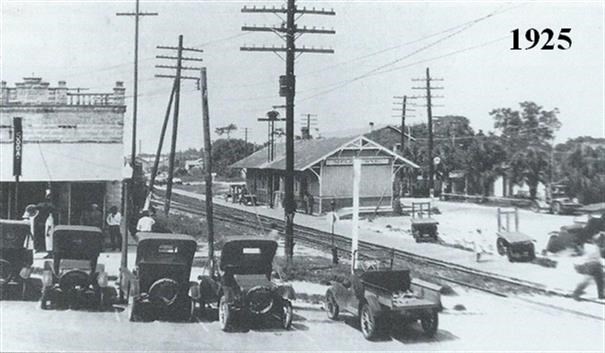
In Melbourne, the pioneering enterprise and social interaction began to change after the railroad arrived in 1893. As a result, the Lagoon began to lose its attraction as a transportation route. Gradually, businesses were drawn toward the iron tracks perched on high ground a few blocks to the west. Then, in 1919, the original downtown area along Front Street was changed forever. A tenant in a waterfront boarding house tossed a kerosene heater out of a second-story window, reportedly after someone shot it full of holes. The heater ignited the wooden sidewalk along Front Street. A strong wind fanned the flames, and the downtown area was quickly consumed.[3] As the center of Melbourne's transportation had now shifted from the river, bus service connected the hotels and the railroads, triggering Melbourne's new downtown area to grow rapidly. As railroads spread across the country, telegraph lines went with them, and next came telephone and electrical wires. The 1920s were the years of the greatest growth in the automobile industry and is the decade when telephone service became widespread in cities across the country.[4]
[4]
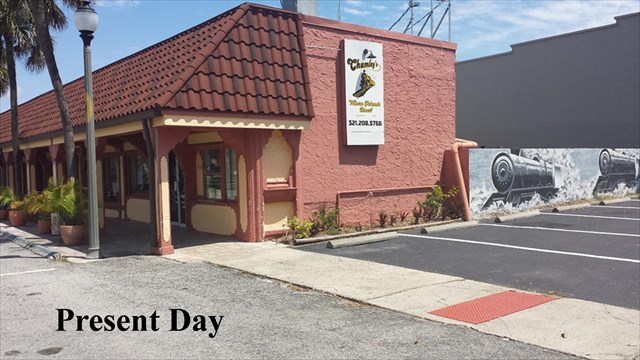
Eventually, travel was shifted from rails to automobiles and airplanes. With less travel via trains, Melbourne’s train depot found less purpose and eventually was decommissioned as a stop. The original passenger rails and wooden loading boardwalk of the train depot was ripped up and turned into a street (Depot Drive), while the old train depot was renovated and converted into many different commercial businesses thereafter. Currently, only the original freight rails remain. A wall mural was erected in 2014 paying homage to the Old Train Depot’s history in the development of the little harbor city called Melbourne.
(1) Bramson, Seth H. "History." Florida East Coast Railway. Florida East Coast Railway, 2011. Web. <https://www.fecrwy.com/about/history>.
(2) Eriksen, John M. Brevard County, Florida: A Short History to 1955. Suntree: Adobe Digital Editions, 2008. 91-92, 219. Web. <http://www.latinamericanstudies.org/florida/Brevard-County-History.pdf>.
(3) "Historic Preservation." City of Melbourne, FL: The Harbor City. Community Development Department, Web. <http://www.melbourneflorida.org/departments/community-development/historic-preservation>.
(4) Raley, Karen, and Ann Raley Flotte. "The Dixie Highway." Melbourne and Eau Gallie. Charleston, SC: Arcadia, 2002. p. 54.
(5) "Melbourne, Florida." Wikipedia. Wikimedia Foundation, Web. https://en.wikipedia.org/wiki/Melbourne,_Florida.
This geocache is rated 3 for Difficulty, because (during certain times of the day) you will need to use stealth in order to make this grab. But other than that, this should be a fairly quick Park&Grab. Bring your own pen to sign the log.
Happy Caching!!!
A $10 Gift Card is waiting with the cache for the FTF!