Squawroot Traditional Cache
K.E.T.: It's apparently beyond the preserve and therefor without permit.
Please note Use of geocaching.com services is subject to the terms and conditions
in our disclaimer.
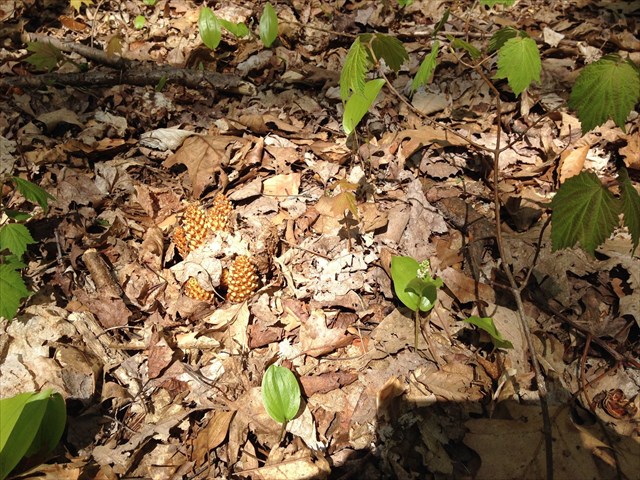
Squawroot is a parasite, taking nutrients from oak or beech roots. These are near the edge of the Ellis Hollow Preserve, just before the powerline. Turn right on the yellow trail at the kiosk. Then right on the red trail until it turns left, after quite a climb. There's a big dead log on the left, just before the unmarked trail you want comes in from the right. N 42 26.614 W 76 24.330.

Onopholis americana, American cancer-root or squawroot or bear corn, is a perennial,[4] non-photosynthesizing (or "achlorophyllous") parasitic plant, from the family Orobanchaceae and more recently from the genus Conopholis but also listed as Orobanche, native but not endemic to North America and when blooming, resembles a pine cone or cob of corn growing from the roots of mostly oak and beech trees.

The entire structure is a yellowish color, turning to brown[4] and achieves heights of 10 centimeters (4 in) to 20 centimeters (8 in) tall.
Stout and unbranched 1.3 centimeters (0.5 in) to 2.5 centimeters (1 in) thick stems.[9] Since C. americana does not photosynthesize[6] it also does not have true leaves; it has instead simple, ovate, tiny scales[4] 1.3 centimeters (0.5 in) long and brown, which appear underneath each flower.[

Conopholis americana produces spikes of yellow to cream flowers densely crowded all around the stem. Each flower is 5-parted, 8 millimeters (0.3 in) to 13 millimeters (0.5 in) long, tubular with a swollen base and facing downwards.[9] As the flowering spike matures and begins to wither and becomes brown throughout the summer and often persisting through the winter, by which time it has become shriveled and black. There is no noticeable floral scent
Each flower is replaced by a seed capsule that is longer than it is wide and contains many small seeds. This plant spreads to new locations by reseeding itself.

The root system is parasitic on the roots of Oak trees (Quercus spp.); dependent on the host tree for its nourishment, the suckers of the parasitic roots cause the formation of large rounded knobs on the roots of the host tree. It is not clear in the literature if squawroot seriously compromises the health of its host tree. It is likely that it, by itself, may exist in a very stable parasite host symbiosis with its much larger and longer lived host oak or beech tree. But, if other stresses combine with squawroot’s presence, the health and vitality of the host tree may be reduced.
Squawroot is edible, and it has a long history of medicinal use as an astringent. It supposedly gets its name from Native Americans’ use of it to treat the symptoms of menopause. It has been used to treat hemorrhages and headaches, and bleeding in of the bowel and uterus. The stalk can also be dried and brewed into a tea.
Don't try it without checking a better source!
The cache is a camoed "micro" pill bottle, with a rolled log with a rubberband and a tiny zip lock plastic bag. This is the snap lid kind. There's an arrow on the lid to show where to push up. No tweezers, please, they kill the plastic. BYOP and put the rubber band on your finger while logging. Then after you log, remember to take the rubber band off your finger and put it onto the log roll, before it goes back into the bag. After you've put it back in the cache, please make sure the lid is well sealed all around, before replacing the cache with its camo.
Please don't continue on the trail beyond the power line cut. You would end up in peoples back yards.
Additional Hints
(Decrypt)
Ybj
Uvqqra ol fabj?
Ebpx
Treasures
You'll collect a digital Treasure from one of these collections when you find and log this geocache:

Loading Treasures