Welcome to St Annes. As recently as 1875 the town did not exist. Where you are standing now was a wilderness of sand dunes.So before we look at the geology, here's a short history lesson:
The Land and Building Company of St Anne's established the town of St Anne's in 1875 as a response to the growth of the holiday trade in the neighbouring resorts of Blackpool and Lytham. The town was named after St Anne's church (1873) which was the first building in the area.
In 1913-14 South Promenade Gardens were laid out, at a cost of £2600 (Lytham St Anne's Express, 29 May 1914), by Messrs Pulham and Sons on former sand dunes, using nearly 1000 tonnes of rock. The principal feature of this area was an ornamental lake with stepping stones, a waterfall over a grotto, and a footbridge. Adjacent was created an Alpine and Herbaceous Garden. Promenade Gardens was subsequently described as 'the prettiest esplanade in the country'.
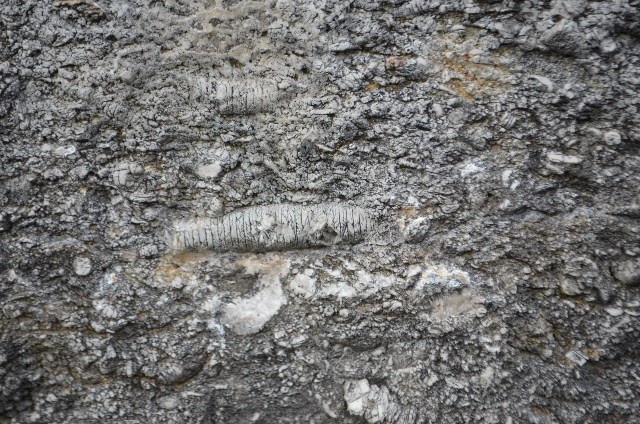
The rock used to create the South Promenade Gardens is Carboniferous limestone laid down about 340 million years ago. Limestone is a sedimentary rock composed mainly of calcium carbonate. Like most other sedimentary rocks, limestone is usually composed of grains. The grains in limestone are mostly skeletal fragments of marine organisms. Often Carboniferous limestone contains large numbers of fossils. Some of the most common fossil organisms found in Carboniferous limestone are brachiopods, crinoids and gastropods.
Brachiopods
Brachiopods are shellfish. There are a few brachiopod still surviving, but they used to be common. The name is derived from bracchium + poda (Latin) meaning 'arm foot'. A brachiopod attaches itself to a rock using a foot or pedicle. It has arms to catch its food.

Crinoids
Crinoids live in the sea. Their name is derived from krinoeides (Greek) which means 'like a lily'. They are also called sea lilies or feather-stars. Despite their name, they are animals.
Gastropods
Marine gastropods are animals that live in water. Their name is derived from gaster + poda (Greek) meaning stomach foot. If you watch a snail moving along on its single foot, you can understand the name. Gastropods are molluscs, like bivalves and cephalopods (ammonites, belemnites and nautiloids). Snail Gastropods include sea shellfish such as whelks.

- At the given coordinates, look at the limestone block containing the obvious fossils. Using the information above, tell me whether the fossils are brachiopods, crinioids or gastropods.
- Compare the block containing the obvious fossils with those around it. How are they different? Look at them and feel them. Describe any differences in colour and texture.
- Do you think the rock containing the fossils is local to the Fylde area? Give reasons for your answers.
- How high off the ground is the block containing the fossils?
- As an optional task, it would be nice to see a photograph of you or your GPSr close to GZ, but please don't upload any spoiler pics.
Please send your answers to me via the geocaching email or messaging facilities which you can find on my profile page.