Búrfellsgjá canyon is a 3,5km long lava pathway running westward from the small volcano Búrfell. The canyon was the channel through which red-hot magma flowed when Búrfell erupted and the lava reached up to the edges of the canyon. When the eruption ceased, the lava channel was left empty. The lava is estimated to be 7000 years old.
Búrfells canyon is a natural protection area, part of which is within the Reykjanes country park, a protected area of some 30.000 hectares.
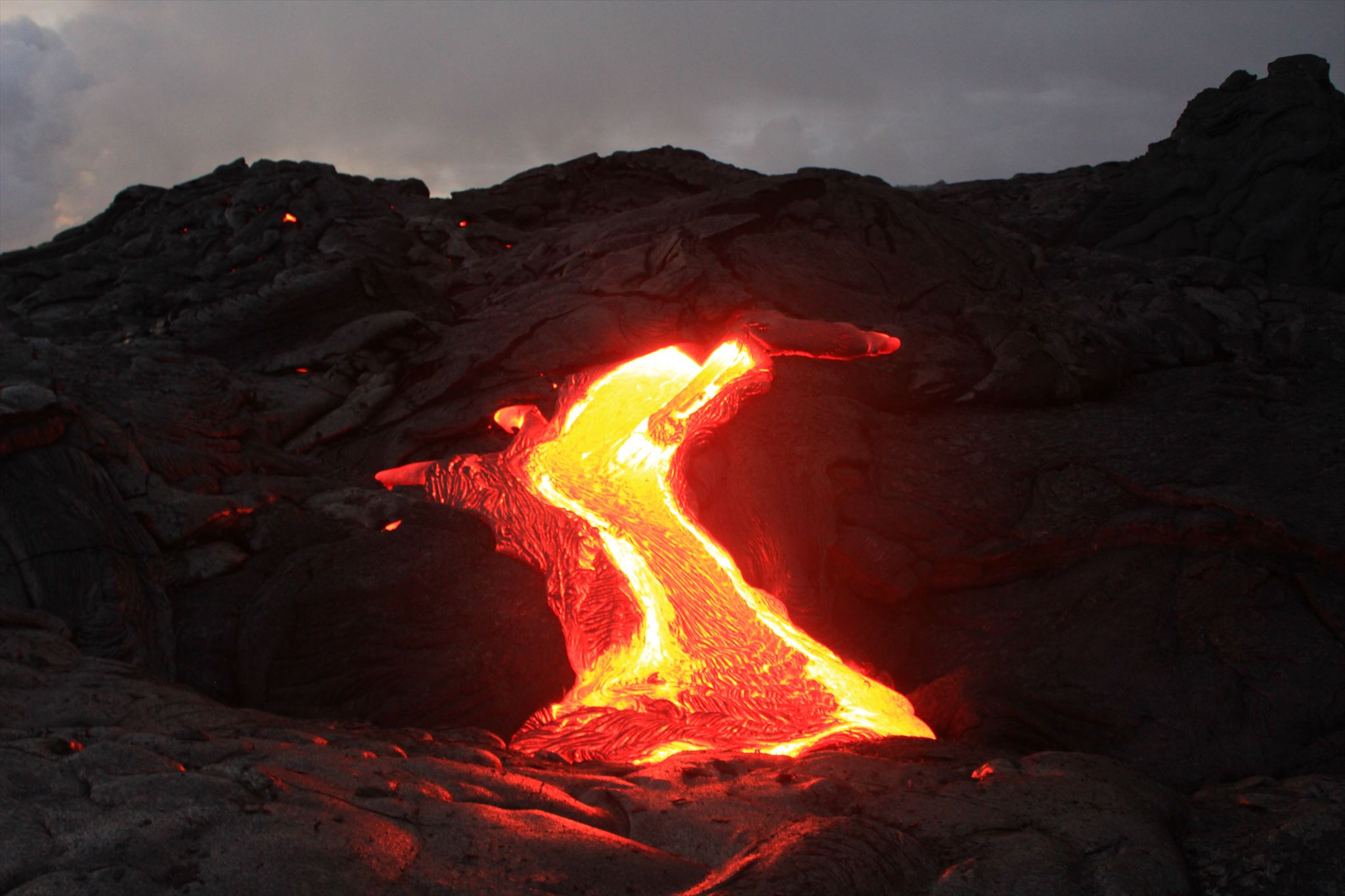
Magma develops within the mantle or crust when the temperature-pressure conditions favor the molten state. Magma rises toward the Earth's surface when it is less dense than the surrounding rock and when a structural zone allows movement. Magma develops or collects in areas called magma chambers. Magma can remain in a chamber until it cools and crystallizes forming igneous rock, it erupts as a volcano, or moves into another magma chamber.
Igneous rock (derived from the Latin word ignis meaning fire) is one of the three main rock types, the others being sedimentary and metamorphic. Igneous rock is formed through the cooling and solidification of magma or lava. Igneous rock may form with or without crystallization, either below the surface as intrusive (plutonic) rocks or on the surface as extrusive (volcanic) rocks. This magma can be derived from partial melts of existing rocks in either a planet's mantle or crust. Typically, the melting is caused by one or more of three processes: an increase in temperature, a decrease in pressure, or a change in composition.
Scoria is a highly vesicular, dark colored volcanic rock that may or may not contain crystals (phenocrysts). It is typically dark in color (generally dark brown, black or purplish red), and basaltic or andesitic in composition. Scoria is relatively low in density as a result of its numerous macroscopic ellipsoidal vesicles, but in contrast to pumice, all scoria has a specific gravity greater than 1, and sinks in water. The holes or vesicles form when gases that were dissolved in the magma come out of solution as it erupts, creating bubbles in the molten rock, some of which are frozen in place as the rock cools and solidifies. Scoria may form as part of a lava flow, typically near its surface, or as fragmental ejecta (lapilli, blocks and bombs), for instance in Strombolian eruptions that form steep-sided scoria cones. Most scoria is composed of glassy fragments, and may contain phenocrysts. An old name for scoria is cinder.When some volcanoes erupt, a rush of gas blows out of the vent. This gas was once dissolved in the magma below. The gas often blows out small bodies of magma that solidify as they fly through the air. This action can produce a ground cover of scoria all around the volcanic vent, with the heaviest deposits on the downwind side
So, here is your tasks:
By lavawall; How high is the wall? What do you think happened here? How could this wall be here?
At the top; What kind of rocks do you find up here? Sedimentary, igneous rock or metamorphic. Explain why? Take a closer look at the loose rocks, how will you describe it? Texture? How did it become like this? Please look at your route up, describe it in short words.
I would be very happy if you took a picture of you og your device somewhere along the route.
Send me the answers on my email, through my profile on Geocaching. You can log straight away. I'll contact you if somethings wrong about the answers.
