Colonel Stevens, founder of the New Jersey Railroad Company, tested the first steam locomotive in the country in 1826, when he showcased his "Steam Waggon" design (basically a steam-powered horse carriage) on a small circular track he had built on his estate in Hoboken, New Jersey.
In the early 19th century the United States lacked the transportation and communication infrastructure necessary for social and economic unity for an industrializing nation. Transportation and communications were at best rudimentary with poorly maintained roads and many areas relying on coastal shipping. Steam powered engines and tools were already emerging and being developed in England as an outgrowth of its mining industry. In the creation of a nation of disjointed, virtually independent republics, there was nothing more critical than the need for inter colonial transportation. This problem was more apparent to Colonel John Stevens who asserted “that efficient transportation, on land and water has been and is the greatest single factor in the progress and prosperity of these United States.”
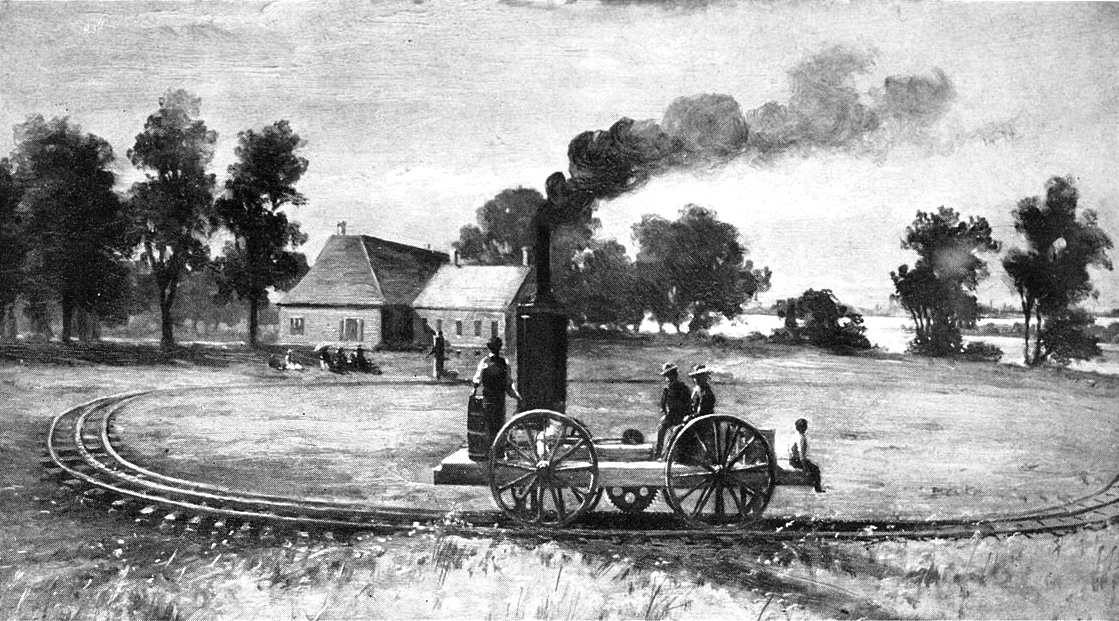 "Steam Waggon"
During the first half of Stevens’s life, there was little inter-colonial commerce, only inadequate mail carriage and little exchange of political views across colonial America. Stevens was fortunate to live through the years from 1749 to 1838, which many historians consider the most vital in building an industrialized America. After the American Revolution, he left the Continental Army and became a modest American figure in social, commercial, and scientific arenas. The colonel was considered a genius of steam, as a leading steamboat innovator of the 1800s. Stevens designed crafts that changed the technology of steam navigation. On land he began twenty years ahead of his competitors and fought for the recognition of steam power in America.
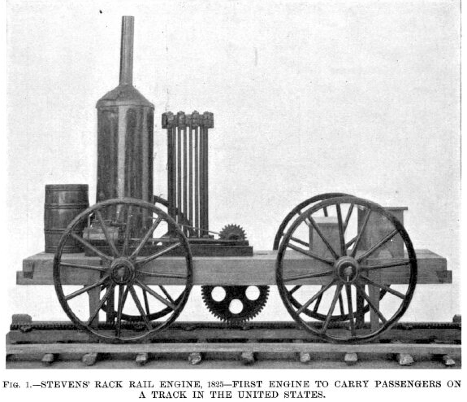 "Steam Waggon"
While drawing attention to the idea of steam power, Stevens faced skepticism and ridicule, yet he engineered and operated the first “steam carriage” to run upon rails in the American hemisphere. In the course of his ninety years, Stevens lived in two states, New Jersey and New York, that border the Hudson River. Some of his inventions came too early for his time, as the United States and other countries were not ready mentally or mechanically to appreciate their value.
By 1821 Stevens turned his attention to land transport after turning over operations of his successful steamboat lines to his sons. This eventually exhausted his energies and his wealth. In 1815, the New Jersey legislature proposed to erect a “RailRoad from the River Delaware, near Trenton, to the River Raritan, at or near New Brunswick.” However, opposition was raised against steam locomotion and opponents argued instead for a canal to be built between the two rivers. Stevens was furious, fearing that the railroad would not be built. He advocated a railroad that would ensure farmers a fair price for what they brought to market. He argued that the canal was useless at the height of the season. "The farmer would spend unnecessary time navigating a canal, losing time, risking spoilage of his crops bringing them to market, and having to sell at reduced prices.
Colonel Stevens took up the challenge and in 1825 he built what he called “the Steam Waggon.” At the age of 75, he designed and erected a circular track spanning 110 feet in radius and 660 feet in circumference on the lower lawn of his Hoboken estate. With pride he wrote, “railroads have no where yet to been made on this side of the Atlantic. Let the experiment be fairly tried.” He demonstrated to every guest at the Hoboken estate a sample of what he proposed to use at the Pennsylvania Railroad. This would later be called The John Stevens: Steam Waggon, comprised of a wooden flatbed carriage mounted on four wagon wheels, with a vertical tubular boiler and water barrel on the front and two benches for passengers at the rear. A single horizontal steam cylinder rotated a notched wheel that fit a rack resting between two wooden steeltopped rails.
Stevens’s steam wagon operated on its circular track until about 1828, when it was moved to a linear section of track near the waterfront of his Hoboken estate. Subsequently, in 1830 the New Jersey legislature chartered the Camden and Amboy Railroad and Transportation Company, after years of the colonel's advocacy for railways. One million dollars of financing was invested in this new venture in only ten minutes. In addition, Stevens’s sons were elected to chief engineer and treasurer of the newly formed company. Among the first order of business, Robert Stevens initiated the design of the “T” rail, still used today, as well as the “fish bar” that connects sections of rail together.