Where is the Carolinian life zone located?
Extending northward from the Carolinas to its northernmost point in southwestern Ontario, the Carolinian Life Zone is a region of biological richness. Ontario’s Carolinian Zone lies south of an imaginary line between Grand Bend on Lake Huron and Toronto on Lake Ontario and includes the entire north shore of Lake Erie. This region enjoys warmer year-round temperatures than any other part of Ontario. The climate supports ecosystems found nowhere else in Canada, along with levels of biological diversity unsurpassed elsewhere in the province.
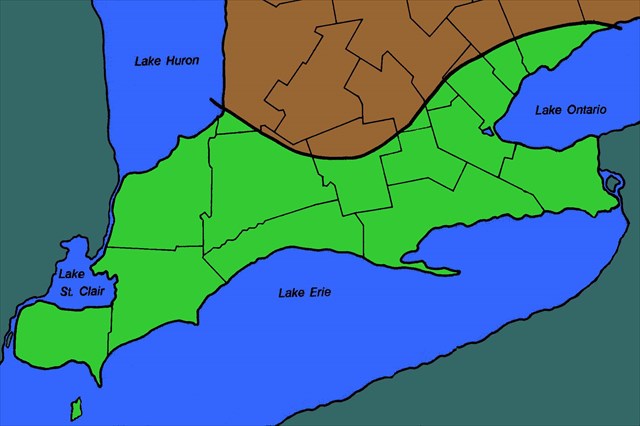
Why is it called a ‘Carolinian’ zone?
“Carolinian” is a name coined by early botanists, who observed that hardwood forests in southwestern Ontario share many characteristics with forests as far south as North and South Carolina in the United States. Forests in Ontario’s Carolinian Zone are populated with trees having a strong southern affinity, such as tulip tree (Lireodendron tulipifera), sassafras (Sassafras albidum), Kentucky coffee-tree (Gymnocladus dioicus), cucumber tree (Magnolia acuminata), black gum (Nyssa sylvatica), and pawpaw (Asimina triloba).
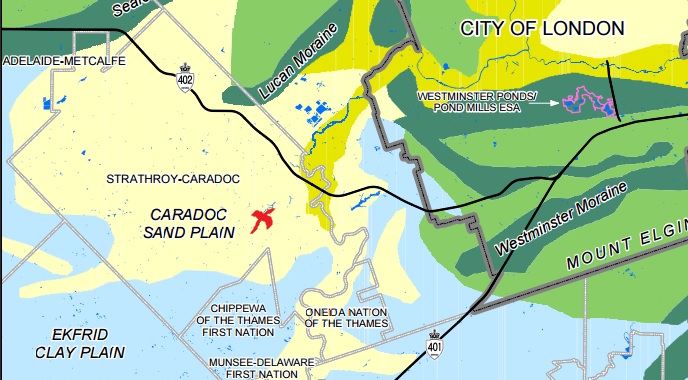
Quick Facts about Carolinian Canada and Soil Types
Even though Carolinian Canada is quite small compared with other Canadian vegetation zones, making up only 1% of Canada's total land area, it boasts a greater number of both flora and fauna species than any other ecosystem in Canada. It is estimated that some 2,200 species of herbaceous plants are found here, including 64 species of ferns, at least 110 species of grasses, and over 130 different sedge species. There are 70 species of trees alone. The soil composition of this region is largely sandy (a phenomenon referred to locally as the "Caradoc Sand Plains") as a result of deposits created on the bottom of the glacial Lake Whittlesey which covered the area approximately 14,000 years ago. The soils found in this region are of three types, Fox sandy loam, Berrien sandy loam and Oshtemo sand. Several small creeks, including the Mill Stream (east of Longwoods) and Komoka Creek, drain the area west of Delaware to the Thames River.
Fox sandy loam – well drained 5-6 inches of dark brown sandy loam ; medium in organic matter content ; medium crumb structure; very friable consistency ; stone free
Berrien sandy loam – imperfectly drained 4-6 inches of grey brown sand or sandy loam ; weak fine crumb structure; stonefree
Oshtemo sand - very deep, well drained 4-5 inches of light brown sand or loamy sand becoming lighter in colour with depth.
Carey Carolinian Arboretum and Trail
The late Dr. Lewis Carey presented his vision of a Carolinian arboretum to the Lower Thames Valley Conservation Authority and Lower Thames Valley Conservation Foundation in 2006. He was inspired by a book on Carolinian forests upon his return to London, Ontario in the early 70s. Dr. Carey was aware of our areas First Nations pre-history and how it was being depicted at the Ska-Nah-Doht Village and Museum at Longwoods. This prompted him to support a project to emphasize the connection between the precious Carolinian forest habitat and the local people.
An existing trail system at Longwoods has been modified with a new extension blazed, and resurfacing has created a beautiful, winding, wheelchair accessible trail. Nesting boxes for Carolinian birds and mammals have been placed along the trail. Nearby, an open area beside our 3 heritage log cabins showcases flowering tree species. Arboretum signs accompany 42 species of Carolinian trees and shrubs, providing the scientific names of the species, unique features, and their historical and present day importance to the residents of the Thames River watershed. The Carolinian species of mature trees, large stock trees and seedlings which are growing along the trail system and plaqued are: Basswood, Beech, Yellow Birch, Bladdernut, Black Walnut, Blue-beech, Burning Bush or Wahoo, Butternut, Buttonbush, Canada Plum, Cherry, Black, Chestnut, Cottonwood, Eastern Cucumbertree, Flowering Dogwood, Pagoda Dogwood, Eastern White Cedar, Slippery Elm, Northern Hackberry, Hawthorns, Bitternut Hickory, Shagbark Hickory, Hop-hornbeam, Kentucky Coffeetree, Sugar Maple, Red Maple, Maple-leaf Viburnum, Nannyberry, Red Oak, Swamp White Oak, White Oak, Pawpaw, Redbud, Sassafras, Serviceberry, ,Spicebush or Benjamin Bush, Staghorn Sumac, Sycamore, Tuliptree, Witch-hazel, White Ash
Time to Get Dirty and Log this find
To get credit for this Earthcache email the CO the answers to the following questions;
1. What is the soil like? Describe it. How does it feel? What does it look like? Walk a few feet off the path and dig up a small amount with your hand to several inches down (remember to replace what you dig up). Based on the cache description above and your observations of the soil in your hand and the area around you which soil type would you say this is?
2. At the listed coordinates there is a sign depicting one of the types of trees that grow here in this portion of the carolinian forest. What is the tree named on that sign? Do you see one close by? Why do you think that type of tree does so well here?
3. Optional. Take a picture of you and/or your GPS or a picture of the area and post it with your log.
https://caroliniancanada.ca/about
https://www.ec.gc.ca/mbc-com/default.asp?lang=En&n=0BEA2B5B-1&offset=1&toc=show
http://www.lowerthames-conservation.on.ca/carey-carolinian-arboretum-and-trail/
http://sis.agr.gc.ca/cansis/publications/surveys/on/on11/on11_report.pdf
https://books.google.ca/books?id=oOnwAAAAMAAJ&pg=PA22&lpg=PA22&dq=Oshtemo+sand&source=bl&ots=GtGaA-7oW4&sig=S7R8TGHgiaBQEpjYbUGuOqQPPNE&hl=en&sa=X&ved=0ahUKEwiN66zBgOzOAhWkF8AKHXWMABIQ6AEITTAH#v=onepage&q=Oshtemo%20sand&f=false