
Read yourself up on one of the most common mineral:
Feldspars: Orthoclase or Plagioclase
It is feldspar which is refeered to as the pink stone.
The color can vary from (light) white, gray to reddish, greenish, and over the (dark) black. Feldspar is a mineral that is found throughout the world, and this typically distinctively as pink veins in granites and gneisses.
Feldspar comes from the German meaning; field, which means fields and spat means stone without ore. It is the most important group of minerals that we have, and make up 60% of the earth's crust. Told in a different way, it is the most common mineral group we have on earth.
The general chemical formula for all feltspatgroups is (K, Na, Ca)(Al, Si)1-3O8. The elements within parenthesis can replace each other. But not all factors are equally common, or possible. There are three important feltspat minerals, and together they constitute the two subgroups:
Subgroup 1: Orthoclases
Subgroup 2: Albite
Subgroup 3: Anorthite
Subgroup orthoclase and albite constitut: Orthoclase (K-feldspar)
Subgroup albite and anorthite constitut: Plagioclase
The mixed crystal groups between the two end joints albite (sodium feldspar), NaAlSi3O8) and anorthite (lime feldspar, CaAl2Si2O8) constitutes plagioclase that usually can be separated from alkali feldspar by distinctive twin striping on the cleaving surfaces. Typical for the plagioclase group is that it has a distinctive "colorless" color.
Feldspar comes from magma in intrusive rocks and extrusive rock in which they crystallize.
The size of the crystals tells us how far and how long they have been in the earth's crust where they were produced. Easily explained: the greater crystals, the longer time they have been formed down in the crust, and the deeper into the earth they have been formed. Feldspar is a vital element in igneous rocks where the proportion and type of feldspar used for classification of rock.

Chart of igneous rock types
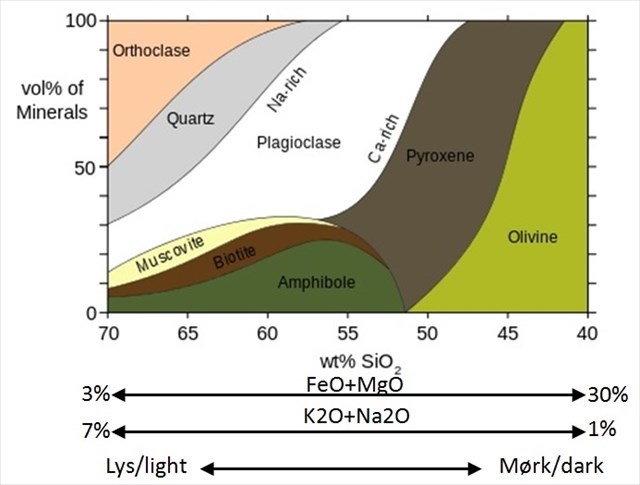
Classification of igneous rocks based on mineral content.

Classification of Igneous Rocks
Bedrock / Precambrian
The bedrock, partially or completely altered rock complexes that form a basis for younger deposits in an area. The term traditionally have been synonymous with rocks formed in the Precambrian time. Previously it was assumed that part of the bedrock was Earth's original solidification crust, but now it is assumed that the oldest known bedrock is formed by the Earth's surface, and later converted by high pressure and high temperature in the deeper parts of the crust. Other rock types, such as plutonic rocks, formed by solidification of the molten mass which penetrated into these rocks deep below the surface.
The most common bedrock is granite, gneiss, gabbro and amphibolite.
Precambrian, long period extending from the time of formation of the earth for approximately 4.6 billion years ago to the beginning of the Cambrian 542 million. Years ago.
Granite becomes gneiss:
A "real" granite is composed by two types of feldspar (plagioclase and orthoclase (K-feldspar)) and at least 20% quartz. As a rule, there are also some other minerals such as biotite and muscovite. Granites are bright rocks, usually gray, pink or red. They can be fine, coarse or porphyritic (large feldpar crystals in a more fine-grained matrix). Due to quartz it is hard and durable. Granite is still a brittle rock. Therefore, it is easy to split along nearly invisible plane directions in the stone.
See the form further up in the cache description.
When a granite is exposed to tectonic forces in the ground, such as for the fold mountains range, it is converted into a gneiss. The gneiss will still have the granitic composition, but because of the deformation, the band and scabbards, and often get lots of bright feldspar veins that comes out of the granite. The dark bands consist predominantly of mica and amphibole which is parallel oriented, also called to lay in foliation. It is because of these structures in the rock we call it a gneiss.
To log this cache.
To get to log this cache you will have to visit the coordinates, and answered the questions given to the earthcache.
When answers are collected, sent them to CO for verification.
As I own about 50 earthcaches there are MANY mails/messages to answer back on, and I will not always be able to answer right-back, BUT I READ ALL SENT ANSWERS AND LOGS, so if anything is not correct or need an upgrade, you will indeed hear back from me.
Thanks for your understanding, and for picking one of my caches.
You can log immediately answers are sent CO. If there are any questions about your answers CO will contact you.
Logs without answers to CO or with pending questions from CO will be deleted without any further notice.
Please do not include pictures in your log that may answer the questions.
Questions
Observer the feldspar in the stone here at gz, the best part to see it is at the polished part (above the North sea region), to best answer the questions below. You can also use the WP added.
1. Answer the questions under by visiting the coordinates and by using the information that’s above in the cache text to easier answer the questions.
A. – "Real" granite is composed by two types of feldspar (plagioclase and orthoclase (K-feldspar)). At gz you can typically only see one of the two varieties, which one? Explain how you got to your answer by using the figure and diagram, where in the diagram you will place the feldspar you see?
B. – Look at the orange line from the chart. How many % feldspar, is in the stones at gz? Is the feldspar light or dark in color? Is it fine or coarse grained? Add the % amount feldspar along with your answer from the first question in task A and tell where you end up in the chart.
C. – What is the size of the feldspar crystals of the stone at gz (in mm), and what does this tell you about the depth (in km) of the formation of the feldspar, and the time perspective?
2. Take a photo of yourself, the group or your GPS when logging the cache.
Without revealing any answers!
(It’s voluntary to post a photo in your online log)
