Cornish China Clay – Get it here! EarthCache
Cornish China Clay – Get it here!
Please note Use of geocaching.com services is subject to the terms and conditions
in our disclaimer.
This EarthCache is located along the publicly-accessible trail around the now disused Baal China Clay Pit. It is one of the few locations where China Clay can be observed in-situ, so is well worth a visit. Parking and access to the trail is available at the headline coordinates.

View of Baal Pit
What is China Clay?
China Clay is the name given to a mixture of very fine grained clay minerals that can be found in weathered granite. The most important component of China Clay is a mineral called kaolinite, named after the location (called Kauling) in China where the clay was first extracted and used to make high-quality Chinese porcelain.
The occurrence of deposits of a similar material in Cornwall was first discovered in 1746 at Tregoning Hill by William Cookworthy, a Quaker Minister and pharmacist who also became the first person in Britain to discover how to make porcelain. Cookworthy went on to open a small porcelain factory in Plymouth, but found that impurities in the clay (in the form of mica) from Tregoning Hill affected the quality and therefore value of his products. Thankfully for Cookworthy, higher-quality material (that lacked the iron-rich impurities) was found at St Stephens near St Austell. Over time, many other uses were discovered for China Clay and its extraction became a major local industry. Chemically inert, bright white in colour and very fine in particle size, the paper industry use China Clay as a white pigment and finisher to make the paper slightly shiny and smooth in texture. China Clay is also used in the ceramic industry for glazes, as a whitening agent for sanitary and table ware and in electrical porcelain to make electrical insulators. It is used widely in everyday pharmaceuticals such as toothpaste, creams and cosmetics and also as a filler in paints, rubber, plastics, white cements and sealants.
Kaolinite crystals are very small – typically just 1-10 microns (thousandths of a millimetre) in size, although some larger ones (up to 100 microns) do occasionally occur. When viewed under a scanning electron microscope, the crystals can be seen to be broadly hexagonal in shape and are often joined together to form stacks of crystals resembling a pile of books as shown below:
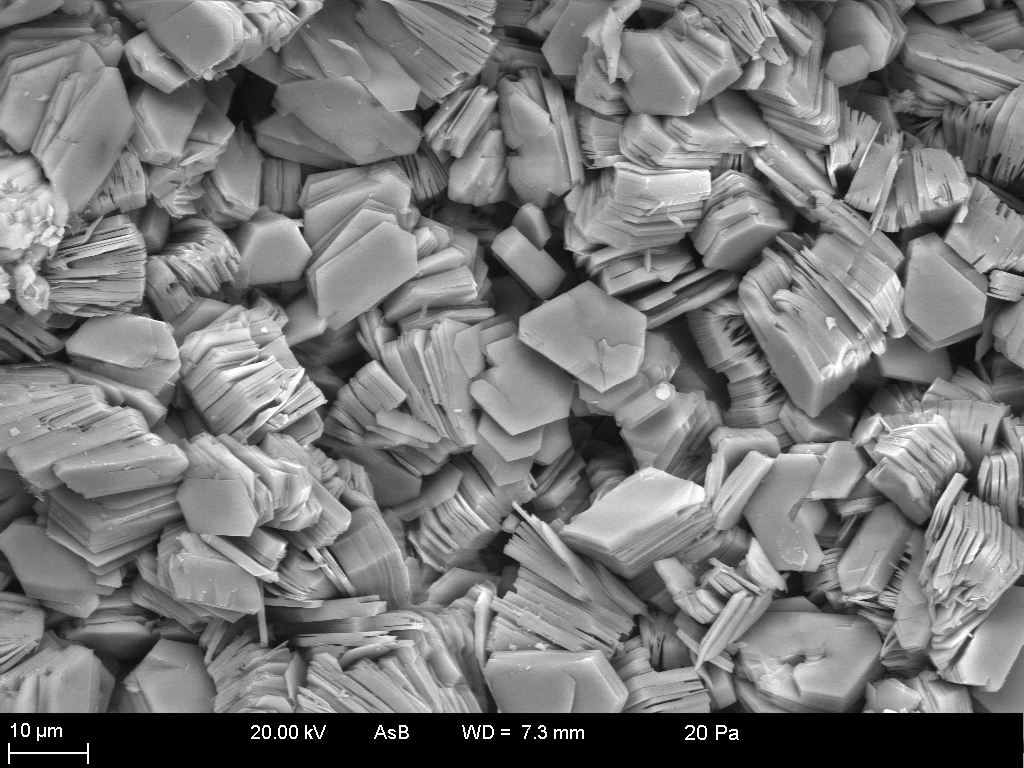
Kaolinite viewed under a Scanning Electron Microscope
Chemically, kaolinite is a hydrated aluminium silicate with the formula Al2Si2O5(OH)4
Each crystal consists of two sheet-like layers – an octahedral layer and a tetrahedral layer. This structure gives kaolinite resistance to many chemicals, making it the ideal inert material to add to products without it affecting the properties of those products.
How was kaolinite formed?
Kaolinite was formed by the hydrothermal alteration of granite. The granite around St Austell formed between 285-270 million years ago during the Early Permian Period, but shortly afterwards, alteration commenced with the intrusion of quartz and tourmaline veins and in some areas, this brought metal mineralisation too. Originally composed of quartz, feldspar and mica, it is the feldspars in the granite that have been altered (mostly in the past 200-25 million years) to produce the China Clay. The quartz remains relatively unaltered, as does the mica (other than losing some of the iron that it contained and/or recrystallising as a finer-grained form). Although some is sold as aggregate, the quartz and mica are waste products in the China Clay industry. It is said that the ratio of profitable China Clay to waste is 1:9. That means for every 1 tonne of China Clay produced, 9 tonnes of waste material has to be moved and dealt with as well. Historically, this waste has been piled-up into tall conical spoil tips known as sky tips and the mix of deep pits and mounds has given the area a characteristic ‘lunar’ landscape sometimes known as the White Alps of St Austell. For this reason, it may interest Doctor Who fans to know that Baal Pit was used as a film set for the series in 1971. It was supposedly the surface of planet Uxarieus in the episode called Colony in Space that featured Jon Pertwee as the Doctor. Some pictures from the episode can be seen below:

The TARDIS in the pit
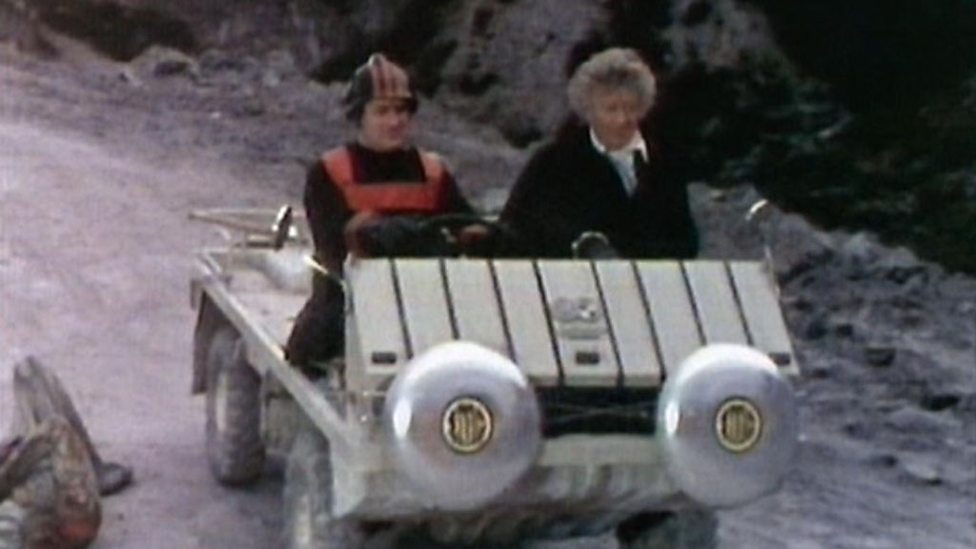
Doctor Who on planet Uxarieus
How is the China Clay Extracted?
The hydrothermal alteration that turned the feldspars in the granite into kaolinite also made the granite very weak. In fact, you can often crumble the rock using your bare hands!
Primary extraction of the clay is carried out by firing a high-power jet of water at the rock face and washing the clay and associated sand particles out as a slurry as can be seen below:

Monitor being used to wash China Clay from the rock
Coarse sand is next to be separated from the slurry using a machine called a classifier and piled-up in to tips around the pit. At this stage, the slurry still contains fine sand and mica held in suspension. By pumping it into a circular tapered pipe called a hydrocyclone, the heavier waste particles (larger than 50 microns) tend to sink to the bottom and the lighter valuable clay particles (finer than 50 microns) tend to float so are easily separated ready for thickening and pressing to remove the water. Depending on the final use of the clay, further refining and engineering (such as grinding, magnetic separation and bleaching) can be carried out to produce specific grades of clay. Whilst the paper industry can use the refined clay directly in slurry form, many other industries require the clay to be dried first. This is done using dryers and kilns such as those located near Par Docks.
In order to claim this EarthCache, proceed to Stage 1 - You should be on a track with a steep face to your left and the disused pit to your right. N.B., For safety, please do not try to cross the fence to look more closely at the pit.
Please message or email me your answers to the following questions through my profile at the top of this page or via this link:-
1) Observe the rock that is exposed here. Describe any features that you can see in the rock face. Pick some of the material up in your hand. Rub it between your fingers and describe the texture and appearance. What colour is the material and what does it feel like? If it is made of grains, estimate their size. Can you identify any of the minerals present?
2) Now go to Stage 2. Observe the rock that is exposed here. Describe any features that you can see in the rock face. Pick some of the material up in your hand. Rub it between your fingers and describe the texture and appearance. What colour is the material and what does it feel like? If it is made of grains, estimate their size. Can you identify any of the minerals present?
3) Having observed and felt the material at both locations, suggest which location shows original unworked China Clay-bearing granite in situ. The other location is formed from tipped processed waste material devoid of any China Clay. Justify your selection in terms of what material you found at each stage.
4) Kaolinite is an important commercial mineral. Select a use and explain which of its properties make it suitable for use in that product.
Feel free to log your find without having to wait for confirmation from me. However, if your answers are not correct or incomplete etc., I will contact you to verify your find.
EarthCache guidelines now make posting a photograph optional, but feel free to upload pics with your log if you wish.
Thanks for taking the time to visit this Earthcache and I hope you enjoy your visit.
Additional Hints
(Decrypt)
Ivfvg gur gjb Fgntr ybpngvbaf naq qrfpevor gur ebpx gung lbh svaq gurer.
Treasures
You'll collect a digital Treasure from one of these collections when you find and log this geocache:

Loading Treasures