Conglomerate is a sedimentary rock formed from rounded gravel and boulder sized clasts, or pebbles, cemented together in a matrix, or bond, usually sand, silt, clay or a combination of these. The rounding of the clasts indicates that they have been transported some distance from their original source (e.g. by a river or glacier) or that they have resided in a high energy environment for some time (e.g. on a beach subject to wave action). The cement that binds the clasts is generally one of either calcite, silica or iron oxide. The matrix can consist solely of the cementing material, but may also contain sand and/or silt sized clasts cemented together among the coarser clasts. Conglomerate can be divided into two broad classes:
Clast supported - where the clasts touch each other and the matrix fills the voids, and
Matrix supported- where the clasts are not in contact and the matrix surrounds each clast.
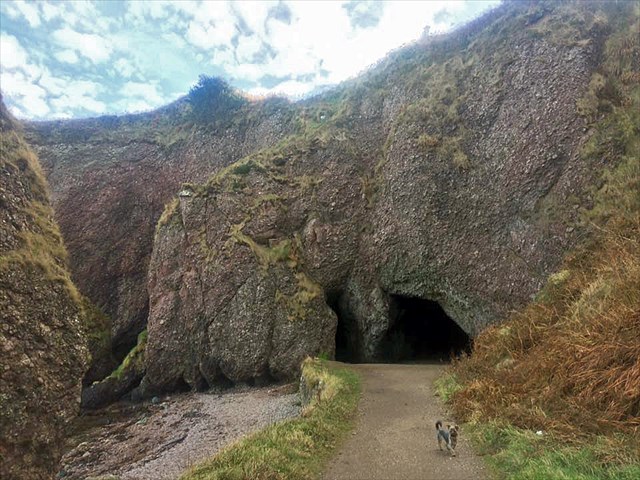
The first thing that you will notice about the caves is that they are red or orange in colour. What this usually means is that they were formed during very dry and hot conditions. In fact, these rocks are approximately 400 million years old and are from the Devonian period, a time when the island of Ireland was at desert latitudes. The second thing that you will notice is that they seem to be made up of lots of pebbles or cobbles, all held together by red sandstone. The pebbles and cobbles originated as loose material lying on the desert surface that would have been swept along by flash floods, a relatively common occurrence in desert environments. As the floodwaters came to the desert lowlands they lost energy and simply dumped all of the pebbles and cobbles. These are now bound by sandstone which acts as the cement that holds the rock together. Caves form by erosion and weathering of rock, either chemically if it is a rock that dissolves such as limestone, or by the mechanical action of water crashing against the rocks. Immediately after the last Ice Age ended about 13,000 years ago, sea level rose very quickly as the huge volumes of water that had been caught up in the ice sheets suddenly melted. This meant that sea level was much higher than it is today, in fact it was where the caves are now. The erosive power of the waves crashing against the cliffs would have formed these caves over thousands of years, but they are now removed from the shoreline so they are no longer forming. This is a common feature along the Antrim Coast where there are wave-formed structures yet they are found some distance from the current coast line.
The caves at Cushendun are part of an Area of Special Scientific Interest so please do not remove any of the rocks from the site.
In order to log the cache you must visit the site, compile the answers to the questions below and forward the answers to me via email or message. Once you have sent the answers you may log the cache. I will contact you if there is a problem. Any logs for which I have not received an email/message with a reasonable attempt at the answers will be deleted without further communication.
1. Which common raised beach feature can be found at N 55° 07.476 W 006° 02.286?
2. To answer this question you will need to enter the cave shown on the left in the photograph (much larger inside than it looks from outside) and go right to the back where you will find an opening to the beach on the left hand side and plenty of natural light. On the rear wall you will see an excellent example of the conglomerate. Describe what you see, in particular any difference in the size of the pebbles, or clasts.
3. Looking at the conglomerate referred to above, do you think it is clast supported or matrix supported?
Please do not post photos containing spoilers.
You can visit here to find out more about the history of the village of Cushendun, its architecture and the various characters associated with it (including Miriam the goat who belongs to the owner of the pub).
*****July 2023: I have had to delete some logs where no corresponding answers have been sent. I will not be running after people reminding them to send answers. The logs will simply be deleted.