Jasper Park, in the village of Vera Cruz, Pennsylvania contains a unique mixture of geological and archaeological features. The park is named after the type of rock that is found here and along many of the ridges in the area: jasper. The Pennsylvania Geological Survey included this site, known as the Vera Cruz Jasper Pits, in their two-volume 1979 publication, "Outstanding Scenic Geologic Features of Pennsylvania". (Source #1)
Jasper, a sedimentary rock, is a type of quartz in microcrystalline form and the jasper here formed as part of the Hardyston Formation during the Cambrian Age between 540 and 490 million years ago. (Source #2) The Hardyston Formation consists mainly of sandstone and quartzite and the jasper is found at the contact point between the Hardyston quartzite and the adjacent schist formation (Schist is a metamorphic rock with medium to large flat grains.) The jasper formed through a process called replacement; over millions of years, silica from the quartzite in the Hardyston formation precipitated into voids in the schist forming large pockets of jasper. Jasper is an opaque rock that is frequently grey, brown, yellow or red in color. The color comes from the minerals, such as iron, contained in the original sediment from which the stone was formed. (Source #3) Some of the rocks you see in Jasper park are conglomerates containing jasper as well as small pebbles of sandstone or other types of rock.
Jasper is used currently in the making of jewelry and decorative ware due to the beautiful colors and patterns that are brought out when it is highly polished. A very hard rock, jasper has a smooth, non-granular, almost waxy, texture. It also fractures along clean lines to create very sharp edges. These qualities made it an ideal stone for Native Americans to use in creating their tools.
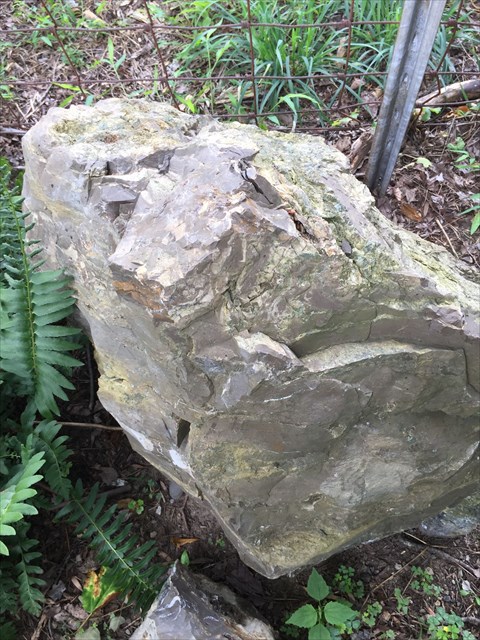
Jasper Rock
The Native Americans mined Jasper in this area as far back as 12,000 years ago and continued to do so until the late 1600’s when the introduction of European metal tools rendered stone tools obsolete. Excavations have been carried out here periodically, beginning in 1894 with Dr Henry Mercer (of nearby Mercer Museum fame) and continued with work done in advance of the the extension of the Pennsylvania Turnpike, which now cuts through the middle of the pits. These and other excavations have shown that to mine the jasper, Native Americans dug holes in the ground using wooden and antler digging tools; they then separated the jasper from the surrounding rock and reduced it down into sizes that were easy to transport. In workshops which existed near the pits, they worked the jasper into sharp tools such as axes and arrowheads. The stone and tools were traded with other tribes throughout the area. The mines created by the Native Americans can still be found in this park. (Source #4)
Placed with permission by:
Upper Milford Township
Daniel DeLong, Manager
5671 Chestnut Street
P.O. Box 210
Old Zionsville, PA 18068
P: 610-966-3223
F: 610-966-5184
email: info@uppermilford.net
Parking Coordinates: 40 30.497, -75 29.994
* The park is open from dawn until dusk.
* This earthcache cannot be accessed from the Pennsylvania Turnpike.
Time to complete: 30 minutes. Round trip walk: .6 miles
To get credit for this EarthCache, answer the questions below and then send to the CO via the message center. You may claim credit for the cache once you have sent your answers. (Please do not post any spoiler photos in your log.)
#1a. – Describe how the jasper in Jasper Park was formed.
#2– From the parking coords, follow the pathway to Stage 1 (Coords: 40 30.505, -75 30.110). The two rocks here behind the bench, one large and one small, contain jasper.
a. Describe the color of the rocks.
b. Describe the texture of the surface of the rock.
c. Do you see sharp edges on the rock?
#3– Stage 2 (Coords: 40 30.489, -75 30.108). Stand facing the fence. There are 2 rocks at this location.
a. Describe the color and texture of the rock on the left.
b. Describe the color and texture of the rock on the right.
c. From what you’ve learned about jasper, which of the rocks contains jasper, the one on the left or the one on the right?
#4 - Stage 3 (Coords: 40 30.475, -75 30.105). Here there are two rocks between the metal fence and the path (they're in front of a metal fence post covered with a thick vine).
a. Describe the color and texture of the rocks.
b. Do you think these contain jasper?
#5 – Return to the first set of rocks (Stage 1). To the north you will see a trailhead heading into the woods. Follow the trail to: 40 30.550, -75 30.100. Here you should see a footpath through the trees on your right. Follow the path to Stage 5 (coordinates: 40 30.548, -75 30.064).
a. From these coordinates, how many pits (mine holes) can you count around you?
**Optional Extra Credit: Include a picture of the statue of Lenape Chief Lappawinze that stands at the entrance to the parking lot.
Information Sources:
1. Outstanding Scenic Geological Features of Pennsylvania, by the Pennsylvania Geological Survey (select Lehigh County once on site:) http://www.pageology.info/scenic/features.html
2. Carr, Kurt W. and McLearen, Douglas C. Recent Testing at the Kings Jasper Quarry, Lehigh County, Pennsylvania. Paper delivered at the Society for American Archaeology, Salt Lake City, UT, April 1, 2005.
3. This Week in Pennsylvania Archaeology. February 8, 2013: http://twipa.blogspot.com/2013/02/lehigh-county.html
4. Hatch, James W. and Miller, Patricia E. Procurement, Tool Production, and Sourcing Research at the Vera Cruz Jasper Quarry in Pennsylvania. Journal of Field Archaeology, v 12, p. 219-230, 1985.