A Vug's Life EarthCache
-
Difficulty:
-

-
Terrain:
-

Size:  (other)
Please note Use of geocaching.com services is subject to the terms and conditions
in our disclaimer.
A Vug's Life Earthcache
IMPORTANT: This Earthcache is accessible via the Herb Gray Parkway Trails. Access to the earthcache site is by foot, bike, skate board, or other non-motorized means. When arriving at ground zero, you will be surrounded by large rectangular rocks.
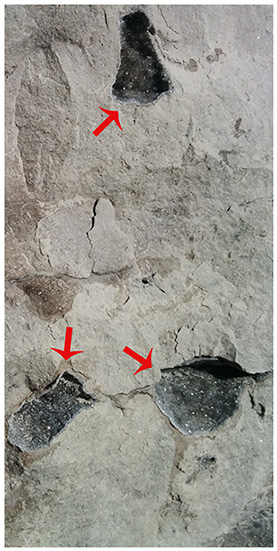 Geode.
A geode is a rock formation that combines minerals to form a hollowed-out rock with crystals lining the inside. See RED arrows in photo. It can take a long time for geodes to form. Some geodes that have been found are thousands to millions of years old. When a geode is split in half, the different layers can be seen, which will include the hollowed out center, crystal deposits and mineral deposits. If a geode is completely filled up with crystals leaving no hollowed space, it is called a nodule. If a geode forms in irregularly shaped pockets, voids or cavities within a formation, they are often called vugs.
Formation.
Geodes form in hollow cavities (holes) inside of a rock layer. They can form in gas bubbles in igneous rocks, such as vesicles in basaltic lavas; or, in rounded cavities in sedimentary formations, which is what you will observe today. After rock around the cavity hardens, dissolved minerals (most commonly silicates and/or carbonates) are deposited on the inside surface. Over time, this slow feed of minerals from groundwater or hydrothermal solutions allows crystals to form inside the hollow chamber. Crystals of varying shapes and sizes appear depending on how long the geode has been forming and by how the water was moving through the cavity.
Diversity.
When a geode is formed and then cracked open, we can see different crystal shapes, sizes and colors. Not all geodes are the same because of the different types of rocks that help them to form. The chemicals that the rocks release into the water that passes through the cavities are full of minerals. Different minerals that cling to the inside result in the different colors of crystal forming the geode.
Most geodes have quartz or calcite crystals that form. Quartz crystals are silicates, which is the most common mineral in the crust of the earth. Calcite’s main ingredient is calcium carbonate CaCO3: dissolved calcium and carbon with some of the oxygen from the water thrown in. Colors appear when other minerals get mixed into the composition. Magnesium, iron and copper in a minute traces can change the colors in the crystals and also change the color variations in the crystal depending on whether they are mixed in with the quartz or with the calcite or both. Heat also plays a part in the colors that appear in a geode.
In order to log this Earthcache, you must email team wiji (see profile for email) the answers to the following questions:
1. Take your time and enjoy finding and examining the geodes. Now, pick one face of any given rock in the area and count the number of geodes. Email us your count. Hint: choose a rock face that the sun is shining on as the geodes will sparkle!
2. What is the diameter of the largest geode you found? What do you think is the main reason which determines a geodes size?
3. Based on your reading above, would you classify the geode formations as nodule or vug? What are the main reasons you used for making this determination?
4. OPTIONAL - Take a photo of your GPSr or yourself/team with any geode. You may include this photo in your log.
++ Congratulations to barrz on the FTF!! ++
Additional Hints
(No hints available.)
Treasures
You'll collect a digital Treasure from one of these collections when you find and log this geocache:

Loading Treasures