Jingshan's history dates to the Liao and Jin dynasties, almost 1000 years ago. The 45.7 meters (150 ft) high artificial hill was constructed in the Yongle era of the Ming dynasty entirely from the soil excavated in forming the moats of the Imperial Palace and nearby canals. It is especially impressive when one considers that all of this material was moved only by manual labor and animal power. Jingshan consists of five individual peaks, and on the top of each peak there lies an elaborate pavilion. These pavilions were used by officials for gathering and leisure purposes. These five peaks also draw the approximate historical axis of central Beijing.
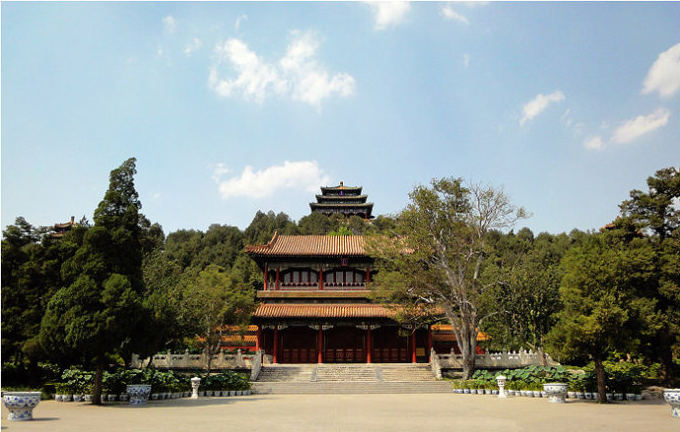
The dictates of feng shui long praised tombs and residences sited south of a nearby hill, serving to channel both harmful yin and cold northern winds. With Jingshan serving that purpose, it gained the name Feng Shui Hill. It is also well known to locals as Coal Hill, from an old rumor that the emperors kept a hidden stash in the park.
The dictates of feng shui long praised tombs and residences sited south of a nearby hill, serving to channel both harmful yin and cold northern winds. With Jingshan serving that purpose, it gained the name Feng Shui Hill. It is also well known to locals as Coal Hill, from an old rumor that the emperors kept a hidden stash in the park.
Jingshan Hill is separated from the Forbidden City by the palace moat. However, until 1928 the park sat directly by the moat and was accessible on the south side only from the Forbidden City via the Gate of Divine Might. In 1928, a new road (New Jingshan Street) was built to the north of the palace moat. This fully separated Jingshan Hill from the Forbidden City. The Gate of Divine Might became the back door of the Palace Museum, and the front gate of Jingshan Park now stood to the north of the new road.
景山的i历史可追朔到辽、金时期,元代,这座小土丘名叫青山,属于元大内后苑的范围。明代在北京修建皇宫时,曾在这里堆过煤,所以又称煤山。由于它的位置正好在全城的中轴线上,又是皇宫北边的一道屏障,所以,风水术士称它为 "镇山"。明清时园内种了许多果树,养过鹿、鹤等动物,因而山下曾叫百果园,山上曾叫万岁山。清顺治十二年(1655),改名为景山。 景山名称含意有三:首先是高大的意思。《诗·殷武》中有"陟彼景山,松柏丸丸"之句,说的是3000年前商朝的都城内有一座景山;其次,因为这里是帝后们"御景"之地;再次,有景仰之意。该园1928年辟为公园。 景山一名是清初改称的。山上的五座亭子,为乾隆年间兴建。当时山上丛林蔽日,鹿鹤成群,生机盎然,极富自然野趣。
让景山出名的是明崇祯皇帝,明崇祯十七年(1644年)三月十九日,李自成军攻入北京,明思宗朱由检缢死于万岁山东麓一株老槐树上。清军入关后,为笼络人心,将此槐树称为“罪槐”,用铁链锁住,并规定清室皇族成员路过此地都要下马步行。
景山原来是跟故宫连着的,1928年景山开放为公园供游人游览,在景山前边修了一条路,才把它与故宫隔开了。