Plagioclase is a series of tectosilicate (framework silicate) minerals within the feldspar group. Rather than referring to a particular mineral with a specific chemical composition, plagioclase is a continuous solid solution series, more properly known as the plagioclase feldspar series (from the Ancient Greek for "oblique fracture", in reference to its two cleavage angles). This was first shown by the German mineralogist Johann Friedrich Christian Hessel (1796–1872) in 1826. The series ranges from albite to anorthite endmembers (with respective compositions NaAlSi3O8 to CaAl2Si2O8), where sodium and calcium atoms can substitute for each other in the mineral's crystal lattice structure. Plagioclase in hand samples is often identified by its polysynthetic crystal twinning or 'record-groove' effect.
Plagioclase is a major constituent mineral in the Earth's crust, and is consequently an important diagnostic tool in petrology for identifying the composition, origin and evolution of igneous rocks.
The composition of a plagioclase feldspar is typically denoted by its overall fraction of anorthite (%An) or albite (%Ab), and readily determined by measuring the plagioclase crystal's refractive index in crushed grain mounts, or its extinction angle in thin section under a polarizing microscope. The extinction angle is an optical characteristic and varies with the albite fraction (%Ab). There are several named plagioclase feldspars that fall between albite and anorthite in the series. (Source)
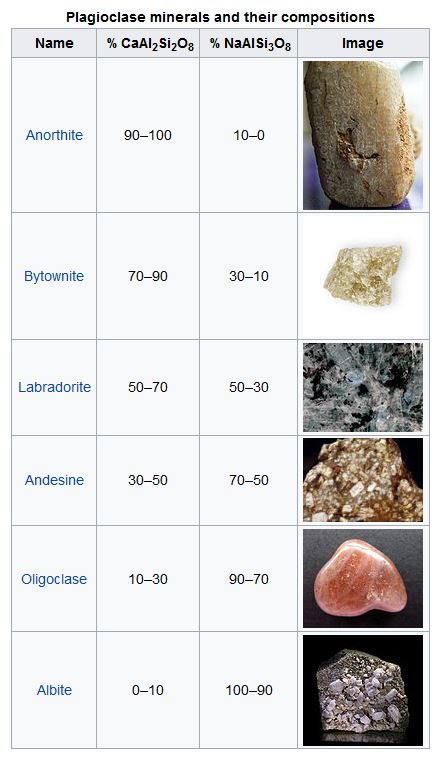
Did you know that when feldpsars are very large, they are referred to by geologists as “horse teeth” ?
Cape Town Geology
The Peninsula Granite is a huge batholith that was intruded into the Malmesbury Group about 630 million years ago as molten rock (magma) and crystallized deep in the earth, but has since then been exposed by prolonged erosion. The characteristic spheroidal shapes of granite boulders are a result of preferential weathering along intersecting fractures and are well displayed around Llandudno and Simonstown. Close up, the granite is a coarse-grained rock consisting white or pink feldspar crystals, glassy brown quartz and flakes of black mica containing inclusions (xenoliths) of dark Malmesbury hornfels. In some places, intense weathering has altered the granite to kaolin clay soils that cause slope stability problems in road cuttings. High quality kaolin is mined near Fish Hoek and Noordhoek.
The Earthcache
The coordinates for the EarthCache are on an outrcrop of the Peninsula Granite. Here, answer the following questions to validate your found:
- What are the dimensions of the feldspars on average at this spot (to help you, the feldspars are the large white (or pink) minerals)?
- Do you see any preferred orientation of these minerals?
- Are these minerals euhedral (regular shaped) or anhedral (irregular shaped)?
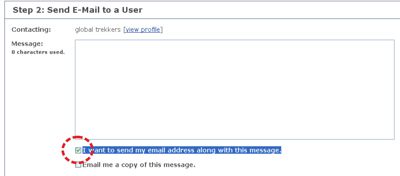
If you feel you have all the answers correct, please log your found but also send me the answers via e-mail so I can check them. If I don’t answer you it is because they are correct and you have another found.Please note that when you e-mail me, please supply the reference (GC703NA) and name (Horse teeth - DP/EC 83) of the cache and please click on the “I want to send my e-mail address along with this message” so that when I reply to you the messages don’t go into e-mail heaven (or hell).
 The most exciting way to learn about the Earth and its processes is to get into the outdoors and experience it first-hand. Visiting an Earthcache is a great outdoor activity the whole family can enjoy. An Earthcache is a special place that people can visit to learn about a unique geoscience feature or aspect of our Earth. Earthcaches include a set of educational notes and the details about where to find the location (latitude and longitude). Visitors to Earthcaches can see how our planet has been shaped by geological processes, how we manage the resources and how scientists gather evidence to learn about the Earth. To find out more click HERE.