Geological Time
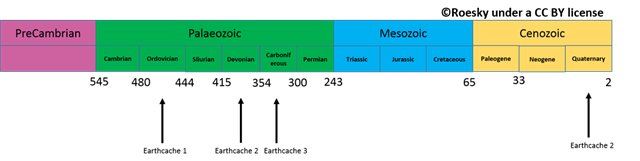
The Earth formed approximately 4.6 billion years ago. Geologists have created a time scale which divides this time into intervals which represent distinct phases in the history of our planet. Below you can see a timescale with Eras on the top which are further divided into Periods on the bottom. The numbers represent the age in millions of years. This Earthcache series will take you on a journey through the Ordovician, Devonian, Carboniferous and Quaternary periods.
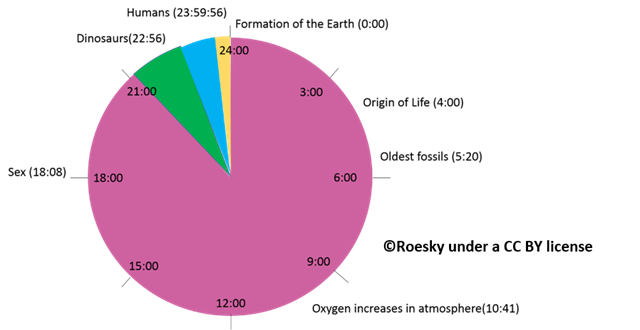
The time spans we are talking about can be daunting and difficult to visualise so I have represented them with their colour on a 24 hour clock. In other words all of Earth history is scaled down to one day. Below you can see that specific events can be given a time on this clock to help us better picture when they occurred. For example the oldest fossils date from 5:20 and humans only appeared at 23:59:56 which means we have only been on Earth for 4 seconds out of a full day. It is worth noting that the most change has occurred late in Earth history. As I introduce each Earthcache I will give the time range to which it corresponds on the 24 hour clock.
EarthCache #1
The Ordovician Period lasted from 488 to 444 million years ago. This is equivalent to 21:27 -21:41 on the 24 hour clock. During this time parts of Scotland were at the floor of the Iapetus Ocean south of the equator.
At this location you will find a rock monolith which originated from Burlington Quarry in Cumbria. It was set up here in 2002 in tribute of the Water of Leith Walkway (Millennium project) which was completed.
Your task will be to write a rock description and attempt to name the rock. This is one of the first things a geologist will do in the field as it provides crucial observational information. A magnifying glass is useful. Make sure to look at the entire rock not just a small section as there can be variability.
Rock Description
-Colour: One colour or several? Shade?
-Grain size: Fine (≤0.5 mm), Coarse (≥1 mm), Granules (2-4 mm) or Pebbles (cm)
-Sorting: Well sorted (equal grain size) or Poorly sorted (range of grain sizes)
-Luster: Vitreous (shiny like glass), Pearly or Earthy (dull, little or no reflection)
-Cleavage: Yes or No. Cleavage is the breakage of a mineral along a flat plane of weakness which forms planar features in the rock.
You can send me the answers via the message center or by email on my profile page. Please do so before completing the log and do not include the answers in it.
Permission obtained from City of Edinburgh Council.
My thanks to Lothian Borders GeoConservation Group for feedback.