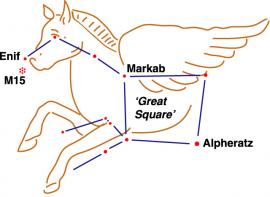
Pegasus is a large pattern of stars marked by a great square — four bright stars that form the body of the winged horse.
Mythology
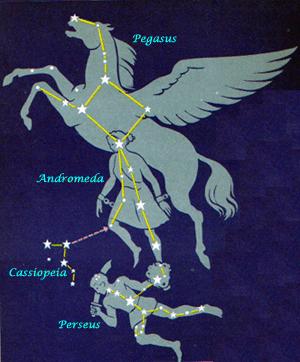
Pegasus is a winged stallion horse derived from Greek mythology, a divine creature that brought forth springs from the Earth wherever it walked. Pegasus was also a servant to Zeus the King of Gods, obeying his every command. In classical Greek mythology, Perseus killed the snake-headed Medusa to save the princess Andromeda from a nasty sea monster. A few drops of Medusa's blood fell into the sea. When it mixed with the foam, it gave birth to Pegasus, who later played a part in the story of another hero, Bellerophon. Pegasus’s mother is therefore considered to be Medusa and his father Poseidon God of the Sea
In modern times, though, Pegasus has become a more integral part of the Perseus story. In recent tellings, when Perseus shows up to save Andromeda, he is riding Pegasus. And the tale of the flying horse became even more convoluted with Disney's animated version of Hercules, in which Hercules and Pegasus are pals.
Astronomy
The brightest star in the Great Square, Alpheratz, isn't in the constellation Pegasus. It's in Andromeda, which is just northeast of Pegasus. It is part of the ancient sky picture that we know as Pegasus. But when astronomers drew the official boundaries for the constellations, this star was placed just across the line in Andromeda. Alpheratz is the brightest star in Andromeda (and also the brightest in Pegasus if you consider it part of the constellation).
The brightest star in the constellation is Markab, which means "the saddle." It's at the southwestern corner of the Great Square.
At another corner is Beta Pegasi. "Beta" means it should be the second-brightest star in Pegasus, and sometimes it is. The star pulses in and out like a beating heart. When it pulses out, its surface cools, so it gets fainter. When it squeezes back in it gets hotter, so it glows brighter, making it Pegasus's brightest star.
Another star in Pegasus, II Pegasi, produced a monster flare a few years ago, a powerful explosion on its surface that generated a torrent of energy and charged particles. The flare was 100 million times more powerful than a typical flare on the Sun. If Earth orbited II Pegasi, such a monster would obliterate the ozone layer and alter the climate, and probably kill much of the planet's life. The star's magnetic field may be energized by a nearby companion star, which causes II Pegasi to spin on its axis once every seven days (versus about 29 days for the Sun). This fast rotation may keep the star's internal layers in high-speed motion, generating a powerful magnetic field that produces flares and other storms.
The stars Marka, β Peg, and γ Peg, and Alpheratz form the large asterism known as the Square of Pegasus. (Asterisms are groups of stars that form simple patterns but are part of one or more constellations.) The front legs of the winged horse are formed by two crooked lines of stars, with another crooked line of stars form the neck and head.
The brightest star in the constellation is Enif , which forms the nose.
The star Scheat forms the foreleg and the star Algenib, Arabic for wing, defines the wing. Although Algenib’s luminosity is 1,900 times greater than the Sun, it is seen only at a magnitude 2.8 because it is 570 light-years away.
Another star in this constellation, 51 Pegasi, is the first Sun-like star known to have a planet orbiting around it.
Among Pegasus’ more remarkable features are its numerous galaxies and objects. M15, a Messier object, is a globular cluster of magnitude 6.4 about 34,000 light-years from Earth. It is one of the most densely packed clusters in the Milky Way galaxy. NGC 7331 is a spiral galaxy about 38 million light-years away. It was one of the first objects to be described as "spiral." Einstein's Cross, a quasar, is an excellent example of gravitational lensing. The quasar is about 8 billion light-years from Earth, and sits behind a galaxy that is 400 million light-years away. Four images of the quasar appear around the galaxy because the intense gravity of the galaxy bends the light coming from the quasar.
Scheat is a red giant around 200 light years from Earth, it is almost 100 times larger in diameter than our sun with twice its mass.
Matar is a binary star system around 170 light years from Earth, the primary star is a yellow giant 250 times brighter than our sun.
Algenib is a blue sub giant emitting 6,000 times the energy of our sun.
Markab is a blue giant with twice the surface temperatures of the sun.
Homam is a blue main-sequence star around 200 light years from Earth.
Enif is officially the brightest star in the constellation of Pegasus, it is an orange supergiant star nearing the end of its lifespan and could possibly explode as a supernova over the next few million years, the star is almost 200 times larger in diameter than the sun and is located 690 light years from Earth.
Some Constellation Facts:
Pegasus is visible in both the Northern and Southern hemispheres. In the Northern hemisphere it can be seen from July to January, in the Southern hemisphere it can be viewed from August to December. In the Southern hemisphere Pegasus will appear upside down.
In 1995 the first exoplanet known to orbit a sun-like star was discovered in the constellation of Pegasus.
The constellation contains the first planets outside our solar system to have been directly observed by an Earth based telescope.
The nearest star to Earth which could possibly explode as a supernova is located in the Pegasus constellation.
Pegasus has been recognized as a constellation for 2,000 years.
Puzzle
There is nothing at the listed coordinates. You must solve the following puzzle to find the cache.
[ β ] [ χ – ф ].[ ( μ * к ) + ( α – ξ ) ]
[ υ – τ ] [ ( μ – ο ) * к ]. [ ( π * π1 ) + ( ψ – η ) ]