To log this EarthCache please email/message me through my geocaching profile the answers to the following questions. Do not post your answers in your log.
Looking at the rock at the given coordinates (the most westerly of the rocks here)
1. Describe the rock (colours, textures, size)?
2. What is it made up of (gypsum etc.)?
3. Describe and compare the anhydrite and gypsum crystals?
4. In which geological period and epoch was this gypsum formed?
5. Using your GPSr or smartphone determine the elevation at the given co-ordinates. Now, using the depth chart, determine if the gypsum seams are above or below the current sea level? And by how many feet/metres?
6. How many drilled holes can you see in this rock?
Optionally, please upload a photograph of yourself/your GPSr at one of the OTHER rocks (we wouldn't want to give away the answers to those that haven't visited this site).
You can log immediately after answers are sent the CO. If there are any questions about your answers CO will contact you. Logs without answers to CO or with pending questions from CO will be deleted without any further notice.
Gypsum (CaSO4·2H2O) and Anhydrite (CaSO₄ ) are forms of calcium sulfate. The name gypsum derives from the Greek word for plaster, gypsos, and anhydrite literally means without water. Gypsum and anhydrite are a sedimentary rocks formed in layers. They are formed in waters with high levels of calcium and sulfate where the water can slowly evaporate and be regularly replenished with new sources of water. These are called evaporate deposits. Gypsum is moderately water-soluble (able to be dissolved in water) and, in contrast to most other salts, it becomes less soluble at higher temperatures. When gypsum is heated in air it loses water and converts first to calcium sulfate hemihydrate, (bassanite, often simply called "plaster") and, if heated further, to anhydrous calcium sulfate (anhydrite). As for anhydrite, its solubility in saline solutions and in brines is also strongly dependent on Sodium Chloride concentration.
Gypsum is also a by-product of certain industrial processes, notably flue gas desulfurisation (FGD). FDG gypsum is currently produced in coal-fired power stations at two sites in Britain (Drax power station, North Yorkshire and Ratcliffe-on-Soar station, Nottinghamshire). The waste gases given off by these power stations contain harmful sulfur dioxide. This is treated with powdered limestone to form calcium sulfate. The amount of natural gypsum extracted in Britain has declined in recent years due to the availability of substantial amounts of high quality synthetic gypsum obtained from these power stations.
Gypsum has many applications but is used principally in the production of plaster and plasterboard. A mixture of gypsum/anhydrite is also used as a retarder in cement manufacture.
The Purbeck Group is a series of layers of rock from the Late Jurassic to Early Cretaceous periods. The name is derived from the Isle of Purbeck where these layers can be seen in the cliffs near Swanage. The Jurassic period started 201 million years ago and ended 145 million years ago when the Cretaceous period commenced. The Cretaceous period ended 66 million years ago. The Jurassic period is divided into 3 epochs; Early (201-174 million years ago), Middle (174-164 million years ago) and Late (164-145 million years ago). The Purbeck Group is between 136 and 152 million years old. The local gypsum and anhydrite deposits are at the bottom of this group.
The Purbeck Group was deposited in an environment of rivers and muddy lagoons, which periodically dried out, resulting in the now economic deposits of gypsum being deposited in this area. When it was formed this region lay at a latitude of about 30°N and thus experienced a tropical climate. The same latitude today as Cairo, Egypt or Austin, Texas. The Purbeck Group has a typical thickness of 77 to 186m in the Weald.
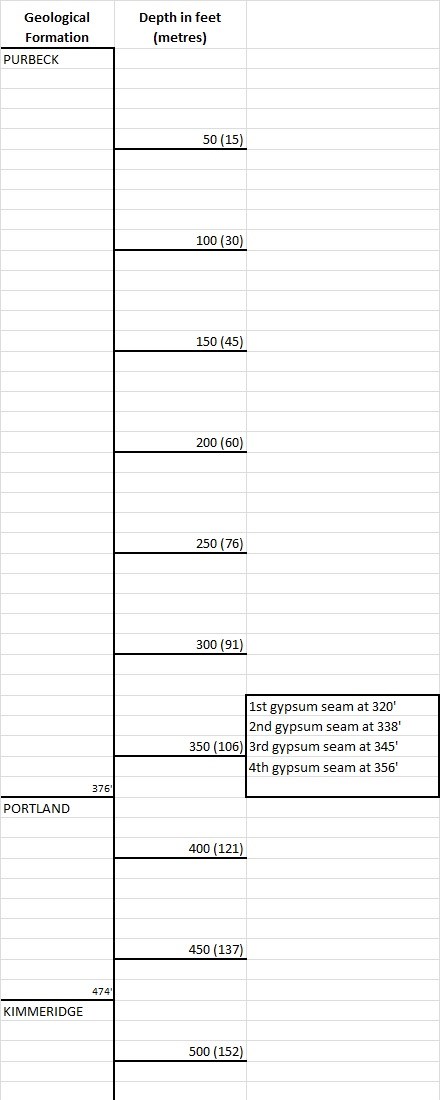
Until 1990 gypsum was worked underground at the mines at Brightling and Mountfield. Mountfield mine has now closed and production is centred on the Brightling mine. This mine is the only operating deep mine in South-East England. Natural gypsum and anhydrite occur as beds or nodular masses up to a few metres thick. Four consistent seams occur in the lower 15m of the Purbeck Limestone Group, separated by mudstone beds. These seams are numbered 1 to 4 in descending order. Production at the Brightling mine is from both the no.3 and no.4 seams, with the majority extracted from the latter. The seams are on average 4-5m in thickness and extracted using the room and pillar mining method.
The sole use of the extracted natural gypsum from the Brightling mine is as a retarder in Portland cement. Reject run-of-mine gypsum stone is crushed, screened and sold as material for farm tracks and building bases. The Robertsbridge works now uses FGD gypsum for plasterboard manufacture.
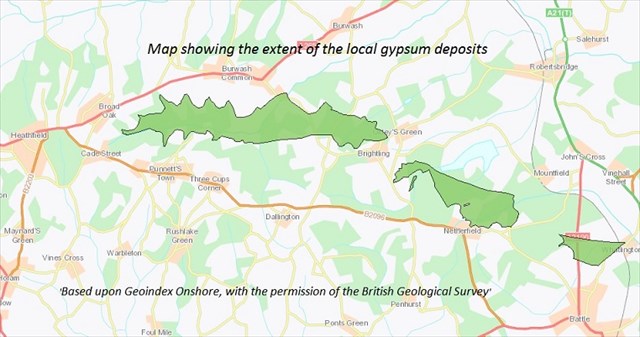
Trial boreholes have been used to calculate the depth and extent of the reserves. At depths of over 150m below the surface it is anhydrite rather than gypsum that is found. Approximately 20 year proven reserves of gypsum have been reported in the Mountfield/Brightling with the possibility of the Mountfield mine reserves being exploited from the Brightling mine.
'Reproduced with the permission of the British Geological Survey ©NERC. All rights Reserved'