This cache has been placed as part of an initiative by the County of Peterborough, its member municipalities, the City of Peterborough and local First Nation communities to celebrate Canada 150+. There are 23 geocaches placed throughout the region showcasing local history.
The geocoin stock has now been exhausted. Please continue to enjoy exploring local history through other geocaches within the Canada 150+ collection.
GC Codes full list: GC74A7F - Payne Murders & First Execution, GC74A76 - Victoria Museum at "Inverlea", GC72PWE - Memengweshii, GC72PWP - Historic Curve Lake Village, GC72PX1 - Old Rail Road Stop, GC72PXA - Hiawatha Church, GC72VFW - Sucker Hunt at "Welbeck", GC74A7Q - Richard Birdsall, GC74A7V - John Deyell, GC74A7Y - Cavan Blazers & Paddy Maguire, GC72VG3 - Balm for her Wounded Heart, GC72VGA - Sedgwick Lime Kiln Park, GC72WDJ - Nepheline Syenite A Global Lustre, GC75D68 - Havelock Public School, GC72WDT - The Brush Factory, GC72VGJ - Sam Edgar Crypt, GC72VGQ - Nelson Brawl at the Keene Hotel, GC75D6H - Lang Grist Mill, GC72VGW - Catharine Parr Traill, GC72WDZ - The Pope Stallion, GC75D5Q - Adam & Eve Rocks, GC74A8B - Going to School on the Oregon Trail.
Beware boaters! In the waters before you lie the ties and foundation of the Cobourg & Peterborough (C&P) Railway. The ambitious 4km pile/crib trestle bridge across Rice Lake from Harwood to Hiawatha was part of a route intended to provide a direct link between the growing cities at either end. This was a time when many smaller railway companies were competing to connect regionally-significant routes.
This railway was first conceived in 1831, with construction later starting in 1853 through the will of D’Arcy Boulton Jr and others. Massive amounts of materials were required. Tic Island was used to help with the bridging of a lake with a deep muddy bottom. Several techniques – pile trestle, stone-filled cribs with burr truss bridge spans, and a centre-pivot drawbridge in the middle of the lake – were employed. The completed cost of Rice Lake Bridge approached £35,000 at the time when a labourer earned about one dollar per twelve-hour day.
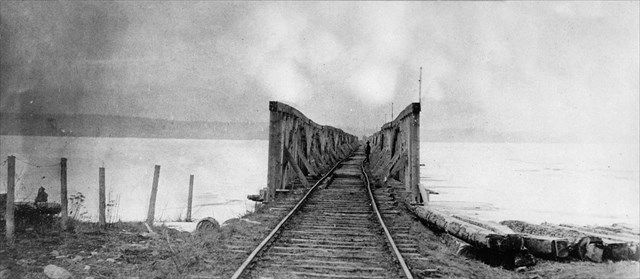
The railway between Cobourg and Peterborough was completed on Dec 29, 1854 to great optimism and excitement. It ran right through Hiawatha and brought many people through the community. Although the bridge sat 4-feet above the water the shifting ice rendered it unstable and it required repairs within 3 days. Under constant repair and suffering damage each winter & spring, it was deemed unsafe for passengers by 1859. When The Prince of Wales visited the area in 1860, he too was taken across the river by boat.
Its final collapse in 1861 is said to have been aided by men from the rival Port Hope, Lindsay and Beaverton (PHL&B) Railway who removed pins and rails from the line. The PHL&B line had opened in 1858 to provide an alternate route around the west end of the lake. Although the ties and rocks of the railway are submerged, they still cause boaters problems to this day.
For more historic photos of this engineering feat, view the walls inside the restaurant facing the lake.
Sources:
Shpuniarsky, Heather Y. and The Village of Hiawatha Book Committee. 2016. "The Village of Hiawatha: A History". pp. 76-77.
"Cobourg and Peterborough Railway", http://www.canada-rail.com/ontario/railways/CP.html#.WNvJ8E3rvIV. Accessed: March 9, 2017.
"Cobourg History, Harwood Station Museum: Part 3. The Rice Lake Bridge", https://www.cobourghistory.ca/histories/harwood-station-museum/67-part-3-the-rice-lake-bridge. Access: March 9, 2017.