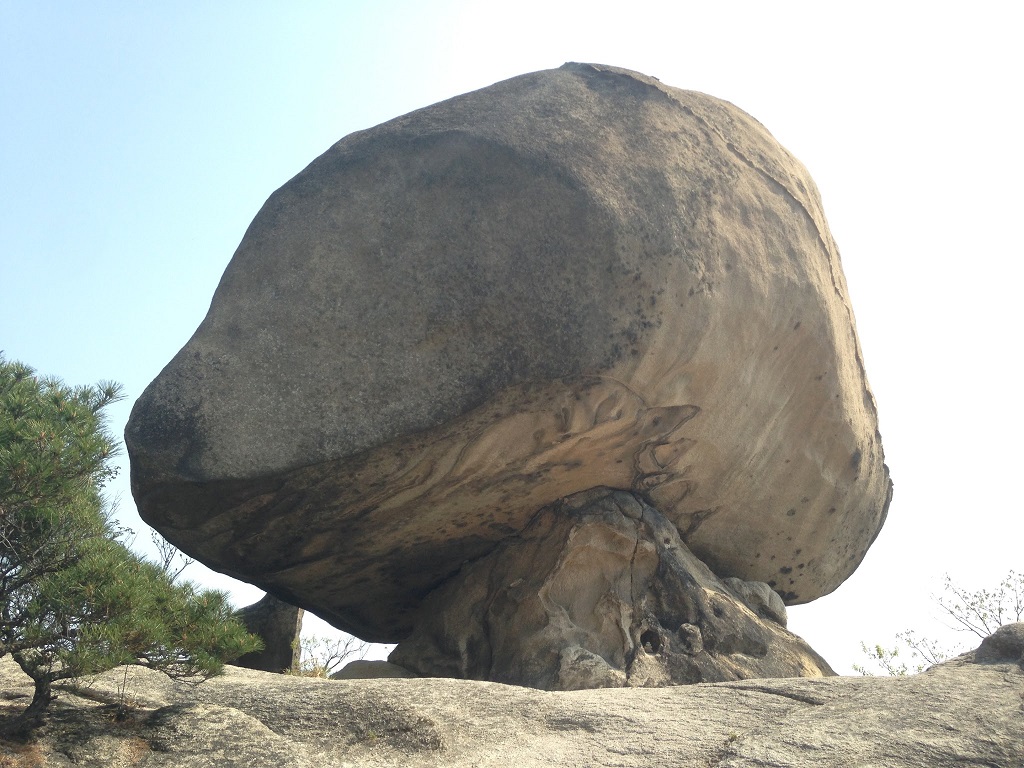
사과바위는 경기도 의정부시 사패산 능선에 솟아 있는 바위이다. 사패산은 전형적인 화강암 산지로서 사과바위와 같은 다양한 모양의 풍화지형이 잘 발달해 있다.
화강암은 원래 땅 속 깊은 곳에서 만들어진 암석이다. 우리가 현재 보는 화강암들은 풍화와 침식 작용을 거쳐 지표 위로 드러난 것들이다. 캐시존에서는 토르, 암맥, 타포니, 포획암, 나마등의 다양한 지질현상을 관찰할 수 있다. 사과바위는 우리나라에서 가장 규모가 큰 전형적인 토르로 알려져 있다.
The Apple Rock rises on the ridge of Sapaesan Mountain, Uijeongbu-city, in Gyeonggi Province. Sapaesan Mountain is a typical granite mountain area, and has a well-developed examples of various weathering.
Granite is originally a rock formed in deep underground.The rocks we see today are exposed to the surface of the earth through weathering and erosion. At the cache zones you can observe various geological phenomena like tor, dyke, tafoni, xenolith and Gnamma. The Apple Rock is also known as the biggest tor in Korea.
토르(Tor)
기반암(바위)에 생긴 갈라진 절리(틈)을 따라 수분이 침투하게 되면 동결융해(凍結融解)현상으로 절리 주변의 모서리 부분은 쉽게 풍화되어 풍화토(새프롤라이트)를 형성한다. 물이 얼면 부피가 9~10% 정도 늘어나며 풍화를 가속시킨다. 동결융해상은 0°C 근처에서 가장 활발하게 일어난다. 한편 가운데 풍화되지 않고 남아있는 가운데의 암석은 둥근 형태를 가지는데, 이를 풍화토의 중심에 있다고 해서 '핵석(core stone)'이라고 한다. 그 후 시간이 흘러 풍화된 흙(새프롤라이트)이 침식에 의해 제거되고 둥근 형태의 핵석이 기반암 위에 남아 탑 모양으로 쌓여 있는 경우가 있는데 이를 '토르(tor)'라고 한다. 주로 화강암에서 잘 발생하는데, 사과바위의 경우 전형적인 화강암 토르이다. 근래에는 화강암 이외에도 다양한 암석에서 다양한 원인에 의해 형성된 돌탑 모양의 지형을 모두 토르로 부르는 경향이 많다.
Granite Tors start to form when magma that has intruded into the crust cools to form a batholith. The softer rock above the batholith erodes away over time leaving the batholith exposed to the elements. While the rock is cooling it starts to contract causing cracks - these also occur when the batholith is exposed and pressure is released.
The crack in the Granite rock are made worse by the process of freeze-thaw weathering. Freeze-thaw weathering takes place when water is trapped in the cracks of a rock and freezes. If the air temperature drops below freezing, the water will freeze and expand by 9-10 per cent putting pressure on the rock which then expands and enlarges the cracks. The process of freeze-thaw weathering occurs until the rock is weakened and shattered. It is most effective where the temperature fluctuates around 0°C.
암맥(Dyke or Dike)
지질학에서 기존에 관입된 암석의 층리면에 대해 수직이나 급경사를 이루는 탁상(卓狀) 또는 판상의 화성암체이다. 지층면이나 암체에 연직 또는 연직에 가까운 모양으로 관입해 있는 판상의 화성암체를 말한다. 두께는 수 cm 에서 수십 m, 길이는 수백 m에서 수십 km에 이르기까지 그 크기가 다양하다. 맥암(dike dock)으로 구성되어 있는데, 침식저항상태에 따라 기존 암석보다 두드러지고, 골을 형성하기도 한다. 또한 기존암석과 색,풍화점도,구조가 달라 구별이 쉽다.
A dike or dyke, in geological usage, is a sheet of rock that formed in a fracture in a pre-existing rock body. Dikes can be either magmatic or sedimentary in origin. Magmatic dikes form when magma intrudes into a crack then crystallizes as a sheet intrusion, either cutting across layers of rock or through an unlayered mass of rock. Clastic dikes are formed when sediment fills a pre-existing crack.
타포니(Tafoni)
암석의 측면에 형성된 풍화혈(해안타포니와 구별). 암석의 입상붕괴나 플레이킹(flaking)에 의해 발달하고 규모가 확 대되는 지형으로 열대 및 아열대 건조기후에서 전형적으로 발달하지만 온대 습윤지역과 남극에서도 발견된다. 규모에 따 라 벌집형 타포니를 따로 구분하기도 한다.
Tafoni (singular: tafone) are small cave-like features found in granular rock such as sandstone, with rounded entrances and smooth concave walls. They often occur in groups that can riddle a hillside, cliff, or other rock formation, which is called honeycomb type tafoni. They can be found in all climate types including Antarctic environment, but are most abundant in semi-arid and arid deserts. Explanation for their formation includes salt weathering. They also frequently occur in granitic rocks.
포획암(Xenolith)
마그마의 관입이나 분출시에 주위의 암체나 지층의 일부가 파괴되어 화강암 속에서 응고된 것이다. 포획암은 그것을 포획하는 모체암석과 화학조성 ·광물조성 ·조직이 다르기 때문에 쉽게 구별할 수 있다.
The xenolith is a rock fragment which becomes enveloped in a larger rock during the latter's development and hardening. In geology, the term xenolith is almost exclusively used to describe inclusions in igneous rock during magma emplacement and eruption.
나마(Gnamma)
나마는 화학적 풍화작용에 의해 기반암 표면에 형성된 접시 모양의 풍화혈이다. 나마는 2가지 이상 광물이 모여 이질성을 보이거나 바위에 작은 저지대가 있을 때 생기기 시작한다. 처음에는 1 cm 또는 그 이하일 수 있지만 그곳은 물을 저장하며 암석 성분의 풍화를 가속화시킨다. 비는 암석 광물이 부식되어 녹아내린 화학성분을 씻어내고, 물이 증발할 때 바람이 또한 광물의 풍화로 만들어진 입자들을 날려버린다. 이런 과정을 반복하며 나마가 형성되고 나마는 점점 커지게 된다. 나마는 점점 더 많은 물을 저장할 수 있게 커지고 이로 인해 광물의 풍화는 더 빠른 속도로 진행된다. 나마가 커져 갈 때 이웃에 있는 나마와 결합하여 더 큰 나마가 되기도 한다.
The gnammas are depressed, erosional features found on or at gently sloping rock. A gnamma is being formed from an irregularity, a mineral heterogeneity or from a small depression in the rock. At first it may have 1 centimeter or less in width. It retains water accelerating the weathering process of the rock minerals. The rains take out some chemical elements dissolved from the decay of the rock minerals. When the water evaporates the wind also carries the particles made from mineral weathering. Through this cyclic process the gnamma becomes larger and larger. The gnamma becomes able to retain more water which causes the weathering of more minerals. And the gnamma to grow even larger. When the gnamma is getting larger it sometimes merge with the neighbouring gnamma making bigger gnamma.
[로그하는 방법]
- 주어진 캐시 좌표에서는 사과바위에 발달된 암맥을 관찰할 수 있습니다. 이 암맥을 감싸고 있는 바위의 종류는 무엇인가요?
- 주어진 캐시 좌표에서 보았을 때 1의 암맥은 어느 방향으로 뻗어있나요? 1) "/", 2) "— ", 3) "|" , 4) "\"
- 사과바위의 핵석과 기반암은 각각 무슨 암석인가요?
- 주어진 캐시 좌표에서 보았을 때 사과바위의 중앙 부분을 위에서 아래로 4등분했을 경우 2번 위치에서 관찰되는 지질 현상은 무엇인가요? 그것의 색상은 다른 부분에 비해 짙습니다. 그리고 그 모양이 다른 부분과 크게 차이가 납니다. 1) "암맥", 2) "타포니", 3) "나마" , 4) "포획암"
- 사과바위 옆에는 약 3미터 정도의 바위가 있습니다. 바위의 측면에서 관찰되는 지질현상은 무엇인가요? 정답은 2개 이상이 될 수도 있습니다. 1) "암맥", 2) "타포니", 3) "나마" , 4) "포획암"
- 사과바위를 배경으로 당신 또는 당신의 GPS를 찍은 사진을 로그에 올려주세요. (선택사항이지만 사진을 올려주시기를 부탁드립니다.)
- 답을 제 Profile에 있는 메시지창을 이용해 제게 보내주세요. 이제 로그하셔도 됩니다. 답에 문제가 있을 경우 제가 메시지를 드리겠습니다.
[How to log]
- From the cache coordinates you can observe the dyke developed on the Apple Rock. What is the name of the rock surrounding the dyke?
- When you see from the cache coordinates to which direction is the dyke in Question 1 stretched ? 1) "/", 2) "— ", 3) "|" , 4) "\"
- What kind of stones are core stone and bed rock of the Apple Rock respectively?
- When you see from the cache coordinates what geological phenomenon can you observe in location described below? Its color is darker than the other area and the shpe is very distinguished. When we devide the central part of the Apple Rock into four part from top to bottom, it is located on the second part. 1) "Dyke", 2) "Tafoni", 3) "Gnamma", 4) "Xenolith"
- Beside the Apple Rock you can find a rock which is about 3 meters high. What kind of geological phenomenon can you see on the side of that rock? Answers can be more than one. 1) "Dyke", 2) "Tafoni", 3) "Gnamma", 4) "Xenolith"
- Upload the photo of you or your GPS with the Apple Rock in the background! (The task is optional but I would highly appreciate if you would do so.)
- Please send the answers to me by message on my profile! You may log as 'Found'. If the answer is not correct, I will contact you.
Ref : https://coord.info/GC6TWR3
https://coord.info/GC6NYQX
https://coord.info/GC6M4G0
| I have earned GSA's highest level: |
 |