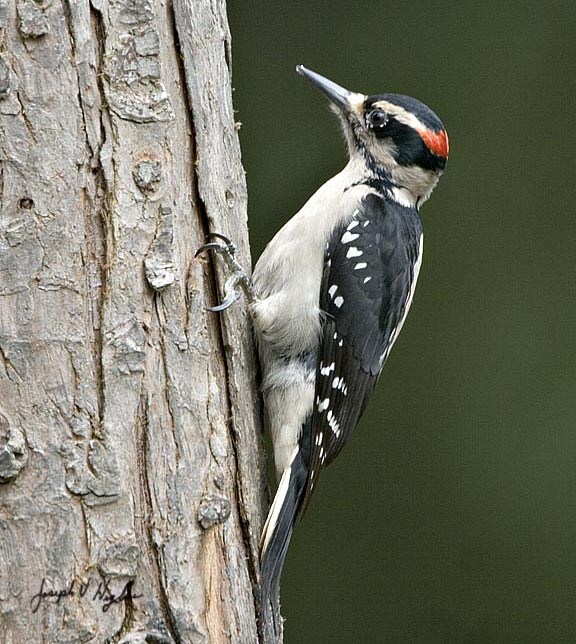
 Downy Woodpecker (left), Hairy Woodpecker (right)
The Hairy Woodpecker (Picoides villosus) is larger than its lookalike, the Downy Woodpecker. It wields a much longer bill than the Downy Woodpecker's almost thornlike bill. Hairy and Downy woodpeckers occur together throughout most of their ranges. The Downy Woodpecker uses smaller branches while the Hairy Woodpecker tends to spend more time on trunks. Look for them at backyard suet or sunflower feeders, and listen for them whinnying from woodlots, parks, and forests. Hairy Woodpeckers are contrastingly black and white. The black wings are checkered with white; the head has two white stripes Males and females look similar, with males having a small red patch toward the back of the head. A large white patch runs down the center of the black back. Hairy Woodpeckers are common in mature woodlands with medium to large trees. They also occur in woodlots, suburbs, parks, and cemeteries. You can find them equally commonly in coniferous forests, deciduous forests, or mixtures, and generally up to about 6,500 feet elevation. Also found at forest edges, around beaver ponds, in recently burned forests, southern swamps, open pine, oak, or birch woodlands, and orchards. Hairy Woodpeckers typically excavate their nests in the dead stub of a living tree, especially trees with heartrot, or in a dead tree. The cavity is often in a branch or stub that isn’t perfectly vertical, with the entrance hole on the underside. This location may help keep flying squirrels and sapsuckers from trying to take over the hole. Hairy Woodpeckers begin excavating their nests less than 2 weeks before egg-laying begins. The entrance to the nest is about 2 inches tall and 1.5 inches wide, leading to a cavity 8-12 inches deep. The inside widens at the bottom to make room for the eggs and the incubating bird. It’s typically bare except for a bed of wood chips at the bottom for the eggs and chicks to rest on.
I heard a Hairy Woodpecker calling while placing the cache. The container is a camouflaged plastic jar with a logbook and swag. You will need to bring your own pen/pencil to sign the log book. The cache is along a seasonal road (not plowed in the winter).