The rate at which suspended sediment settles and the rate at which a river clears depend on the particle size of the suspended sediment. Large particles such as sand settle out very quickly whereas fine silt sediments can take much longer.
Suspended glacial sediment can be smaller than micron size, which corresponds to very fine silt or rock flour. Rock flour consists of fine particles of minerals, generated by mechanical grinding of bedrock by glacial erosion. Because the material is very small, the rock flour becomes suspended in glacial meltwater streams making the water appear cloudy, which is sometimes known as glacial milk.
Although clay-sized, the flour particles are not clay minerals, but typically ground up quartz and feldspar. Rock flour is carried out from the system via meltwater streams, where the particles travel in suspension. Rock flour particles may travel great distances either suspended in water or carried by the wind, in the latter case, forming soil deposits called loess.
Earthcache tasks. You will need a clear container. A clean empty drink bottle or similar is fine.
-Collect a sample of meltwater from the river. Take care. You do not want to fall in the river.
-Let the water stand for at least 12 hours.
-Estimate how much silt has settled, by volume, i.e. how much of the volume of the sample is now taken up by settled silt. <1%, 2%, 5%, 10%, >10%
-Is the water clear after standing for 12 hours?
-Would the water make good tea? Milo?
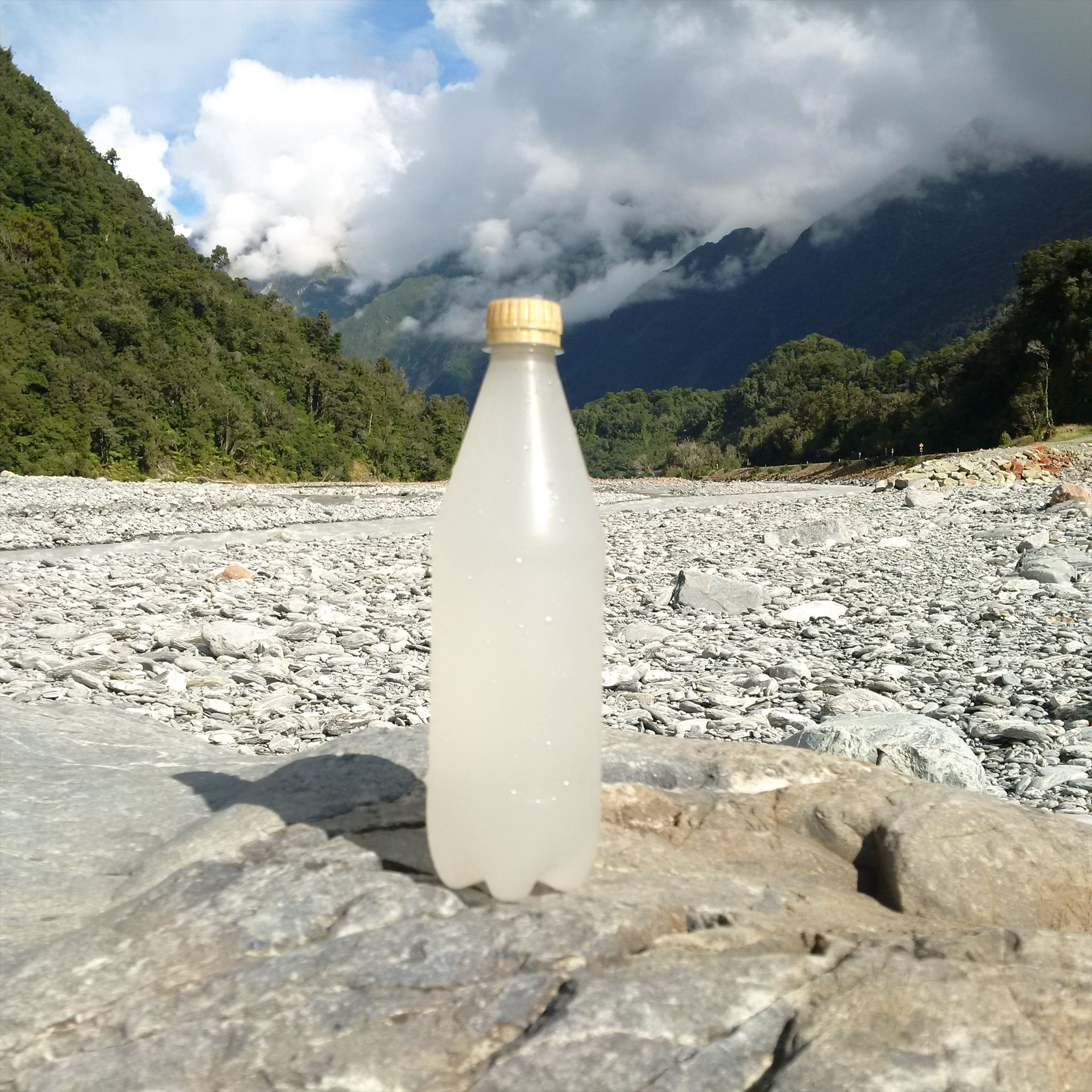
Prof Freddo's sample 1 minute after collection.