Within the City of Highland Park, there are three unusual places that are the realization of some very "forward thinking" ideas of almost a hundred years ago.
Three underpasses (or "Subways" as the British would call them) are closed-off leftovers from a time when motorized vehicles were new and manmy of today's traffic rules were not in-place to protect pedestrians from the "fire breathing dragons" that automobiles can sometimes be perceived as.

Cortland & Second Tunnel, West Side (1937-L, 2017 R)
These "underground crosswalks" were installed in a time before the freeway system came to Metro Detroit, and many of the sidestreets and main thoroughfares of the area were much more laden with vehicles than they are nowadays, even though there are probably more of them now than there was back then.
Second Ave. was a direct route connecting the neighborhoods that were "outlaying" back then, to the Downtown Detroit area. It was a route to allow folks a method of getting to and from their daily jobs and Second was a rather fast (slow speed by today's standards) way to get there.

East Side Corner : Cortland & 2nd (1925)
The City of Highland Park in its heyday, was a bustling enclave city, full of homes, schools, and families. It was also a very affluent city with money to experiment, partially due to the many folks that lived here working for Henry Ford at his assembly plant nearby building the automobiles that were gaining in popularity.
In the 1920's, motorized vehicles on the streets was a relatively new development, in part because of Ford's automobile being made affordable more than they had been previously, and other automakers following suit shortly thereafter. Not everyone had an automobile, but those folks that did have one were also not given the same amount of training on how to operate it. Safety was a secondary thought, many times, instead of as it is nowadays with many hours of instruction and safety being taught to every driver on the road.

2017 : Cortland and 2nd looking down
During this time of the early 1920's, children were no different than they are nowadays, with many of them running out into the streets unknowingly being the victims of the "fire-breathing monsters" when the accidents occured. Some, unfortunately, were being killed by these traffic accidents.
The public began to change their way of thinking when it came to safety, because in 1924 alone, an unthinkable total of 96 children perished because of vehicular incidents, and many more injured. Automobiles were not as safe as they are nowadays either, with almost haphazard ways to make them "stop", and just as haphazard as the ones that made them "go".
The Highland Park City management and planners knew that the Automaker's assembly processes for putting-together a vehicle was completely altering the way automobiles were produced, with Ford's most notably making them more affordable to the "common people".

Looking West 2017 view of John R & Candler
The City wanted to limit the need of losing children crossing streets at all costs and they knew that they had to do something to protect the public safety. They grappled with many ideas at the time, and we aren't sure what other ideas they had, but the one idea that seemed the most plausable and feasable to them was these underground tunnels as a solution to the problem of Public Safety. They knew that the amount of automobiles was not going to decrease, so they knew they had to act fast to safeguard the public and make it better for folks who lived here and protect their most valuable of possessions: their children.
Designs were drawn up, plans made, and funds allocated for the projects. Digging began, and the cement poured...all the while with the safety of the public in mind.

2017 view "down below" at Pilgrim and 2nd
The three underpasses were created to allow pedestrians a way to cross these busy streets to get to school and other destinations, without the hazards of waiting for traffic to stop and allow them to get there safely.
The Second and Cortland tunnel was constructed at a planned cost of $5,000, and was dug-out with a steam shovel.
Lawrence Whitsit, who was the city engineer for Highland Park at the time, told the newspaper:
“Everything has been done to make the tunnel acceptable to children and to the average pedestrian. We have made the stairs an easy grade, the interior of the tunnel pleasant, and done everything to ensure it’s generous use.”

Second and Pilgrim - East Side (2016)
There were supposedly 5 crossings built in total, between three in Highland Park being the first ones completed, and then later-on two in Detroit constructed. The two in Detroit were at Capital Park and the other near Mid Town, at Cass and Peterboro.

Detroit Crossing at Cass and Peterboro (1920's)
The three that were completed in Highland Park had two of the three crossings that were the same, with one of the tunnels (Second and Pilgrim) having a different configuration than the rest. This one has a "T- or I-Type" design where there are two sets of steps on either side of the street leading below-ground, then a 90-degree turn to actually cross below the street. The other two were essentially "straight crossings".

Second and Pilgrim - Looking South (2017)
To preserve nighttime safety, the tunnels would be closed-off and an iron-gate placed across the openings.
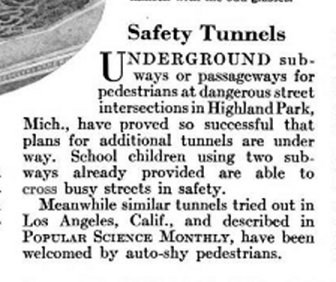
The designs and ideas of these were thought to be so innovative, that in the December 1928 issue of Popular Science (page 72) had a short article about the crossings. The article notes how these crossings helped the auto-shy pedestrians to cross the busy streets safely and that "similar tunnels" had been tried out in Los Angeles, California.
The tunnels were used for many years and would be influential in protecting the public, until safety measures were focused more on the Automobile and it's driver, rather than focusing on pedestrians being more cautious this way. It was found to be a much more efficient method, rather than having tunnels installed at every intersection of a busy neighborhood.
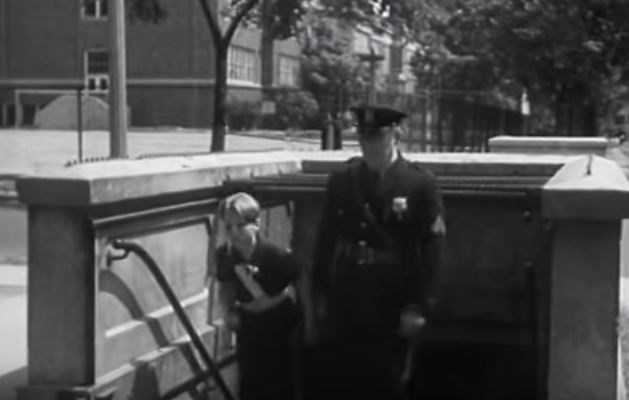
Years later in 1937, there was even a Safety Film produced which featured the tunnels and how to use them. That film can be found here with the Cortland Underpass featured at about 6m:55s:
Youtube link: (https://www.youtube.com/watch?v=zB3vUkF7AQw)

Eventually, the tunnels were closed to the public and metal "shutters" and fencing installed to keep folks from using these 1930's Safety Features. The metal shutters used to cover the stairs were frequently used as an impromptu instrument as students stood atop them and stomped repeatedly to make as much noise as possible. This would happen during the walk to or from school and the reverberating noise created would be almost magical and soul-satisfying to some. Amazing what kind of sound would come from metal panels over a voided structure. There were also some loud thunderous noises being the soundtrack to various childhood fights that were witnessed as well. Standing atop these structures were the best seat at the intersecting corners where skirmishes would frequently occur. It was not clear the kids that played, gathered, and argued near these concrete structures that there were actually stairs which lead to underground passageways.

John R. and Candler (2017)
There are stories from folks who had either used them, or had been told from their parents that the tunnels may have had "side tunnels" either in them, or planned for them, to eventually make an underground network of walkways for folks to travel through. It's unknown whether these stories were based in fact, or just the tales of the kids that traveled through them.
Today, only the three in Highland Park remain, with the two that were in Detroit being long-since closed-off and having no visible remains above-ground to the public any longer. The tunnel openings that remain are covered by sheets of steel and fencing at the top, but the years of wear and prying eyes have left some of them partially open for folks to gaze inside the once-used "subways" as they were called by the neighbors here. There is "junk" and other abandoned stuff down below, and because of the debris, the tunnels do flood when it rains hard enough because the drains that were installed are clogged.

SB view of 2nd and Pilgrim (2017)
The few square-feet above-ground that these "portals" take up, now only serve as a reminder of what once was thought to be very "forward thinking in Safety" at the time.
It’s fascinating to see how the culture that was so focused on Automobiles affect how we, as a society, approached safety and our neighborhoods this way. They are unique details to a city that once had five times the residents that it does nowadays, and these reminders stand here as a testament to just what we would do to protect our own.
The caches placed here are to give you a glimpse into what used to be a very cool idea and remind us to always be safe and aware of what is around us....sometimes hiding in plain sight.
**WARNING**
DO NOT attempt to ENTER THE PASSAGEWAYS.
The GEOCACHES ARE NOT THERE,
but are on the OUTSIDE in plain view of the public.
IT IS ILLEGAL TO ENTER THE TUNNELS.
AS ALWAYS, BE AWARE OF YOUR
SURROUNDINGS AT ALL TIMES.