Ghost Town of Kerriston, Washington Traditional Cache
Shaddow: Now a Ghost Cache
Ghost Town of Kerriston, Washington
Please note Use of geocaching.com services is subject to the terms and conditions
in our disclaimer.
Kerriston
This cache is placed at the former townsite of Kerriston, Washington. The following I've been able to put together during my research of the town, general area and NW railroad history.
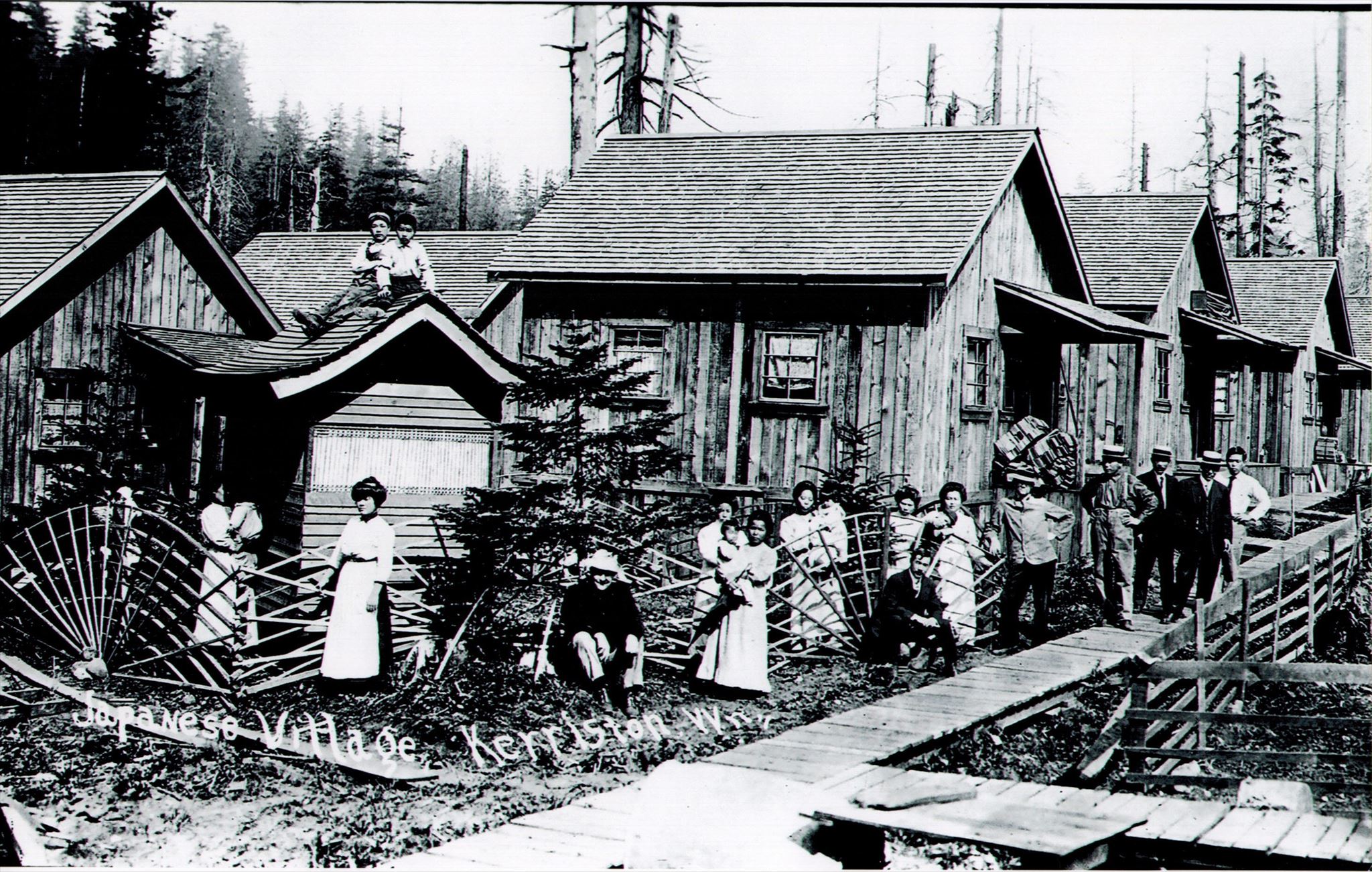 As was the case with many early company-owned mill towns, Japanese workers were employed in Kerriston, and they had their own separate housing in the town, referred to as the 'Japanese Village.'Photo courtesy of Maple Valley Historical Society
Kerriston was a company owned town covering an area of about 50 acres located on the Raging River near the confluence of Kerriston Creek, a spot about smack-dab in the middle of the backside of Rattlesnake Ridge and in the valley between Rattlesnake and Taylor Mountains. It is named after Albert Kerry, a Northwest lumberman and president of Kerry Timber Company who was also known for his civic involvement in Seattle. He is much better remembered by Kerry Park on Queen Anne Hill which is also named in his honor.
In the period prior to the founding of Kerriston, small independent railroads spider-webbed the Pacific Northwest and were the primary means to move goods and people. The area around Kerriston was serviced by the small railroad line Green River & Northern Railway, an 11.9 mile long railroad incorporated on September 22, 1890. The line eventually terminated to the north at the Lovegrew Mill and ran from the south through several small nearby towns such as Hemlock, Barneston and Selleck, all of which were eventually condemned for the creation of the Cedar River Watershed. Near the Cedar River it crossed paths with the Chicago, Milwaukee, St. Paul and Pacific Railroad cross-country mainline (part of which are now known as the John Wayne Pioneer Trail, a local section of which is the Iron Horse State Park Trail that includes the Snoqualmie Tunnel). The line originated in Kangley where it connected with many other rail lines continuing to places such as Enumclaw and beyond. On April 21, 1898, before Kerriston was founded, the railroad had been acquired and became a branch line of the Northern Pacific Railway, a fate similar to many if not most of the smaller railroads in the area.
Kerriston began as a small village in 1891. The town's main industries were producing cedar shingles and shacks and bricks. Kerriston bricks were known for their quality and were used throughout the area and in Seattle in the early 1900's. A post office was established on November 23, 1904, and remained in operation until January 31, 1935. It operated out of a large store that was built to accommodate the mill and its workers. Much of the rest of the town’s business was also centered on the store. The town grew rapidly, with its population reaching 300 by 1907. Around 1908 the town and mill were sold to the Northwest Lumber Company, but it continued growing to between 400 and 500 during the 1910s. Kerriston continued on through most of the 1920s though the town’s population slowly dropped during the decade. The population decrease accelerated later in the 1920s and by 1929 business activities in Kerriston were over and the trains had stopped coming. By the 1940s only a few buildings remained and by the 1960s even these were gone. All that remain today are some foundations and many artifacts.
Kerriston's decline is often attributed to declining timber supplies but I believe more likely the result of several, probably much larger, factors that also included growth of centralized industries and more so the water needs of the City of Seattle. Kerriston's fate was probably sealed by the development of the Cedar River Watershed which was to become the main water supply for Seattle. Efforts to develop the water supply began as early as the 1890s and by 1899 the City of Seattle had already acquired ownership of much of the watershed and a dam and pipeline was being built. In 1901 the first water was supplied to Volunteer Park and Lincoln reservoirs on Capitol Hill. While Kerriston is not in the watershed proper, the grade of the deadend rail line did pass through the heart of it and when the land was condemned it effectively did the same to the town of Kerriston.
Note that the cluster of houses and private property that start more than a half mile to the south, and which are accessible via public road from the south, are not part of Kerriston. You can not access this cache from the south. This is private property.
Route, Current Conditions and the Cache
There are two ways to approach via public property. Today myself and X-Huey-Drv took both of them in a lollypop loop from the gate at Highway 18 near I90. These routes can be readably determined with some map work.
We approached the direct way on the old railbed some of which was fairly overgrown but also had a short section that was in quite good and even drivable condition now 4x4 road accessed from elsewhere. Near Kerriston this route again returned to old railbed and it deteriorated very quickly. Now in the boundaries of the old town we crossed Kerriston Creek and navigated around a beaver pond and dam located at what I think is the old mill site. Interestingly and ironically, the beavers incorporated one of the old Kerriston made bricks and some shingles into their dam. Floating in the pond were a couple of old railroad ties.
We continued on to where I placed the cache. Along the way we continued to find old artifacts mostly of the metal ductwork type though there were a few clay pipes and even a piece of concrete. My understanding is that there are some large concrete foundations further up the Raging River but we did not look for them. If you do, stay within 1/2 mile south of the cache or you risk entering private property. Instead we moved uphill towards the heart of the residential section.
On the way and near where I believe one of the brick kilns was located, and not too far from the cache site, we found a couple of old small water or pressure tanks and some low quality bricks, some of which had markings indicating exposure to extremely high heat and therefore which I assumed lined the interior of the kiln.
Very near the cache site is a nice spot with some repurposed bricks and some larger metal artifacts. The cache is located under one of the more personal artifacts (rather than of more industrial type) and about 60' at 140 degrees of the large stump near the repurposed bricks. The cache is a large lock and lock painted black.
From the cache site we continued up to where we noted a very large old stump and just beyond a logging road with relatively recent tire tracks. Obviously this way is easier, though longer and much less adventurous. We assumed the tracks were associated with the person who had left many pieces of white and red stripped and hand numbered flagging usually located at artifact sites. They missed many of the ones that we found and I suspect found many that we did not. I don't know who it was and I would be very interested in meeting them and discussing Kerriston history.
We continued exploring the area and found an old bathtub, some very high quality bricks, the ones I assume for which Kerriston was known, and a few other artifacts including some metal plumbing pipe. I could have, and would have loved to, explore this site for many more hours but it was time to leave.
At the end of the day we logged about 12 miles and something like 1,500 feet of elevation over about 7.5 hours. If you take the easier, longer way both directions then expect those numbers to be higher. If you start at one of the ends of the Rattlesnake Ridge trail, it will be even more. If you bike in from HW18, which I recommend, it will be a lot faster. Only the last few hundred feet will be bushwhack. Come prepared. We don't think it was too bad but many would probably disagree with us.
Note there are bears out here, we saw one on the way in and the tracks of another on the way out. They almost always are not an issue but of course take due care.
Please do not take or disturb artifacts. Practice Leave No Trace.
Additional Hints
(Decrypt)
[In description]
Treasures
You'll collect a digital Treasure from one of these collections when you find and log this geocache:

Loading Treasures