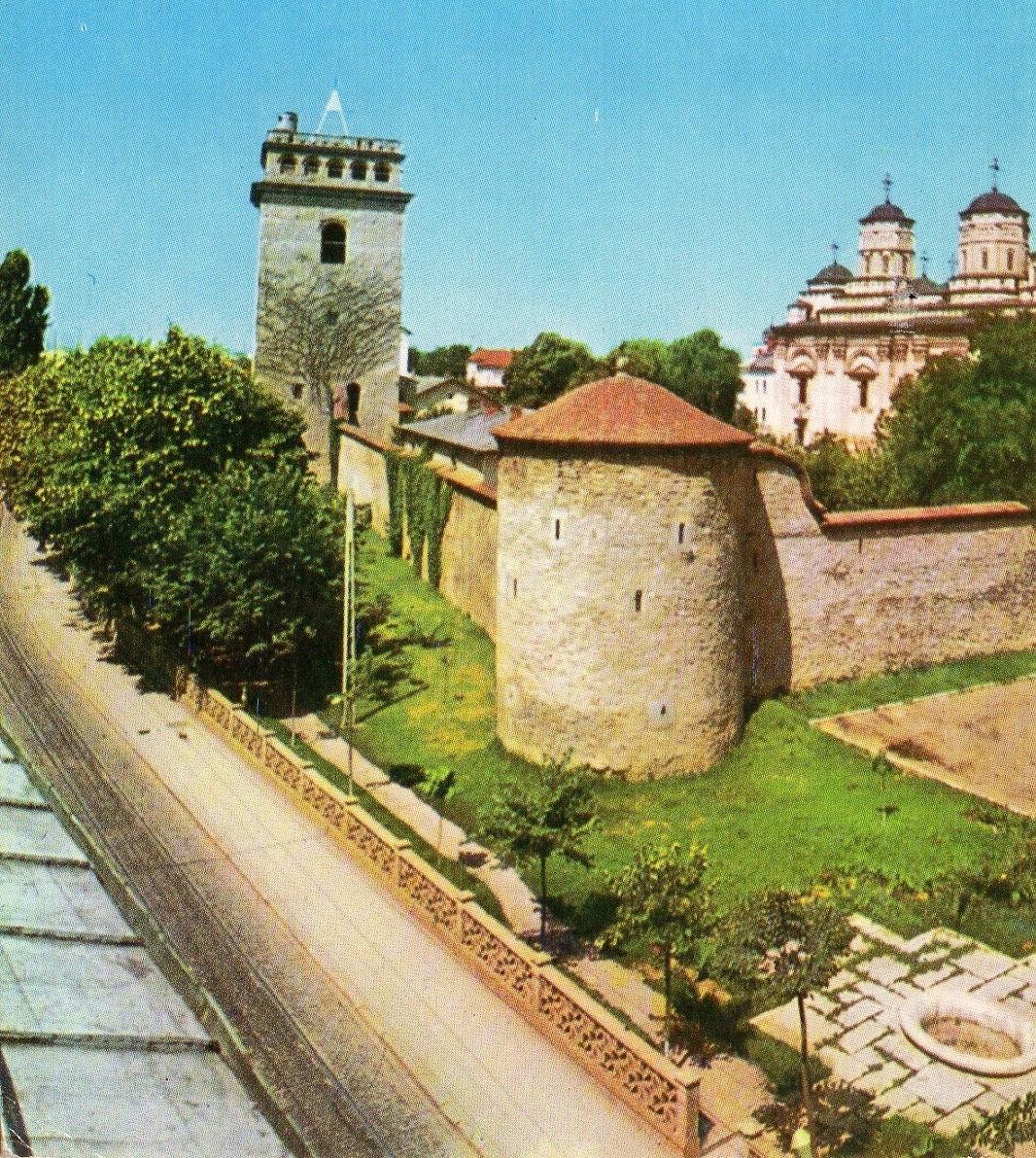
[RO  ] Mănăstirea Golia a fost construită pe la 1550 de logofatul Ioan Golia (Golăe) apoi reconstruită in 1650 de domnitorul Vasile Lupu folosind o echipă de meșteri italieni.
Duca-Vodă ridică turnurile rotunde de la colţurile incintei in 1668. Astăzi zidurile de incintă au o înălțime de 9 m și o grosime de peste 1 m, cu un brâu de sprijin în interior, pe care cândva se patrula.
Turnul clopotniţă ar data din vremea lui Ieremia Movilă pe la 1600. Turnul a servit drept inchisoare ocazională în 1705 apoi ca loc de adăpost in timpul ciumei din 1819 dar şi in vremea asediului intreprins in 1821 de trupele lui Alexandru Ipsilanti. În 1859 aici se infiintează un post de pompieri in turnul Goliei care prelua sarcina de a supraveghea oraşul de la cei opt clopotari din turnul biserii Trei Ierarhi.
Astăzi turnul are o scară in spirală cu 120 de trepte care duce la încaperea clopotelor și terasa superioară de unde se poate contempla "orașul celor șapte coline".
In partea de vest a ansamblului se păstrează din 1750 vechea prima casă de apă din Iași, cu fantana turcească in exterior. In 1766 Grigore Ghica va capta izvoare din jurul Iaşilor si cu ajutorul unor conducte de ceramică se aduce apa in mănăstire. In casa de apă apa se vărsa intr-un bazin, printr-o gură mare de leu, iar de acolo în rezervorul din faţa cişmelei, de unde se distribuia in oraş. Acum casa de apă este transformată in casă de bilete.
In casa parohială a locuit(1866-1872) şi diaconul Ion Creangă care la inceputul anilor 1870 a tras cu puşca in ciori fiind exclus din cler.
Biserica este închisă în afara orelor de program: Luni - Vineri 09.00-17.00; Sâmbătă - Duminică: 10 -14. Cache-ul nu este 24/7.
[EN  ] Golia Monastery was built in 1550 by the boyar Ioan Golia (Golãe), then rebuilt in 1650 by the prince Vasile Lupu using a team of italian craftsmen.
Duca-Voda raised the round towers at the corners of the enclosure in 1668. Today, the enclosure walls have a height of 9 meters and a thickness of over 1 m.
The bell tower dates back to the time of Jeremiah Movila in 1600. The tower served as an prison in 1705, then as a shelter during the plague of 1819, but also in the time of the siege carried out in 1821 by Alexandru Ipsilanti's troops. In 1859 a fire station was set up in the tower of Golia.
Today the tower has a spiral staircase with 120 steps that leads to the bells room and the upper terrace where you can contemplate the "city of the seven hills."
In the western part of the ensemble is preserved from 1750 the old first water house in Iasi (Jassy), with the Turkish fountain outside. In 1766 Grigore Ghica will catch the springs around Iaşi and, with the aid of some ceramic pipes, water will be brought to the monastery. In the water house, the water spilled into a pool, through a large mouth of a lion, and from there into the reservoir in front of the cistern, where it was distributed in the city. Now the water house is transformed into a ticket house.
In the parochial house lived (1866-1872) and the deacon Ion Creangă who in the early 1870s shot the crow.
The church is closed outside the program hours: Monday - Friday 09.00-17.00; Saturday - Sunday: 10-14. Not 24/7.
 Geocaching România
[RO ] Ai grijă să nu fii văzut! - ACDS - Adu ceva de scris.
[EN ] Extreme stealth required! - BYOP - Bring your own pen.