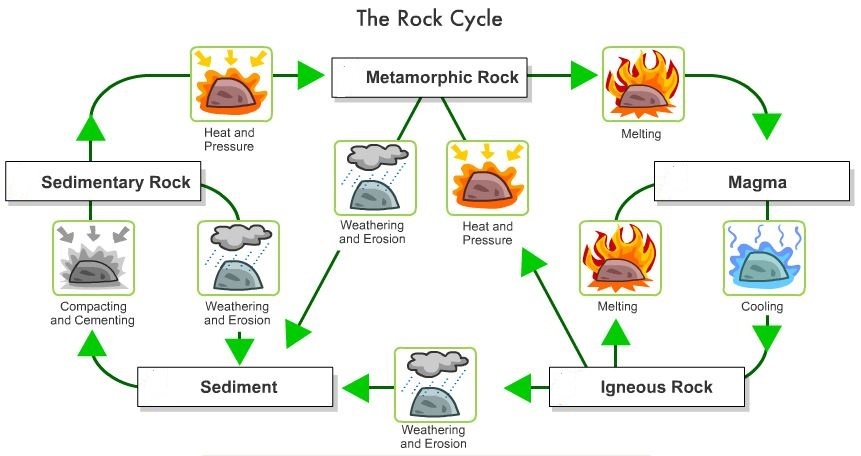
The Rock Cycle:
The rock cycle concept states that rocks are continually changing from one type (metamorphic, sedimentary, igneous) to another and back again. James Hutton (1726–1797), the father of modern geology, founded this concept. As forces inside the earth bring rocks closer to the surface, other forces on earth sink them back down. Elements that make up rocks are never created or destroyed — instead, they are constantly being recycled.
Metamorphic
Metamorphism is the distinct re-arrangement of minerals within pre-existing rocks (protoliths). This occurs without the protolith melting into liquid magma. This change occurs primarily due to heat, pressure, and the introduction of chemically active fluids. Metamorphism typically occurs at mediocre depths where temperatures are between 200°C and 850°C.
Sedimentary
Sedimentary rocks are formed by the deposition and subsequent cementation of mineral and/or organic particles (detritus) at, or near the Earth's surface and within bodies of water. Sediment is formed by the weathering, erosion and transportation to the place of deposition by water, wind, ice, mass movement or glaciers (agents of denudation). This sedimentation may also contain the shells of aquatic creatures. Sedimentary rocks are deposited in layers as strata, forming a structure called bedding.
Igneous
Igneous rocks are formed through the cooling and solidification below the surface (magma) of the earth (intrusive), or on the surface (lava) of the earth (extrusive). This molten rock is generally derived from partial melts of existing rocks deep within the earth's mantle or crust. Solidification below the earths surface helps retain heat allowing for the formation of larger grained crystalline rocks. Solidification above the earths surface allows for quick cooling and retards the formation of crystal growth aiding in the formation of natural glasses and other fine grained rocks.
A. Site #10. Phyllite:
Phyllite is a fine-grained rock with a marked fissility (a tendency to split along flat planes of weakness) due to the parallel alignment of platy minerals within. It is formed from the reconstitution of fine-grained, parent sedimentary rocks, such as mudstones or shales. It may have a sheen to its surfaces due to tiny plates of micas. It is primarily composed of quartz, sericite mica, and chlorite. Its grain size is larger than that of slate but smaller than that of schist.
A1. What type of rock (metamorphic, sedimentary, igneous) is Phylite?
A2. What processes are needed for the alteration of Banded Iron into Phyllite.
A3. Are the individual layers easily separated?
B. Site #14. Banded Iron:
Banded iron formations (also known as a BIFs) are distinctive units of rock that are almost always of Precambrian age. A typical BIF consists of repeated, thin layers (a few millimeters to a few centimeters thick) of silver to black iron oxides (magnetite or hematite), alternating with bands of iron-poor shales and cherts, often red in color, of similar thickness. Each band is similar to a varve (annual layer of sedimentation), to the extent that the banding is assumed to result from cyclic variations in available oxygen. Some of the oldest known rock formations, formed over 3,700 million years ago, include banded iron layers, but most were deposited between 2,400 and 1,900 mya. Banded iron beds are an important commercial source of iron ore, such as the Animikie Group in Minnesota. It is believed that the Sudbury Meteorite Impact event (Canada 1,849 Mya) affected concentrations of dissolved oxygen in the sea, and with that, an end to the creation of new banded-iron formations to this day.
B1. What type of rock (metamorphic, sedimentary, igneous) is Banded Iron?
B2. What processes are needed for the alteration of Rhyolite into Banded Iron.
B3. Which is more predominant? The red or the black layers?
B4. Are the individual layers easily separated?
C. Site #16. Rhyolite:
Rhyolite is of a felsic (silica-rich) composition. It may have any texture from aphanitic (crystals not detectable by the unaided eye) to porphyritic (containing distinct visible crystals). The mineral assemblage is usually quartz, sanidine and plagioclase with minor amounts of hornblende and biotite. Vugs (voids) within the rock, through the processes of precipitation and deposition, often contain red beryl, topaz, opal, jasper, and agate.
C1. What type of rock (metamorphic, sedimentary, igneous) is Rhyolite?
C2. What processes are needed for the alteration of Phyllite into Rhyolite?
C3. Is the rock in question aphanitic or porphyritic?
D. Personal Observations:
Photos taken at each of the 3 sites might be of great help in determining the answers to these questions.
D1. According to the "rock cycle".....any rock type (sedimentary, igneous or metamorphic) is basically only one alteration away from becoming one of the other 2 rock types. Given this close relationship.....what are the "major" differences between each of the rock types found at these 3 sites?
Email the answers to the 11 questions, to me, by clicking on my name above. If your answers are not received by me, your log could be deleted as per GC.com rules. Photos are accepted and appreciated as long as the answers are not pictured. You do not have to wait for confirmation from me before logging this cache as completed. Most of all……learn……and enjoy the view.
