[LKC] Sangiorgetto Traditional Cache
-
Difficulty:
-

-
Terrain:
-
Size:  (micro)
Please note Use of geocaching.com services is subject to the terms and conditions
in our disclaimer.
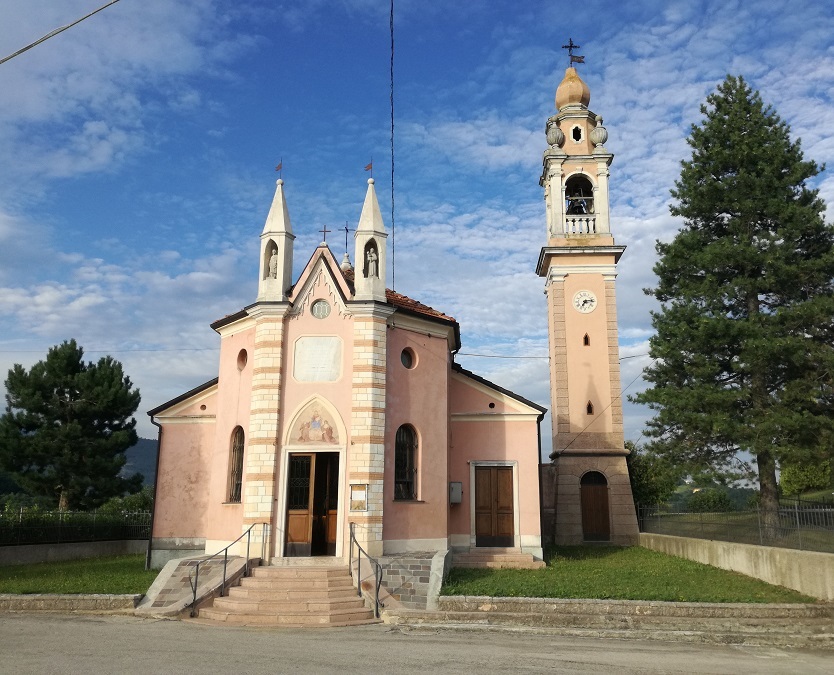
Questa cache è nascosta nei pressi della chiesa dedicata a Sangiorgio. Nel contenitore c'è solo il logbook per cui portate la vostra penna per firmare.
This cache is hidden near the little church dedicated to S. Giorgio. The container is small, bring your own pen!
Sangiorgio di Perlena
San Giorgio di Perlena è una frazione del comune italiano di Fara Vicentino, in provincia di Vicenza.
Situata circa a metà strada tra Bassano del Grappa e Schio, sorge in una zona collinare dalla quale domina la pianura vicentina. Confina a nord con il comune di Salcedo, a est con quello di Mason Vicentino, a sud con Breganze e a ovest con il capoluogo comunale.
Il paese posto sopra un colle, all'altezza di circa 291 metri sul livello del mare, ha per confini naturali ad est il torrente Laverda e a ovest il torrente Chiavone Nero. Il suolo è di natura vulcanica e assai fertile. Il clima non è mai particolarmente freddo, perché, come gli altri paesi circostanti, è difeso a nord dall'Altopiano dei Sette Comuni.
Il toponimo di San Giorgio trova origine nell'epoca longobarda. Incerto è il significato del toponimo Perlena, forse di origine romana, deriva da fundus Pernenae, fondo di Pernena, il proprietario. Come la pieve di Breganze fu matrice di San Giorgio, così Perlena era un vicus nell'area del pagus di Breganze. Viene ricordata tra le pertinenze di Breganze in un documento di investitura del 1148; in un altro del 1262 figura tra i beni posseduti da Vicenza, dopo essere stata possedimento di Ezzelino III. Nella decima papale del 1297 la ecclesia S. Jeorgii de Perlena, tenuta da un clericus, era soggetta alla pieve di Breganze.
Fino ad alcuni secoli fa, Perlena indicava un territorio più ampio dell'attuale, giungendo a nord fino ai confini dei Sette Comuni. Nel settembre 1455 il Comune di Perlena con un provvedimento preso dal Consiglio dei Cento di Vicenza, data la grande estensione, venne diviso nei quattro decanati di Porciglia, Fortelongo, Castagnomoro e Salcedo.
La chiesa di Sangiorgetto
Nella contrada Cima, a lato della strada San Giorgio - Salcedo, sorge una graziosa chiesetta chiamata San Giorgetto e localmente anche dei Roa. Ha uno stile neogotico tipico di numerose chiese della seconda metà dell'Ottocento ed è un esempio della forza di volontà e realizzativa della popolazione.
La chiesetta è dedicata alla Beata Vergine della Consolazione ed è stata inaugurata l'11 settembre 1904. Fu costruita su iniziativa degli abitanti del luogo e soprattutto della famiglia dei Galvan, una delle più benestanti del paese per le numerose proprietà di terreni. La famiglia si fece carico della ingente spesa per i materiali edilizi, mentre la gente del luogo prestò gratuitamente la manodopera necessaria. Il terreno venne donato da Giuseppe Cantele, come appare scritto sulla facciata. In un secondo tempo venne costruita la piccola sacrestia. All'interno una scritta che porta la data del 1924 ricorda che la costruzione della chiesa fu il frutto della pietà per la Vergine Maria e del reverendo Giovanni Galvan, dei suoi fratelli Valentino e Francesco e dei fedeli.
La chiesetta di San Giorgetto dipende dalla parrocchiale di San Giorgio di Perlena. La zona di Cima con la sua chiesetta viene vista come un piccolo San Giorgio, un San Giorgetto appunto. L'altro nome di uso corrente "chiesa dei Roa" fa riferimento alla famiglia Galvan che, come si è visto sopra, si era fatta carico all'inizio del Novecento della spesa per il materiale edilizio. "Roa" era infatti fin dal Settecento il soprannome delle famiglie Galvan, sia di quelle che nell'Ottocento abitavano a Cima, sia di quelle che abitavano a sud di Farneda di Sotto, in una località segnata nella carta dell'I.G.M. del 1887 col nome di "casa Roa".
[Fonte: Wikipedia]
Sangiorgio di Perlena
San Giorgio di Perlena is a hamlet of the Italian municipality of Fara Vicentino, in the province of Vicenza.
Situated about half way between Bassano del Grappa and Schio, it rises in a hilly area dominating the Vicenza plain. It borders at the north with the municipality of Salcedo, to the east with the one of Mason Vicentino, to the south with Breganze and to the west with Fara.
The country is located on a hill, about 291 meters above sea level, has as natural boundaries to the east Laverda river and to the west the Chiavone river. The soil is volcanic and very fertile. The climate is never particularly cold because, like other surrounding countries, it is defended from north by the Seven Commons Plateau.
St. George's name finds its origins in the Longobard era. Unsure is the meaning of the Perlena name, perhaps of Roman origin, derived from fundus Pernenae, owner of Pernena's fund. Like the Breganze pier was Saint George's matrix, so Perlena was a vicus in the Breganze pagus area. It is recalled among the pertinences of Breganze in an investment document of 1148; In another of the 1262 figure among the assets owned by Vicenza, after being possessed by Ezzelino III. In the 12th papal of 1297, the ecclesia S. Jeorgii de Perlena, held by a clericus, was subject to the Plateau of Breganze.
Until a few centuries ago, Perlena indicated a wider territory than the present, reaching north to the boundaries of the Seven Communes. In September 1455 the town of Perlena with a measure taken by the Council of the Hundred of Vicenza, given its great extension, was divided into the four decanates of Porciglia, Fortelongo, Castagnomoro and Salcedo.
The Church of Sangiorgetto
In the Cima district, beside the road from San Giorgio to Salcedo, stands a pretty little church called San Giorgetto and locally also Roa. It has a neo-gothic style typical of numerous churches of the second half of the nineteenth century and is an example of the willpower of the population.
The church is dedicated to the Blessed Virgin of Consolation and was inaugurated on September 11, 1904. It was built on the initiative of the local people and above all of the Galvan family, one of the most affluent in the country for its many land properties. The family was burdened with the enormous expense of building materials, while the locals provided the necessary manpower free of charge. The ground was donated by Giuseppe Cantele, as it appears written on the facade. At a later time the small sacristy was built. Inside a letter dated 1924, remember that the construction of the church was the fruit of piety for the Virgin Mary and Reverend Giovanni Galvan, his brothers Valentino and Francesco and the faithful people. The church of San Giorgetto depends on the parish church of San Giorgio di Perlena. The Cima area with its little church is seen as a small San Giorgio, a San Giorgetto exactly. The other name of current use "Roa's Church" refers to the Galvan family, which, as seen above, had been charged at the beginning of the twentieth century for building materials. Since the 18th century, "Roa" was the nickname of the Galvan families, both of those who lived in Cima in the nineteenth century and of those who lived south of Farneda di Sotto, in a location marked in the I.G.M card. Of 1887 under the name of "Roa House."
[Source: Wikipedia]
Additional Hints
(Decrypt)
Zntarpgvp
Treasures
You'll collect a digital Treasure from one of these collections when you find and log this geocache:

Loading Treasures