PLEASE
Once you have grabbed the cache and signed the log take a few minutes to look at the tree (the parking attendant at the gate in Spring Street will allow entrance to the enclosure during office hours). Look at the gnarled trunk that gives an indication of the tree's age. Remember that where you are standing was until 70 years ago only tens of meters from Woodstock beach. Imagine what it would be like standing where you are with the corpses of slaves dangling from the branches. Imagine too the scene when the Cape Commander of the Batavian Republic signed the articles of surrender to the British forces under the branches of this old Milkwood tree. Isn't geocaching fascinating?
A Short History
For those interested only in “park and grab” caches and collecting “smileys” here are the basic facts of why the tree is regarded as important in South African history.
-
It was a landmark on the shore of Table Bay used by the Portuguese before colonial settlement at the cape.
-
It is near to where Khoekhoe (Hottentots) in 1509 killed 64 Portuguese sailors for abducting a baby and pilfering their cattle.
-
In later centuries, the tree became known as the Old Slave Tree. Under its shade slave masters bartered away humans like livestock, and from its gnarled branches, numerous ‘disobedient’ slaves were hung.
-
It was later renamed the Treaty Tree as the treaty that ended the Battle of Blaauwberg was signed under its branches in 1806, bringing about 104 years of British government of the Cape.
Ihe tree has witnessed the following colonial history of the Cape of Good Hope:
-
Dutch rule 1652 – 1795
-
British occupation 1795 – 1803
-
Return to Dutch rule (Batavian Republic) 1803 – 1806
-
Second British occupation 1806 – 1814
-
British Colony 1814 -1910
-
Cape Province 1910 -1994
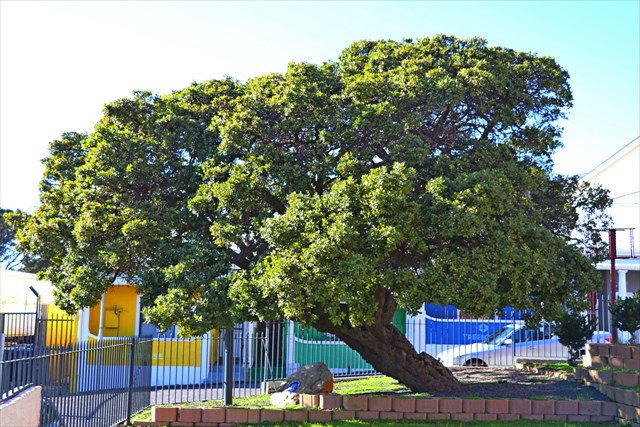
The Treaty Tree
The Full Story
For those geocachers who appreciate the educational aspects of the hobby greater detail on the historical significance of the site of the Treaty Tree follows.
The tree stands on what used to be Cape Town’s beachfront. Until the land reclamation of the Cape Town Foreshore in 1952 the Treaty Tree was close to the old Woodstock beach, with an uninterrupted view of the sea and ships coming in and out of the bay. It’s an impressive white milkwood (melkhout in Afrikaans; umqwashu in Xhosa, scientifically termed a Sideroxylon inerme) found along the coast between the Cape and northern KwaZulu-Natal.
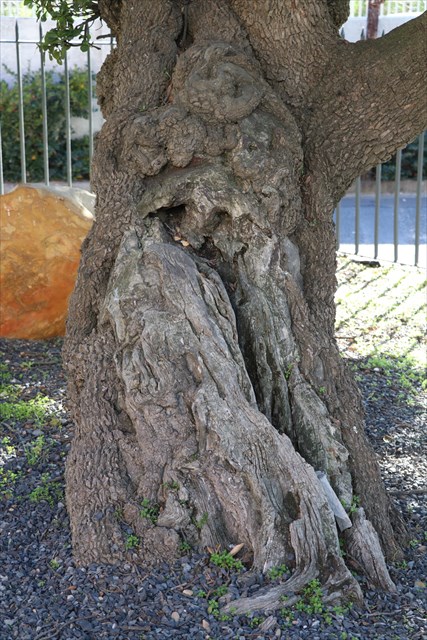
It’s not known exactly how old the milkwood tree is, but there is evidence that it was a landmark for Portuguese sailors in the days before the Dutch landed at the Cape in 1652, even being old enough to have ‘witnessed’ the 1510 Khoekhoe (Hottentot) killing of 64 of the Portuguese explorer Captain d’Almeida’s soldiers, who had made off with their cattle and had also abducted a Khoisan baby.
In later centuries there are accounts of slaves being sold under its shade and of recalcitrant slaves being executed by hanging from its branches. The tree has definitely seen a lot of Cape history pass by, from the end of slavery in the 1830s to the reclaiming of large parts of Table Bay a century later.
In January 1806 a British force of 63 ships including nine warships and about 6000 men arrived at Melkbosstrand to take possession of the Cape. The British naval commander was Commodore Popham, and the Army was commanded by Major General Sir David Baird. During the British landing at Melkbosstrand on 6th January 35 of the 93rd Highlanders were drowned. The remainder landed on the 7th, and deployment of British troops on land began early on the 8th. The British had no horses or transport so the eight heavy artillery pieces were pulled by 500 sailors from the warships.
During the Battle of Blaauberg, on the south-eastern slopes of Blaauberg hill, the British forces were opposed by General Janssens, the Batavian Governor and Commander who led a local force, composed of Batavian troops, burgher militia, some French soldiers and an artillery contingent made up of Javanese and Malays and The Hottentot Light Infantry. (Not a force to fight a trained and well led invading enemy.) Janssens did all he could but the British were a larger force, and he eventually withdrew. It was not a bloodless battle though. Fifteen British soldiers were killed, and a further 17 died of their wounds, with many others wounded. The British marched to Cape Town on the 9th of January and Colonel Von Prophalow surrendered shortly afterwards, under the "Treaty tree" in Woodstock. (See the text of a letter from the Cape Archivist to the Town Clerk of Woodstock below.)
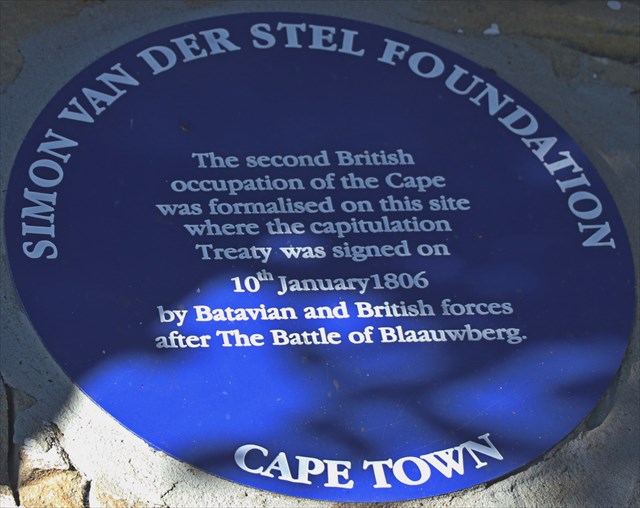
Janssens was an astute Governor who ensured that the British accepted, as part of the surrender, many of the reforms that the Batavian Government had introduced to the Cape: notably, Individual and religious rights. The battle of Blaauwberg and the subsequent surrender under the Treaty Tree changed the course of South African History -- the Union Jack flew over the Cape for over a century.
On 13 August 1814 all Dutch possessions at the Cape were formally ceded to Britain by a convention under which Dutch vessels were entitled to call at the Cape of Good Hope for the purposes of refreshment and repairs. Britain also agreed to pay five million pounds sterling to the United Netherlands for their Dutch possession at the Cape, thus establishing the British administered Cape Colony.
As it had become forgotten, derelict, and abandoned the Cape Town City Council took possession of the plot of land on which the ancient tree stands in 1966. It was proclaimed a National Monument in 1967 (see the text of the formal declaration below). The bent and gnarled milkwood is now fenced off to protect it from vandalism.
Treaty House, which stood alongside the Treaty Tree, survived well into the 20th century but was eventually demolished in 1935.

Signing The Treaty Under the Tree
(From a painting in the Castle of Good Hope Museum)
Text of Letter from Cape Archivist to the Town Clerk of Woodstock
(in response to an enquiry whether the treaty had been signed
under the milkwood tree or in the adjacent house.)
E. S. SMITH, Esqre.
Town clerk
Woodstock.
24th October, 1904.
Dear Sir,
In reply to yours of the 21st instant, I may inform you that there were virtually three Capitulations, viz.:-. •
A preliminary one signed in the Castle on the 9th January, 1806, by Lieutenant-Colonel Hieronymus Casimir von Prophalow, Commandant of the Town, Castle, and circumjacent fortifications, and Brigadier-General Ferguson, in His Britannic Majesty's Army, in tile name of Major-General Sir David Baird, Commander-in-Chief of the said Army.
This was, however, superseded by another, signed by H. C. von Prophalow, Commandant of the Castle, etc., Major-General Sir D. Baird, and Commodore Sir Henry Popham on the 10th day of January, 1806, at Papendorp, near Fort Knokke, which delivered up the Town, Castle, and circumjacent Fortifications of the Cape of Good Hope to Great Britain.
The third Capitulation was signed on the 18th January, 1806, by Lieutenant-General J. W. Janssens, Governor and Commander-in-Chief of the Batavian Forces at the Cape of Good Hope, and Brigadier General Beresford, duly authorised by Major-General Sir David Baird, and Commodore Sir Henry Popham, commanding the Military and Naval Forces of His Britannic Majesty, by which General Janssens surrendered himself and his troops to Great Britain. It was signed in Hottentots Holland, and confirmed in the Castle by the signatures of Sir D. Baird and Sir H. Popham, on the following day, the 19th Jan., 1806.
I cannot tell you, as I have not the data, and cannot go beyond the record, whether the house you mention is the place where the second capitulation was signed, or whether the signing took place under the trees still existing near the building, but there appears no valid reason to doubt the accuracy of the tradition, as the event occurred so very near our own time, and has never been questioned, as far as I am aware. (Emphasis added)
Yours faithfully.
H. C. V. Leibbrandt, Keeper of the Archives.
Text of the Formal Proclamation of the Treaty Tree as a National Monument
PROCLAMATION OF A MONUMENT: No. 747. 26 May 1967.
By virtue of the powers vested in me by section 8 (1) (a) of the Natural and Historical Monuments, Relics and Antiques Act, 1934 (Act No.4 of 1934), I hereby proclaim certain piece of land, being Erf No. 10736, Cape Town, to be a monument.
DESCRIPTION.
Capitulation of the Cape, 10th January, 1806:
Certain piece of land, situate in the City of Cape Town, Cape Division, being Erf No. 10736, Cape Town, at Woodstock. Measuring 4.608 square feet. Deed of Transfer No. 20177/1966, dated 28th September, 1966, paragraph 15; Diagram No. 260/1853 filed with Deed of Transfer No. 173/1855, dated 12th April, 1853.
HISTORICAL INTEREST.
In a building which stood adjacent to this land the capitulation conditions were signed on 10th January, 1806, whereby the property of the Batavian Government at the Cape was transferred to the commanders of the British forces, Maj-Genl. Sir David Baird and Commodore Sir Home Popham.
J. DE KLERK,
Minister of Education, Arts and Science
Sources
http://www.ilovewoodstock.co.za/2011/11/the-woodstock-treaty-house-and-tree/
http://samilitaryhistory.org/6/c06janne.html
http://www.getaway.co.za/travel-stories/treaty-tree-national-historic-monument-backyard/
https://www.sa-venues.com/attractionswc/woodstock-treaty-tree.php
http://treeco-treeco.blogspot.co.za/2012/01/treaty-tree.html