Swede Tunnel Speleothems EarthCache
-
Difficulty:
-

-
Terrain:
-

Size:  (other)
Please note Use of geocaching.com services is subject to the terms and conditions
in our disclaimer.
For this earthcache, you will need the following equipment: a 50 lumen or brighter flashlight and a camera capable of taking low light photography.
Coordinates will take you to the entrance of the Swede Tunnel.
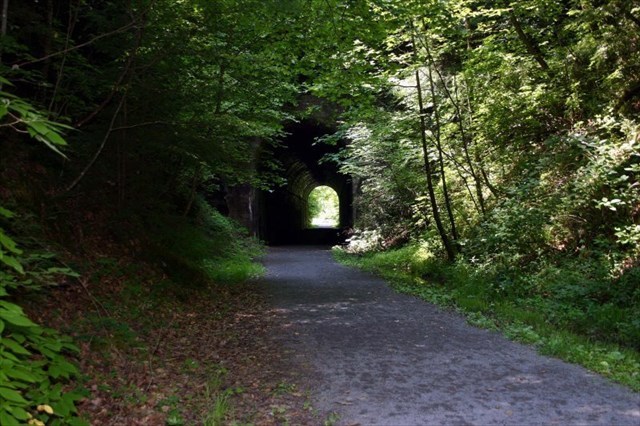 Swede Tunnel was built in 1922 as the Interstate Railroad ran a line up from Miller Yard through Guest River Gorge to Coeburn and points beyond. It went out of service in the ’60s and all the trackage has been removed.
The line was abandoned and fell into disrepair in the latter half of the 20th century before a group of dedicated citizens worked with the USDA Forest Service to develop a trail along the railroad’s former route. Today, the trail and a sizable parking area exist within the Gorge, and the Guest River has been designated a Virginia Scenic River for its incredible natural beauty.
The overlying bedrock was once an ancient sea floor. Millions of years of sediments, shells, bones and minerals created limestone. Limestone is high in a mineral called calcium carbonate. Water seeped from above and started to dissolve rock above and deposit in the cracks below.
The tunnel you will soon be traveling is a man-made cave: a hollow spot below the surface of the earth. Water enters the surface above this location, it slowly dissolves the minerals. The mineral rich water moves through the cracks to this cavern. As water finds cracks, it drips to the floor below, leaving some of the minerals behind. This process happens over and over as long as there is a supply of water and minerals. The main mineral in this type of process is calcium carbonate, remember where that came from.
The minerals left behind start to form a sedimentary rock called speleothems. The faster a speleothem is created, the more fragile, the slower, the more stable.
Stalactites are speleothems that grow from the ceiling. Cone stalactites are slower growing, cone shaped. Soda straws are fragile, tubular stalactites usually about the diameter of water drops and fast growing. Pearls are round, pebble like. Curtains look like waving fabric along the ceiling.
Stalagmites are speleothems that grow along the floor. They can look like mushrooms, buttons, donuts, dinner plates, cones or just cover the floor in layers.
Flows are speleothems that from along the wall. Flows look like frozen water falls. Flowers look like delicate moss or plants.
Columns are formed when a stalactite and stalagmite connect in a cavern.
Please email me the answers to the following questions :
1. Locate speleothems in this tunnel. From your observations, what type of speleothems do you find?
2. What kind of obvious speleothem is missing? Why do you suppose this main category is missing?
3. What colors do you observe of the speleothems? Form a hypothesis: what is causing these colors? What supports your hypothesis?
4. Find the longest speleothem from the ceiling you can find. Make an estimate of its length.
You are welcome to post photos of your visit to the site, but this is optional and not part of the logging requirements.
FTF HONORS GO TO
KickenChicken
| I have earned GSA's highest level: |
 |
Permission for this EarthCache placement has been approved by Ranger George Herschel, of the Clinch Ranger District.
Additional Hints
(No hints available.)
Treasures
You'll collect a digital Treasure from one of these collections when you find and log this geocache:

Loading Treasures