In the early days of underwater exploration, divers realized that their time underwater was limited by the amount of Nitrogen their tissues absorbed. With large nitrogen loads, the divers would have to spend hours making their way back to the surface slowly to keep the nitrogen from bubbling out of their tissues and bloodstream too quickly. Their slow ascent with decompression stops was designed to prevent decompression sickness, also known as "the bends."
These early explorers also noticed a narcotic effect -- a dulling of the senses -- while diving below about 20 m (66 ft). This narcotic effect was also due to nitrogen and came to be called Nitrogen Narcosis. The relation of depth to narcosis is sometimes informally known as "Martini's law", the idea that narcosis results in the feeling of one martini for every 10 m (33 ft) below 20 m (66 ft) depth.
In the early 1960s, as NASA was launching its attempts to send man to the Moon, the Office of Naval Research was launching an effort to show that man could live and work at the bottom of the ocean. In a parallel to the “Space Race,” ONR led biomedical studies in what would become known as the Sealab undersea habitat. In July 1964, Sealab I was lowered into the water at the U.S. Naval Station (Argus Island) Bermuda in July 1964. It housed four researchers for 11 days at depths far exceeding those to which recreational scuba divers can reach today.
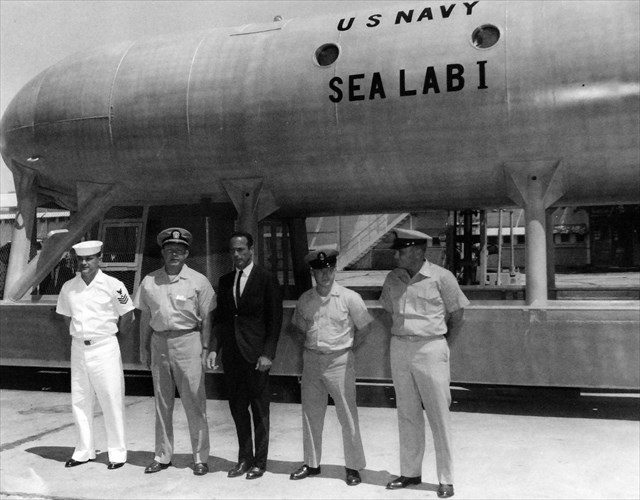
Gunner's Mate First Class Lester E. Anderson, USN; Lieutenant Robert E. Thompson, MC, USN; Astronaut M. Scott Carpenter, Chief Hospital Corpsman Sanders W. Manning, USN; Chief Quartermaster Robert A. Barth, USN.
Below is an excerpt from the Office of Naval Research website
The principal investigator was Navy Capt. George Bond, the “Father of Saturation Diving.” His experiments explored the extreme physiological and psychological exposures of undersea habitation. Among their many pioneering efforts, the team investigated the effects of nitrogen narcosis on cognition, tested diver warming with the new “Neoprene” foam wet suit and developed a method to compensate for the high-pitched “chipmunk” speech experienced when breathing helium.
Sealab was primarily a habitability study, but the experiments also enabled covert missions that played a key role in the undersea Cold War of the 1970s. ONR’s Sealab expeditions vastly advanced the operational capabilities of saturation diving and submarine rescue.
Another major Sealab challenge was developing safe decompression procedures for saturation diving. These experiments aided in the creation of the decompression tables used today.
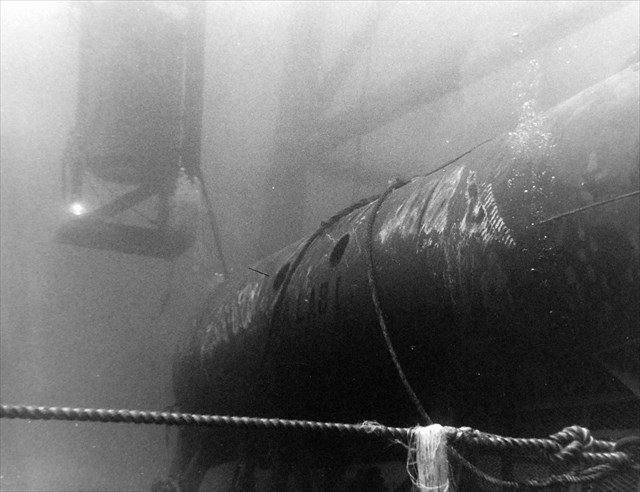 Sealab at a depth of 192 feet
In order to claim the find on this Virtual Cache, you will need to visit Sealab I in its current home at the Museum of Man in the Sea in Panama City Beach, FL. While there, you will gather some information and snap a photo to post with your log.
1. Post a photo of you and/or your team of elite cachers at Sealab I. Your face does not have to be identifiable in the photo.
2. Send me a message or e-mail telling me the number of steps(stairs) leading up to Sealab's "back porch".
I hope you enjoyed your visit to Sealab and took the time to look around at the other exhibits. As a scuba diver, I find this stuff fascinating.
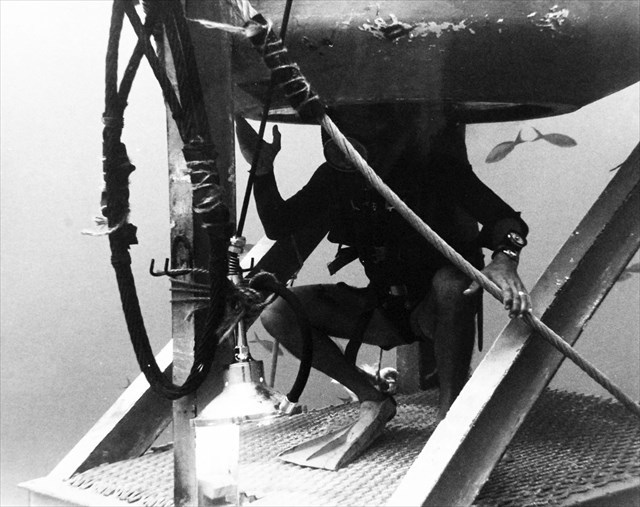 Sealab diver exiting the habitat for a dive
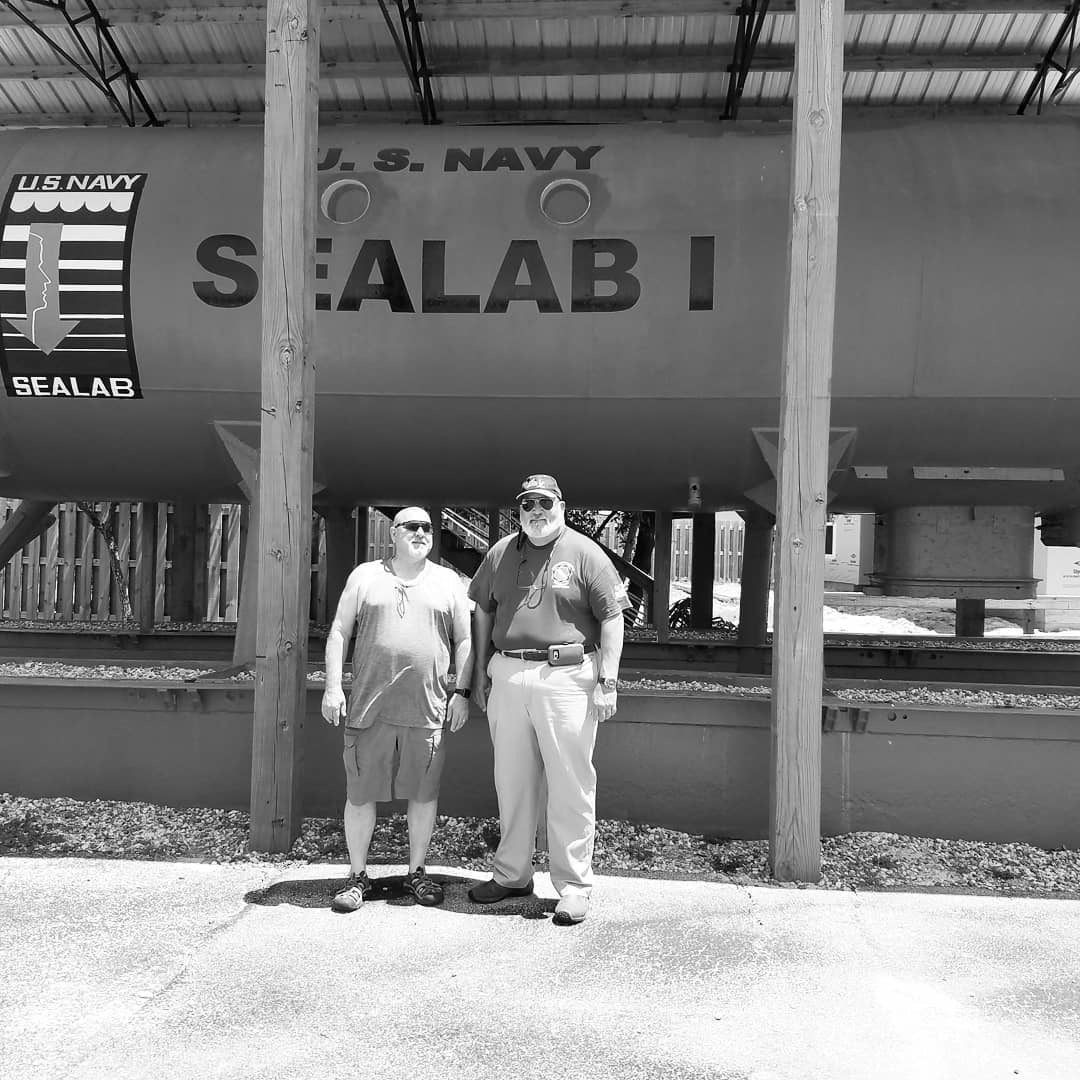 David and Chief at Sealab after we took students diving in the gulf in May 2018.
Virtual Reward - 2017/2018
This Virtual Cache is part of a limited release of Virtuals created between August 24, 2017 and August 24, 2018. Only 4,000 cache owners were given the opportunity to hide a Virtual Cache. Learn more about Virtual Rewards on the Geocaching Blog.