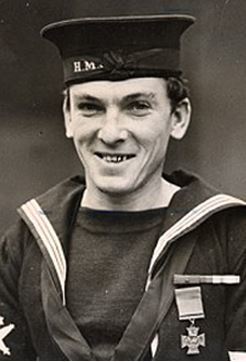
James Joseph Magennis VC (spelling originally McGinnes) (27 October 1919 – 12 February 1986) was a Belfast-born recipient of the Victoria Cross, the highest and most prestigious award for gallantry in the face of the enemy that can be awarded to British and Commonwealth forces. He was the only native of Northern Ireland to receive the Victoria Cross for Second World War service. Magennis was part of several operations involving X-Craft midget submarines in attacks on Axis ships. In July 1945 Acting Leading Seaman Magennis was serving as the diver on the midget submarine HMS XE3 under the command of Lieutenant Ian Fraser. They were tasked with sinking the 10,000-ton Japanese cruiser Takao, the first of the Takao Class. She was berthed in the Straits of Johor, Singapore acting as an Anti-aircraft battery. The codename for the operation was Operation Struggle. His commanding officer Lieutenant Ian Fraser was also awarded the Victoria Cross for his actions on 31 July 1945 during the operation
On 30 July 1945 the XE3 was towed to the area by the submarine Stygian. She slipped her tow at 23:00 for the forty-mile journey through hazardous wrecks, minefields and listening posts to reach the Takao. After arriving at the Takao at 13:00 on 31 July 1945. Magennis slipped out of the wet-and-dry chamber and he attached limpet mines to the Japanese cruiser Takao under particularly difficult circumstances. He had to chip away at barnacles and seaweed on the bottom of the cruiser for 30 minutes before being able to attach six limpet mines to Takao's hull using an improvised piece of rope (the hull was covered with a thick layer of seaweed, and the magnets of the limpet mines would not hold them on the hull). During this time his breathing apparatus was leaking and he returned to the submarine after completion of his task very exhausted.
On withdrawing, Lieutenant Ian Fraser found that one of the limpet carriers which was being jettisoned would not release itself. Magennis immediately volunteered to free it commenting: “I’ll be all right as soon as I’ve got my wind, Sir”. This he did, after seven minutes of nerve-racking work with a heavy spanner. On completion Magennis returned to XE3 for the second time, allowing the four-man midget submarine to make its escape out to open sea to meet the waiting Stygian.
When the mines on Takao exploded, they blew a hole in it 20 by 10 metres (66 by 33 ft). Several compartments below the lower deck were flooded, including two ammunition magazines, the main gun plotting room and the lower communications room further disabling the ship but not sinking it. It was discovered after the end of the war that Takao was manned by a skeleton crew and had no ammunition aboard for her 8-inch main armament. Japanese forces surrendered Seletar Naval Base to the British on 21 September 1945. On 27 October 1946, Takao was towed to the Strait of Malacca and was sunk as a target ship by the light cruiser HMS Newfoundland on 29 October 1946
The citation was published in a supplement to the London Gazette of 9 November 1945 (dated 13 November 1945) and read:
ADMIRALTY
Whitehall, 13th November, 1945.
The KING has been graciously pleased to approve the award of the VICTORIA CROSS for valour to: —
[...]
Temporary Acting Leading Seaman James Joseph MAGENNIS, D/JX. 144907.
Leading Seaman Magennis served as Diver in His Majesty's Midget Submarine XE-3 for her attack on 31 July 1945, on a Japanese cruiser of the Atago class. The diver's hatch could not be fully opened because XE-3 was tightly jammed under the target, and Magennis had to squeeze himself through the narrow space available.
He experienced great difficulty in placing his limpets on the bottom of the cruiser owing both to the foul state of the bottom and to the pronounced slope upon which the limpets would not hold. Before a limpet could be placed therefore Magennis had thoroughly to scrape the area clear of barnacles, and in order to secure the limpets he had to tie them in pairs by a line passing under the cruiser keel. This was very tiring work for a diver, and he was moreover handicapped by a steady leakage of oxygen which was ascending in bubbles to the surface. A lesser man would have been content to place a few limpets and then to return to the craft. Magennis, however, persisted until he had placed his full outfit before returning to the craft in an exhausted condition. Shortly after withdrawing Lieutenant Fraser endeavoured to jettison his limpet carriers, but one of these would not release itself and fall clear of the craft. Despite his exhaustion, his oxygen leak and the fact that there was every probability of -his being sighted, Magennis at once volunteered to leave the craft and free the carrier rather than allow a less experienced diver to undertake the job. After seven minutes of nerve-racking work he succeeded in releasing the carrier. Magennis displayed very great courage and devotion to duty and complete disregard for his own safety.
Magennis was the only Victoria Cross winner of the Second World War to hail from Northern Ireland. As a result, Magennis obtained something of a “celebrity status” in his home city. The citizens of Belfast raised more than £3,000 as part of a “Shilling Fund.” The City Fathers of Belfast refused to give Magennis the freedom of the City though. Sources differ as to the reasoning behind this; some claim it was due to religious divisions, others claim it was due to the City Fathers not “…believing that such an honour could not be bestowed on a working-class Catholic from the inner-city slums.” In 1946 Magennis married Edna Skidmore, with whom he had four sons. The money from the Shilling Fund was spent quickly by Magennis and his wife; she remarked: “We are simple people… forced into the limelight. We lived beyond our means because it seemed the right thing to do.” In 1949 he left the Navy and returned to Belfast, where, at some point, he sold his Victoria Cross. In 1955 he moved to Yorkshire, where he worked as an electrician. For the last years of his life, he suffered from chronic ill health, before dying on 11 February 1986 of lung cancer hours before his heroism was honoured by the Royal Navy Philatelic Office with a first-day cover.
When Magennis first won the VC, he was treated rather shabbily by the Unionist-dominated Belfast City Council because he was from a working class Roman Catholic family. Although the public collected £3,600 in appreciation of his heroism, the council refused to give him the freedom of the city. The only official recognition was a small photograph tucked away in the robing room of the council chamber. The first memorial was only erected in 1999 after a long campaign by his biographer George Fleming and Major S.H. Pollock CD (Canada).
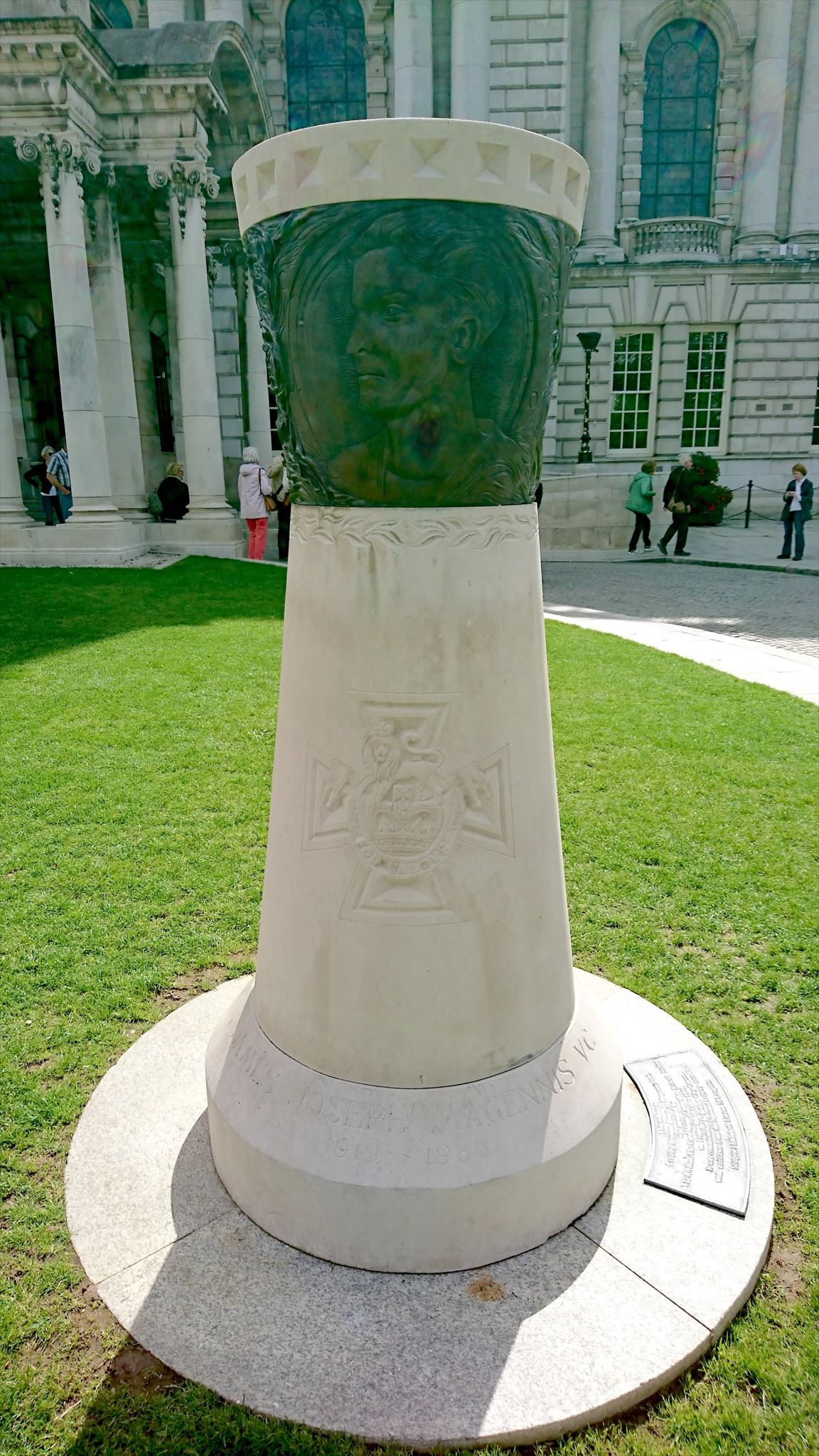
The memorial, a bronze and Portland stone pillar, was officially unveiled in Belfast on 8 October 1999. The ceremony was conducted in the grounds of Belfast City Hall in the presence of Magennis’s son Paul, by the Lord Mayor of Belfast, Bob Stoker. Magennis’s former commanding officer, Ian Fraser, was reported as saying: “Jim gave me bother from time to time. He liked his tot of rum, but he was a lovely man and a fine diver. I have never met a braver man. It was a privilege to know him and it’s wonderful to see Belfast honour him at last.”
In 1986, there was some publicity in the newspapers that his VC would be up at auction. This attracted the interest of Michael Ashcroft, Baron Ashcroft who bought the VC for £29,000 (plus fees) amidst strong competition from dealers and private collectors. This was the first Victoria Cross bought by Baron Ashcroft, who, as of date, owned 162 medals. His collection is by far the largest in the world spanning 128 years from acts of valour at the start of the Crimean War in 1854 to an act of courage during the Falklands War in 1982. In July 2008, Ashcroft announced a donation of £5 million for a permanent gallery at the Imperial War Museum, where the 50 Victoria Crosses held by the museum are now on display alongside his own collection of 162 VCs

If you are standing at the posted co-ordinates you will find the memorial pillar in front of you. In order to log this Virtual Cache please carry out the following tasks -
- Please post a photograph of yourself (or your GPS/Smartphone beside the pillar) with your found log.
- Tell me in a message or email the name of the sculptor who created this memorial.
You can log the cache once you have completed the requirements and sent me the answers to the questions. Do not reveal any of the answers in your online logs!
Logs that do not have an image attached and/or where I have not received the answers in a reasonable time after the online log will be deleted.
Thanks for taking the time to find this cache!
The grounds of Belfast City Hall are open :-
1st May – 30th September : 7am - 9pm; 1st October – 30th April : 7am - 7pm.
Do not attempt to find this cache outside of these hours.
Information source - Wikipedia
This Virtual Cache is part of a limited release of Virtuals created between August 24, 2017 and August 24, 2018. Only 4,000 cache owners were given the opportunity to hide a Virtual Cache. Learn more about Virtual Rewards on the Geocaching Blog.