This cache combines a natural feature with local folklore, and takes you to the footprint of Hang Tuah.
Type of Earthcache: Denudation (Erosion) / Geomythology.
The myth surrounding the footprint
The story of Hang Tuah has fascinated and triggered the imagination of generations of Malaysians. This 15th century celebrity has not only left his mark on the pages of Malaysian history, but his more avid fans believe that he also left more permanent impressions such as footprints on Malaysian rocks.
Here at Tanjung Tuan, Hang Tuah was supposed to have left such a footprint. The site has become a place of worship for believers, however misplaced, as this EarthCache will attempt to show.
The prosperity of the site fluctuates. It can be quite deserted with troops of monkeys scampering over the outcrop where the footprint is located and playfully waiting for the company of tourists. The site also has permanent shelters.
It is uncertain what sort of favours the devotees solicit. As Hang Tuah, a Laksamana in 15th century Melaka, had a reputation for bravery and skills in combat, it is possible that the devotees believe the spirit of Hang Tuah could be prevailed upon to remove evil influences, if any, in the way of whatever is desirable. Also, according to the Sejarah Melayu (Malay Annals), Hang Tuah was a sort of 15th century sex icon who made such a favourable impression in Majapahit (Java) that 'wives and maidens alike were all a-flutter at the sight of the Laksamana' and 'such was the passion of the women of Majapahit for the Laksamana' that they were advised to take sireh 'to allay the pangs of whole day's love'1.
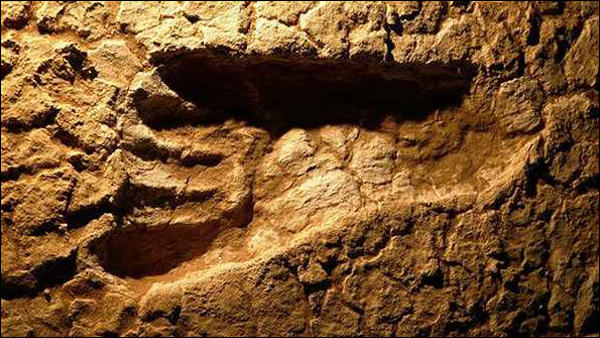
Image 1: Fossil footprint of an human, between 19,000 and 23,000 years old.
(Source: Lake Mungo NPWS Interpretation Centre, 2005)
The geological approach
Geologists are familiar with the preservation as moulds or casts of fossil footprints and tracks left in soft sediments, which have subsequently lithified. Fossil human footprints are also known in the literature, Image 1 shows an example of a 19,000 to 23,000 years old footprint of a barefooted early human laid down in wet clay containing calcium carbonate, which hardens like concrete, in Mungo National Park, Australia2. However, the so-called Hang Tuah footprint is not so convincing.
It is a hole in a hard quartz vein outcrop slightly less than 2 metres thick (Image 2). The shape of the hole is not really evident unless it is filled with water. Tourist guides and devotees routinely obtain water from the nearby well (aptly named Hang Tuah's Well) and pour it into the hole for this purpose. The outline of the hole resembles that of a human wearing some kind of footwear owing to the absence of toes. The footprint is estimated to be size 10-12 (UK/US) / 43-45 (EU) befitting someone the stature of the legendary Hang Tuah perhaps.
Unlike the soft sediment treaded upon by the early Australian whose footprint appears in Image 1, any footprint to be so impressed on the hard quartz vein would require the quartz to be pulverized underfoot up to a depth of about 10 cm. This is not possible unless in the realm of kung-fu fantasy!
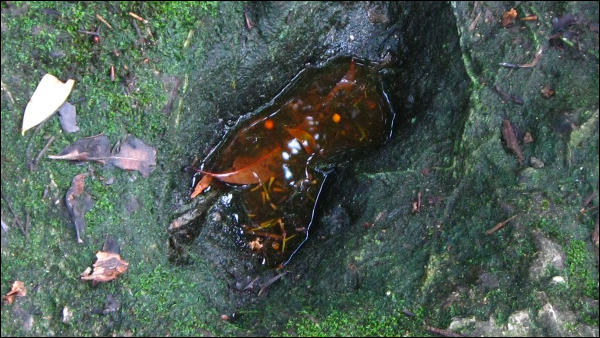
Image 2: The so-called Hang Tuah's footprint in a quartz vein at Tanjung Tuan.
(Source: Barnyard Dawg, July 2017)
Solution Cavity
The hole in the quartz vein is a solution cavity. Twidale3 has given a very detailed account of the development of solution cavities in hard rocks like granites, which are generally considered to be almost insoluble. The rocks are soluble albeit more slowly than the more familiar limestone.
Solution cavities come in all shapes and sizes and they can develop anywhere in or on a rock where water persistently accumulates. Given that solution cavities can be of every possible shape it will not be difficult to find other occurrences of the so-called footprints.
Highlighting a few examples of well-known solution cavities across Malaysia will help to further explain the difference between a cavity formed by solution and one by abrasion;
Potholes like those developed in syenite-monzonite in Jeram Besu, Benta, Pahang are solution cavities and deeper potholes which are cylindrical are called chimneys like those developed in granite at Telaga Tujuh waterfall, Langkawi. The upper waterfall behind the Merbok Museum, Kedah has a solution cavity in granite which has the shape and depth of a modern bath tub with fresh water flowing in at one end and out at the other. Thus, abrasion by sediments has little to even no role in the deepening of the solution cavities as is evident from the development of the rock chimneys. At Telaga Tujuh, one of the chimneys filled to the brim with water has a diameter of about 2 metres and a depth of more than 5 metres. Water at a depth of 2 metres or more in the vertical chimney is dead still and sediments at the bottom rest in peace. Any deepening is clearly by solution and not abrasion.
Coincidentally, additional examples of abrasion cavities can be found at nearby EarthCaches.
Rock dissolves under the action of rainwater or groundwater charged with H2CO3 (carbonic acid) and naturally occurring organic acids. When bedrock is dissolved by natural acid in rain- or groundwater that seeps through bedding-planes, faults, joints and so on, these openings expand as the walls are dissolved to become caves or cave systems.
Large solution cavities such as caves take many geological epochs to form, and as the solution cavity grows larger, the ceiling of the cavity begins to collapse due to the lack of support. This cycle continues for a while – the cavity grows through dissolution, the ceiling collapses under its own weight – until finally, the ceiling reaches the ground surface and collapses. If the cavity is large enough, the entire overburden falls into the cavity and you are left with a large sinkhole or doline. Should the structure be above ground, the result might be or a cave with with avens (skylights) or roofless caverns such as found at the Batu Caves site near Kuala Lumpur.
So what's next?
The recognition of the footprint to be a solution cavity adds to the list of geological features worshiped by some people in Malaysia. Exfoliated slabs of granite and weathering remains of granitic rocks, inselbergs and menhirs, in parts of Negeri Sembilan and Malacca, were and still are objects of worship and reverence. Peculiarly shaped dripstone deposits bearing some resemblance to the elephantine Ganesha and boulders of somewhat phallic appearance and thereby resembling the linga have also been worshiped as evidenced by offerings left at these features.
Solution cavities like the so-called Hang Tuah's footprint will predictably become bigger and deeper with time especially if tourist guides continue to religiously keep the hole filled to the brim with water. This predictable development will likely seed the further myth that the footprint is 'alive' and therefore ought to be even more potent in answering the wishes of the devotees. A myth like this especially if propagated with some success stories will quickly spread far and wide.
Usually and incredibly, a myth like this will have a long currency not withstanding this write-up.
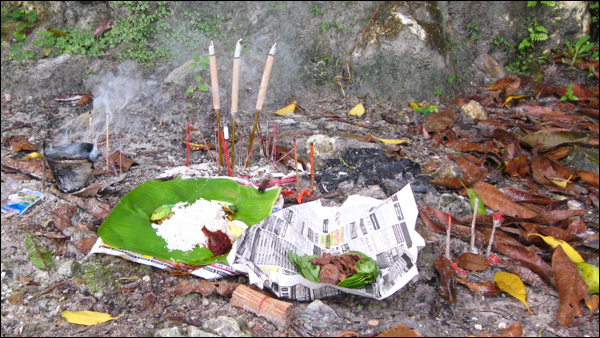
Image 3: Offerings at Hang Tuah's footprint.
(Source: Barnyard Dawg, July 2017)
How to claim this EarthCache?
Send me the following;
1. The text "GC7C74W Footprint of Hang Tuah" on the first line.
2. The answers to the following questions;
- Is this cavity a solution or abrasion cavity?
- What is the main reason for such a cavity in this rock?
- Aside from rainwater, other types of water could be used to refill this cavity and make the outline of the footprint appear. There are two naturally available sources of water on site, name both.
- Can you spot other cavities in this rock?
- Estimate the length, width and depth of the cavity.
3. Provide a photo of yourself or a personal item to prove you have visited the site.*
References
1 Brown, C.C., 1970. Sejarah Melayu or Malay Annals. Oxford Univ. Press, Kuala Lumpur (an annotated translation). 2 Lake Mungo NPWS Interpretation Centre, Australia, 2005. 3 Twidale, C.R., 1982. Granite landforms. Elsevier Scientific Publ. Amsterdam. 4 Geolocical Society of Malaysia, Volume 23, No. 3. Manuscript received 7 March 2002.
* Effective immediately from 10 June 2019, photo requirements are permitted on EarthCaches. This task is not optional, it is an addition to existing logging tasks! Logs that do not meet all requirements posed will no longer be accepted.
For additional information, visit; Geosociety.org, Geocaching.com Help Center and Geocaching.com Forum.
Finding the answers to an EarthCache can often be challenging, and many people tend to shy away from these caches because of this. However, it is my opinion that geocaching is also meant to be a fun family experience that simply aims to introduce interesting and unique locations such as this one. Flexibility on logging requirements, however, can only be applied if it can be established that you have actually taken the time to visit the site. For this reason, a proper log describing your adventure accompanied by a good number of photos would be much appreciated.

Join us at Geocaching Malaysia