

ESPAÑOL
El caché
Este caché está ambientado en la expedición científica que a finales del siglo XVIII midió la longitud de arco de meridiano entre las ciudades de Dunkerque y Barcelona con el único objeto de establecer un sistema único y universal de pesos y medidas: el Sistema Métrico Decimal.
Para obtener las coordenadas finales deberás leer detenidamente el artículo y además realizar una serie de sencillas operaciones sobre el servicio de mapas Goolzoom.
El caché está ubicado en una tranquila zona del centro de Zaragoza aunque muy frecuentada por geomugles, por lo que deberás extremar tu cuidado al cogerlo y dejarlo.
El caché es magnético.
La recepción de la señal GPS normalmente es mala, por lo que una vez en la zona cero deberás guiarte por la pista y ... por tu intución.
La medida de todas las cosas
Hoy en día se utiliza el sistema métrico decimal prácticamente en todo el mundo, facilitando con ello la comunicación científica y el comercio; pero no siempre ha sido así.
Las medidas que se empleaban en el siglo XVIII no sólo eran diferentes de una nación a otra, sino también incluso dentro de una misma nación. Incluso medidas que recibían el mismo nombre eran diferentes de una ciudad o provincia a otra. Esta variedad dificultaba el comercio y la administración del Estado. Los sabios incluso tenían problemas para comparar sus resultados con los de otros colegas. Por poner un ejemplo, sólamente en Francia existían unas doscientas cincuenta mil unidades diferentes de pesos y medidas.
Fue la Revolución Francesa la que proporcionó la oportunidad de desembarazarse de los grilletes de la costumbre y edificar un nuevo mundo basado en la razón. Uno de los muchos cambios que proporcionó fue precisamente el establecimiento de un sistema de medidas universal.
Para garantizar que este nuevo sistema no se considerase obra de una persona o una nación, decideron extraer la unidad fundamental, el metro, mediante la medición del propio globo terrestre. Una medida natural, salida de la propia Tierra.
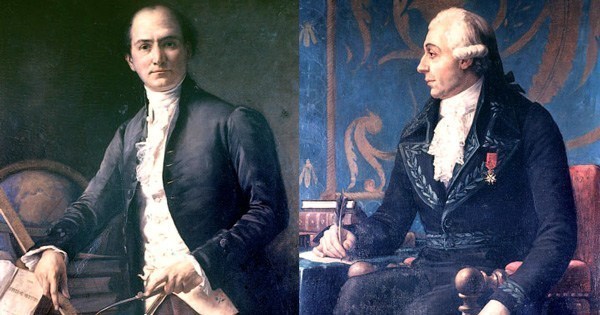
Pierre Mechain y Jean-Baptiste Delambre
Durante casi siete años, entre y 1792 y 1798, una expedición comandada por los astrónomos de la Academia de Ciencias, Pierre Mechain y Jean-Baptiste Delambre, midió el arco de meridiano entre las ciudades de Dunkerque y Barcelona con el único objeto de definir el metro: la diezmillonésima parte de la distancia que media entre el Polo Norte y el Ecuador.
Curiosamente no fue Francia el primer país en adoptar el sistema métrico decimal, sino que fue adoptado inicialmente por Holanda, Bélgica y Luxemburgo. Actualmente es mundialmente aceptado, aunque paradójicamente, una de las pocas excepciones la constituye la nación que está a la cabeza de la economía mundial: Estados Unidos. Thomas Jefferson no consiguió convencer al Congreso de los Estados Unidos para que convirtiese su país en la segunda nación en adoptar el sistema métrico y todos los reformadores que lo han intentado desde entonces también han fracasado.
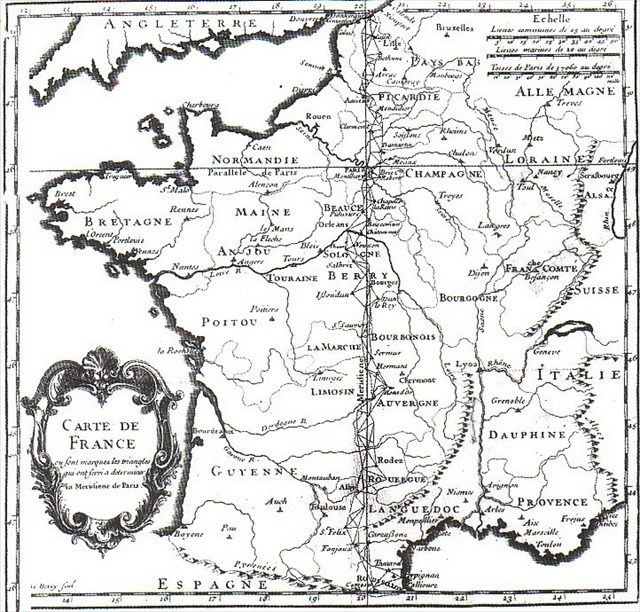
Meridiano entre Dunkerque y Barcelona
Algunas curiosidades:
- Las almenas de la torre de Vigía del castillo de Montjuic aún conservan las marcas que el astrónomo Pierre Mechain dejó durante los trabajos para determinar el sistema métrico. (Ver artículo en La Vanguardia)
- La Sonda "Mars Climate" se estrelló en Marte porque la NASA no tradujo kilómetros a millas.(Ver artículo en El País)
Bibliografía recomendada:
- La Medida de todas las cosas (Ken Alder).- Novela histórica que narra las peripecias de los astrónomos Mechain y Delambre durante su expedición, en una época histórica convulsa, con la misión de medir la Tierra. Muy recomendable, te gustará.
- La Base du système metrico decimal (Jean-Baptiste Delambre): fue escrito por uno de los astrónomos participantes en la expedición con el objeto de exponer todos los hallazgos de la misma.
- El crimen del sistema métrico decimal (Miguel Izu): El ministro que impulsa la adopción del sistema métrico decimal en España, Bravo Murillo, y el diputado que lo defenderá en el Congreso de los Diputados, son tiroteados en plena calle. Un comisario de la policia debe de averiguar quién y el por qué del atentado.
Resolución del caché
El caché se encuentra en las siguientes coordenadas:
N 41º 38.ABC' W 0º 53.DEF'
Comencemos por la LONGITUD:
D
- Z = Año en que comenzó la expedición para la medida del meridiano entre Dunkerque y Barcelona.
Reduce a un dígito efectuando la suma (ejemplo: 1765 = 1 + 7 + 6 + 5 = 19 = 1 + 9 = 10 = 1 + 0 = 1)
- D = Z + 1.
E
- Y = Año en que se promulgó la ley que establecía un solo sistema de medidas y pesas, el sistema métrico decimal, en todos los dominios españoles.
Reduce a un dígito efectuando la suma (ejemplo: 1765 = 1 + 7 + 6 + 5 = 19 = 1 + 9 = 10 = 1 + 0 = 1)
- E = Y - 3.
F
- Un metro tiene 10 decímetros, un decímetro 10 centrímetros, un centímetro 10 milímetros … ¿Sabes por qué el sistema métrico … es decimal?
a) Porque no había computadoras cuando se creó el sistema métrico, si no sería binario. ( F = 7 )
b) Porque los logaritmos neperianos están directamente relacionados con los logaritmos decimales. ( F = 5 )
c) Por que los humanos tenemos 10 dedos en las manos, y por ese motivo la base de la numeración que utilizamos es decimal. ( F = 0 )
La LATITUD será un poco más complicada, pero sólo un poco más:
ABC
- El lugar utilizado en Barcelona por el astrónomo Pierre Mechain fue la torre de vigía del castillo de Montjuic, exactamentente en las coordenadas N 41° 21.813' E 002° 09.995'.
- Haciendo uso del servicio de mapas Google Maps (no es necesario registro) nos situaremos en el mismo meridiano que el punto anterior, pero en la latitud de París (no es casualidad que fuera elegido este meridiano, ya que pasa por París). Deberemos buscar el nombre de la isla (en francés), en medio del río Sena, que es atravesada por dicho meridiano.
- W = Nombre de la isla del punto anterior, redúcida a número de la siguiente manera:.
Sustituye las letras por números haciendo el uso del teclado de un teléfono móvil y efectúa el producto de todos los dígitos. Ejemplo: PIEDRA = 7 * 4 * 3 * 3 * 7 * 2 = 3528

Puedes validar la solución a tu puzzle con certitude.
Otros cachés de la serie
GEOHISTORIASTipoNºNombreUbicación #1El problema de la longitudParque Grande#2La medida de todas las cosasProximidades Plaza Aragón#3El error intencionadoProximidades Plaza Aragón#4Las dimensiones de la TierraProximidades Plaza Aragón
ENGLISH
The caché
This cache is set in the scientific expedition that at the end of the eighteenth century measured the meridian arc length between the cities of Dunkerque and Barcelona with the sole purpose of establishing a unique and universal system of weights and measures: the Metric Decimal System.
To get the final coordinates you should read the article carefully and also perform a series of simple operations on the Goolzoom map service.
The cache is located in a quiet area in the center of Zaragoza but very frequented by geomugles, so you must exercise extreme care when picking it up and leaving it.
The cache is magnetic.
The reception of the GPS signal is usually bad, so once in zone zero you must be guided by the clue and ... by your intuition.
The measure of all things
Today the decimal metric system is used practically all over the world, thus facilitating scientific communication and trade; but it has not always been so.
The measures used in the eighteenth century were not only different from one nation to another, but even within the same nation. Even measures that received the same name were different from one city or province to another. This variety hindered the commerce and the administration of the State. Sages even had trouble comparing their results with those of other colleagues. To give an example, only in France existed some two hundred and fifty thousand different units of weights and measures.
It was the French Revolution that provided the opportunity to get rid of the shackles of custom and to build a new world based on reason. One of the many changes it provided was precisely the establishment of a universal system of measures .
To ensure that this new system was not considered a work of a person or a nation, they decided to extract the fundamental unit, the meter, by measuring the earth's own globe. A natural measure, leaving the Earth itself.
Pierre Mechain and Jean-Baptiste Delambre
For almost seven years, between 1792 and 1798, an expedition led by the astronomers of the Academy of Sciences, Pierre Mechain and Jean-Baptiste Delambre, measured the meridian arc between the cities of Dunkerque and Barcelona for the sole purpose of defining the meter: the ten-millionth part of the distance between the North Pole and the Equator.
Interestingly, France was not the first country to adopt the metric system, but was initially adopted by the Netherlands, Belgium and Luxembourg. It is now universally accepted, although paradoxically, one of the few exceptions is the nation that is at the head of the world economy: the United States. Thomas Jefferson failed to convince the United States Congress to make his country the second nation to adopt the metric system, and all reformers who have tried since then have also failed.
Meridian between Dunkerque and Barcelona
Some curiosities:
- The battlements of the watch tower of the Montjuic castle still retain the marks that the astronomer Pierre Mechain left during the works to determine the metric system. (See article in La Vanguardia)
- The "Mars Climate" probe crashed on Mars because NASA did not translate kilometers into miles. (See article in El País)
Recommended bibliography
- Measure of all things (Ken Alder): Historical novel that narrates the adventures of the astronomers Mechain and Delambre during its expedition, in a historical time convulsed, with the mission to measure the Earth. Highly recommended, you will like it.
- La Base du système metrico decimal (Jean-Baptiste Delambre): was written by one of the astronomers participating in the expedition in order to expose all the findings of the expedition.
- The crime of the metric system (Miguel Izu): The minister who promotes the adoption of the decimal metric system in Spain, Bravo Murillo, and the deputy who will defend it in the Congress of Deputies, are shot in the street. A police commissioner must find out who and why the attack.
Cache Resolution
The cache is in the following coordinates:
N 41º 38.ABC' W 0º 53.DEF'
Let's start with the LONGITUDE:
D
- Z = Year in which the expedition began to measure the meridian between Dunkerque and Barcelona.
Reduce to one digit by adding (example: 1765 = 1 + 7 + 6 + 5 = 19 = 1 + 9 = 10 = 1 + 0 = 1)
- D = Z + 1.
E
- Y = Year in which the law was enacted that established a single system of measurements and weights, the metric system, in all Spanish domains.
Reduce to one digit by adding (example: 1765 = 1 + 7 + 6 + 5 = 19 = 1 + 9 = 10 = 1 + 0 = 1)
- E = Y - 3.
F
- A meter has 10 decimeters, a decimeter 10 centimeters, a centimeter 10 millimeters ... Do you know why the metric system ... is decimal?
a) Because there were no computers when the metric system was created, otherwise it would be binary. ( F = 7 )
b) Because the neperian logarithms are directly related to the decimal logarithms. ( F = 5 )
c) Because humans have 10 fingers in their hands, and for that reason the basis of numbering we use is decimal. ( F = 0 )
The LATITUDE will be a little more complicated, but only a little more:
ABC
- The place used in Barcelona by the astronomer Pierre Mechain was the watchtower of the Montjuic castle, exactly at the coordinates N 41° 21.813' E 002° 09.995'.
- Using the Google Maps service (registration is not necessary) we will be located on the same meridian as the previous point, but at the latitude of Paris (it is no coincidence that this meridian was chosen, since it passes through Paris). We will have to look for the name of the island (in French), in the middle of the Seine river, which is crossed by this meridian.
- W= Island name from the previous point, reduced to number as follows: Substitute letters for numbers using the keyboard of a mobile phone and make the product of all digits. Exaimple: PIEDRA = 7 * 4 * 3 * 3 * 7 * 2 = 3528
- ABC = W - 5574
You can validate the solution to your puzzle with certitude.
Other caches of the serie