There are three species of bears in North America. The most common is the American black bear (Ursus americanus). Unfortunately named, the black bear can be various shades of black, white and brown. This species is found in all provinces and territories in Canada except Prince Edward Island, and in 40 of the 50 United States. There are approximately 900,000 black bears throughout N.A. Although some subspecies, such as the Louisiana black bear, are protected as “threatened” under the U.S. Endangered Species Act, most are not.
The grizzly or brown bear (Ursus arctos), is found in British Columbia, Alberta, the Yukon and Northwest territories as well as in the states of Wyoming, Montana, Idaho and Washington. Coastal versions of this species are often called brown or Kodiak bears, while the smaller inland variety is often called the “grizzly” bear on account of its “grizzled” appearance. All are members of the same species, though some biologists suggest that the brown bears on Kodiak Island have been isolated long enough to be considered a separate subspecies (Ursus arctos middendorffi).
Due to the lack of human development in its remote Arctic habitat, the polar bear (Ursus maritimus) retains more of its original habitat than any other remaining large carnivore. Approximately 25,000 polar bears live in the northern regions of Canada, Alaska, Russia, Norway and Greenland. The global polar bear population, estimated to be 22,000-25,000 bears, is relatively stable. However, in 2006 the World Conservation Union (IUCN) upgraded the polar bear from a species of “least concern” to a “vulnerable” species.
text from “get Bear Smart society”
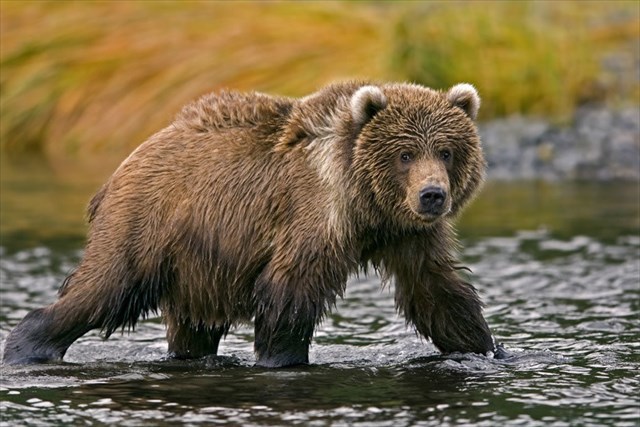
image from “kodiakbear.org”
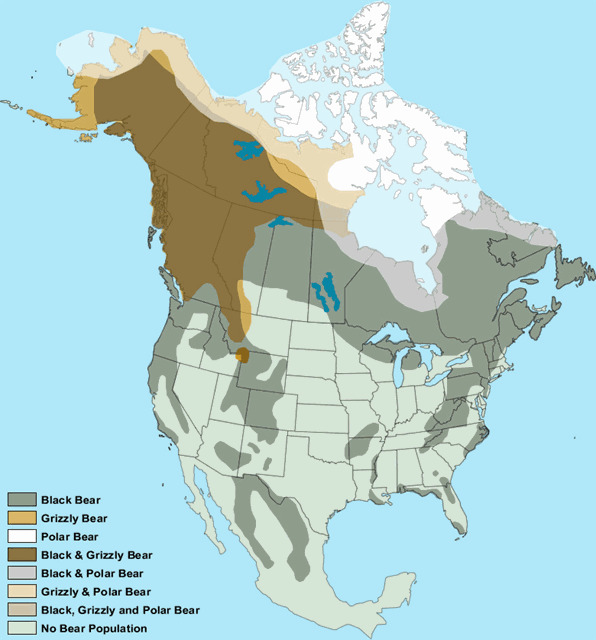
map from “Geology.com”