AYUNTAMIENTO DE ALICANTE
"PIEDRA JULIANA"

El edificio del Ayuntamiento de Alicante es un palacio barroco del s.XVIII .El período de construcción del edificio para el Ayuntamiento de la ciudad comprende desde 1.699, cuando V. Soler redacta el proyecto, hasta 1.780, fecha que se dan por finalizadas las obras (BEVIÀ y VARELA: 1.994, 63).

Se trata de un edificio singular con torres en los extremos y dividido en altura en tres plantas que rematan en una balaustrada. En la fachada principal, de 49m. de longitud, se subraya la horizontalidad por el balconaje del primer piso y la distribución de huecos y macizos.
La puerta principal está situada en la Plaza de Ayuntamiento y la puerta de atrás, en la Plaza de Santa Faz o llamada, antiguamente, de la Fruta. El edificio colinda con un edificio anexo del ayuntamiento de la calles Jorge Juan, esq. Lonja de Caballeros, esq. Mayor, donde las excavaciones arqueológicas han exhumado restos del sistema defensivo bajo medieval de Alicante, cuyo trazado se dirige hacia el edificio del Ayuntamiento.
 Entrando por la puerta principal, nos encontraremos en frente un pilar donde se inicia la barandilla de la escalera principal, donde se encuentra la "cota cero", punto de referencia desde el que se midió la altura sobre el nivel del mar de todos los puntos de España. Del interior del edificio destaca el Salón Azul, Cámara Real de Isabel II en 1.858, con una capilla lateral presidida por una Inmaculada de Lucas Espinós y en la que se puede celebrar misa merced a una bula pontificia de Pio VI suscrita en 1.775.
La piedra utilizada para la construcción del Ayuntamiento procedía de la cantera de la Serra Grossa o Cerro de San Julián. La abundancia de calcarenita aporta una luminosidad potente y majestuosa a la edificación. Esta piedra fue conocida por los canteros y alicantinos en la época de su máxima extracción como "Piedra Juliana", siendo esta una denominación local, tal como ocurre en la zona de Cadiz que la denominan "Piedra Ostionera".
Adscripción cultural: Moderno - Contemporáneo
Cronología: Siglos XVIII, XIX - XX.
=> ¿QUE ES UNA PIEDRA JULIANA?
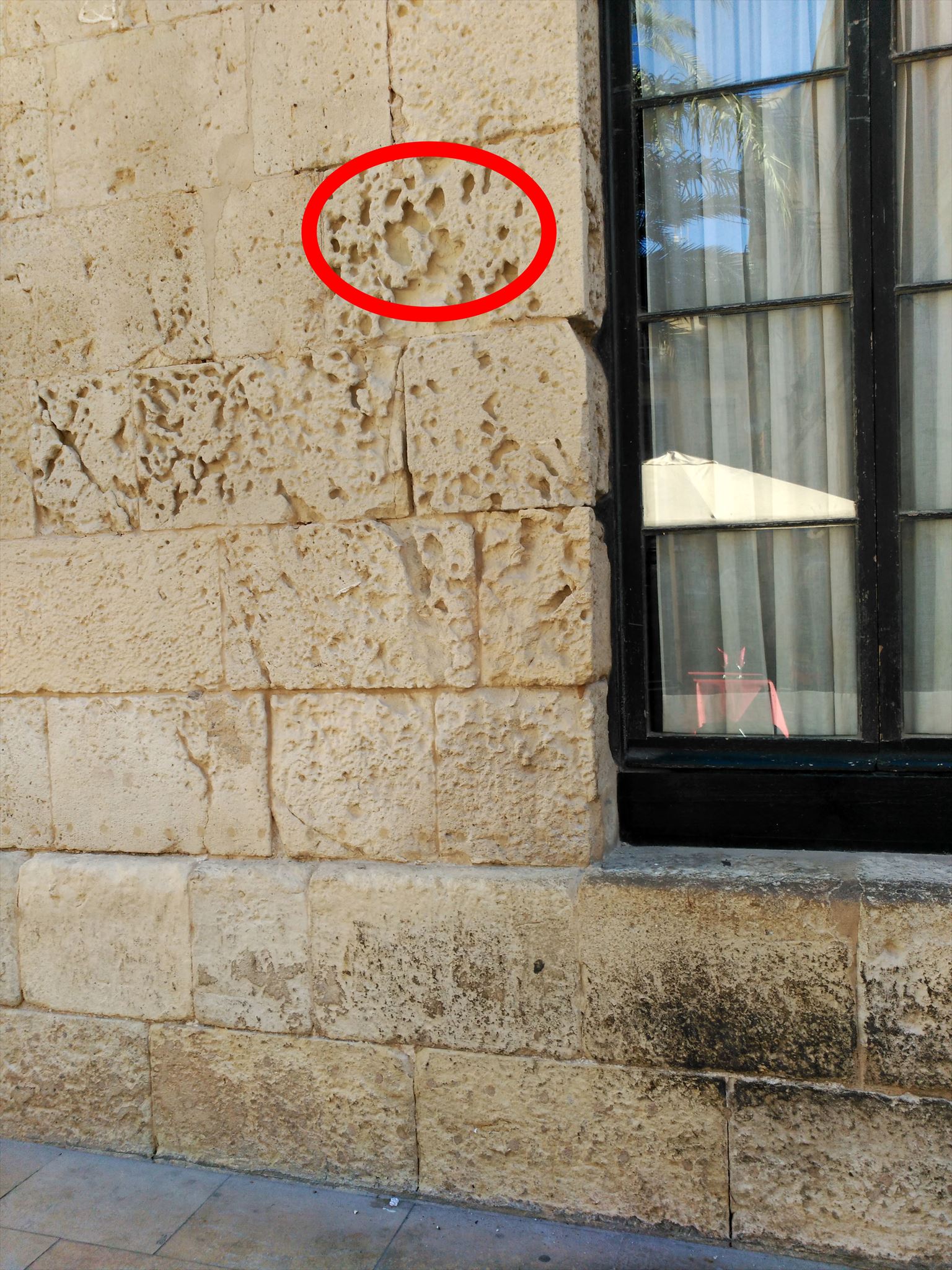 La "Piedra Juliana" es el nombre local de una Calcarenitas, para ser mas coloquial, una piedra caliza porosa con una gran cantidad de restos de conchas marinas (Glycymeris sp. Ostrea edulis y Pecten sp.) y piedras erosionadas por el mar. Piedra ampliamente utilizada como material de construcción.
Bien labrada constituye un elemento constructivo de gran belleza por su color y textura. Con ella se han construido gran cantidad de obras en la ciudad de Alicante y sus alrededores.
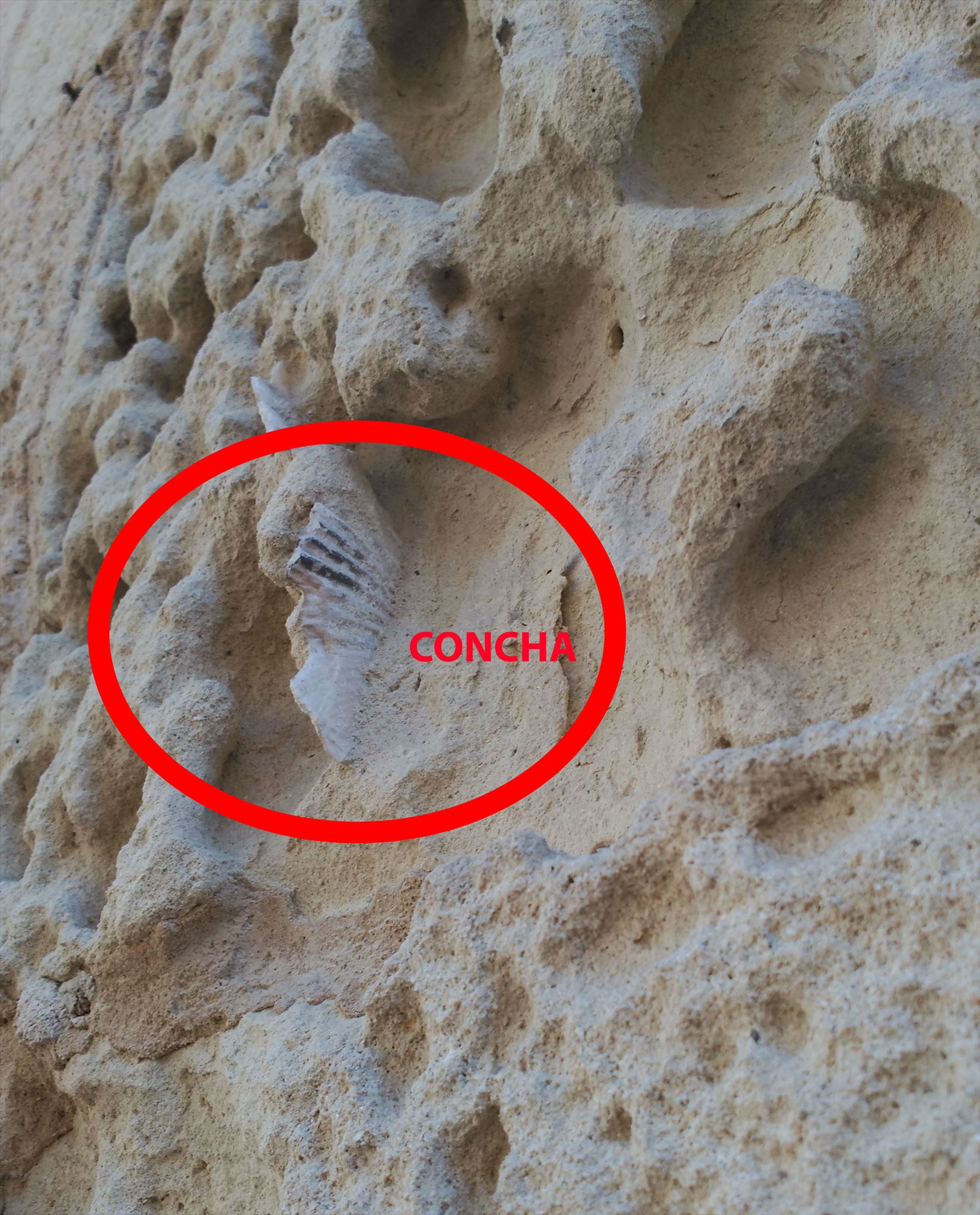 Sus diferentes tonos de marrón -que van del color miel al marrón oscuro-, su aspecto muy poroso, su peculiar textura, y la presencia de conchas en su superficie, la hace inconfundible a simple vista. En la foto de la derecha se aprecia un Pecten
La Piedra Juliana, forma los principales afloramientos de las colinas que rodean el perímetro urbano de la ciudad de Alicante. Estos afloramientos han actuado como canteras durante siglos y han proporcionado los sillares de los principales edificios históricos de la ciudad.Una de ellas era la cantera que existia hasta el año 1929 en la Serra Grossa o Cerro de San Julian, donde proviene el nombre local de la piedra.
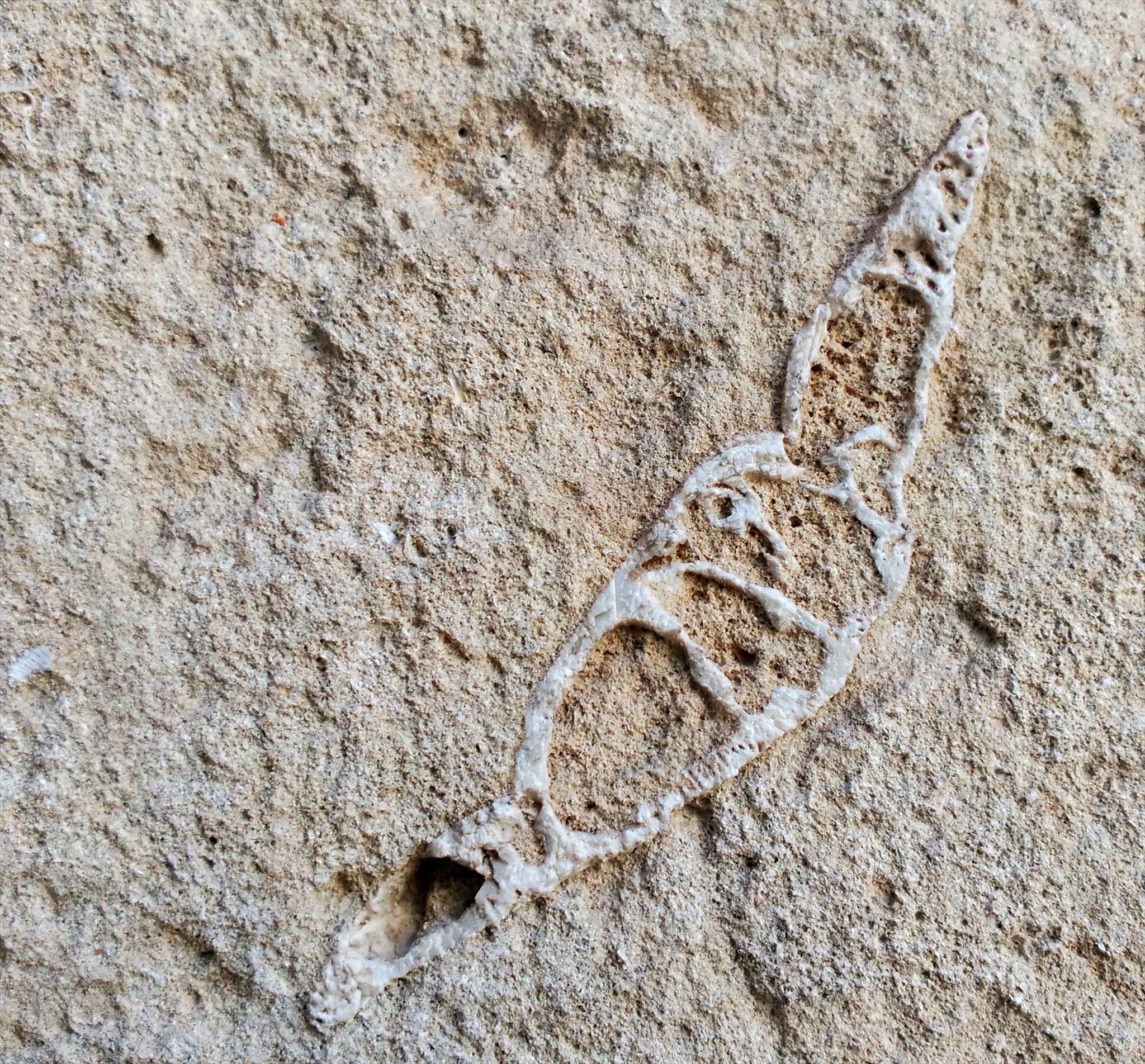
Ostrea edulis
La Serra Grossa y Cerro San Julián forman parte de un macizo calcáreo de pendientes escarpadas que se alinea de forma paralela al mar en dirección NE-SO y ubicados en la parte oriental de la Cordillera Bética. Tiene una clara prolongación hacia el núcleo urbano representado por el Monte Benacantil o Castillo Santa Bárbara.
Una de sus peculiaridades es el gran número de fracturas (fallas y microfallas) que presenta la sierra. Entre los materiales que presenta el monte encontramos margas limosas, calcarenitas blandas, margas arenosas y calcarenitas bioclásticas. Estas últimas ofrecen espectaculares elevaciones de hasta casi 100 metros de desnivel prácticamente vertical.

=> ¿QUE ES UNA CALCARENITAS?
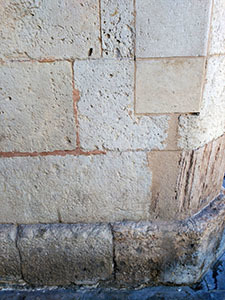 COMPONENTES: Las calcarenitas es una roca detríticas carbonáticas. Son aquellas rocas en las que los granos arenosos o/y el cemento que los aglutinan tienen abundancia de carbonato cálcico de forma que el porcentaje de este mineral, aun inferior al 50%, es lo suficientemente alto como para que la roca dé reacción clara al tratamiento con ácido clorhídrico en frio.
ORIGEN: Se forman, frecuentemente, en aguas dulces o marinas (prefosas), siendo una cáliza del Neógena del Prebético.
ASPECTO: El color depende de las impurezas en el cemento y en los granos, pudiendo variar desde colores claros a pardos o pardo rojizos.
=> ¿QUE ES UNA ROCA DETRÍTICAS CARBONÁTICAS?
Las rocas carbonáticas o rocas carbonatadas (coloquialmente carbonatos) son un tipo de rocas sedimentarias compuestas principalmente por minerales de carbonato cálcico (CO3Ca) o de otros carbonatos. Constituyen el 25-30% del registro sedimentario de la Tierra.
Las principales rocas carbonáticas son:
-Calizas, compuestas por calcita o aragonito (diferentes formas cristalinas del carbonato cálcico).
-Dolomías, compuestas principalmente por dolomita, un carbonato de calcio y magnesio [(CO3)2CaMg].
-Margas, compuestas por una mezcla de carbonatos y minerales de la arcilla.
Las rocas carbonáticas pueden formarse o disolverse tanto en aguas continentales como marinas, dependiendo de numerosos factores, que incluyen la temperatura, pH o la concentración de iones.
=> ¿QUE ES UNA ROCA SEDIMENTARIA?
 Las rocas sedimentarias (del latín sedimentum, asentamiento) se forman por la precipitación y acumulación de materia mineral de una solución o por la compactación de restos vegetales y/o animales que se consolidan en rocas duras. Los sedimentos son depositados, una capa sobre la otra, en la superficie de la litósfera a temperaturas y presiones relativamente bajas y pueden estar integrados por fragmentos de roca preexistentes de diferentes tamaños, minerales resistentes, restos de organismos y productos de reacciones químicas o de evaporación.
Una roca preexistente expuesta en la superficie de la tierra pasa por un Proceso Sedimentario (erosión o intemperismo, transporte, depósito, compactación y diagénesis) con el que llega a convertirse en una roca sedimentaria; a esta transformación se le conoce como litificación. Debido a que las rocas sedimentarias son formadas cerca o en la superficie de la tierra su estudio nos informa sobre el ambiente en el cual fueron depositadas, el tipo de agente de transporte y, en ocasiones, del origen del que se derivaron los sedimentos.
Las rocas sedimentarias generalmente se clasifican, según el modo en que se producen, en detríticas o clásticas, y químicas o no clásticas; dentro de ésta última, se encuentra una subcategoría conocida como bioquímicas.
=> ACTIVIDAD PROPUESTAS PARA SER APROBADO EL EARTHCACHE:
Para poder loguear este earth cache deberás localizar el fósil propuesta en las coordenadas de este Cache y escribirme al correo que aparece en mi perfil, con las respuestas a las siguientes preguntas. Se borrará sin previo aviso todo log que no cumpla dicho trámite previo:
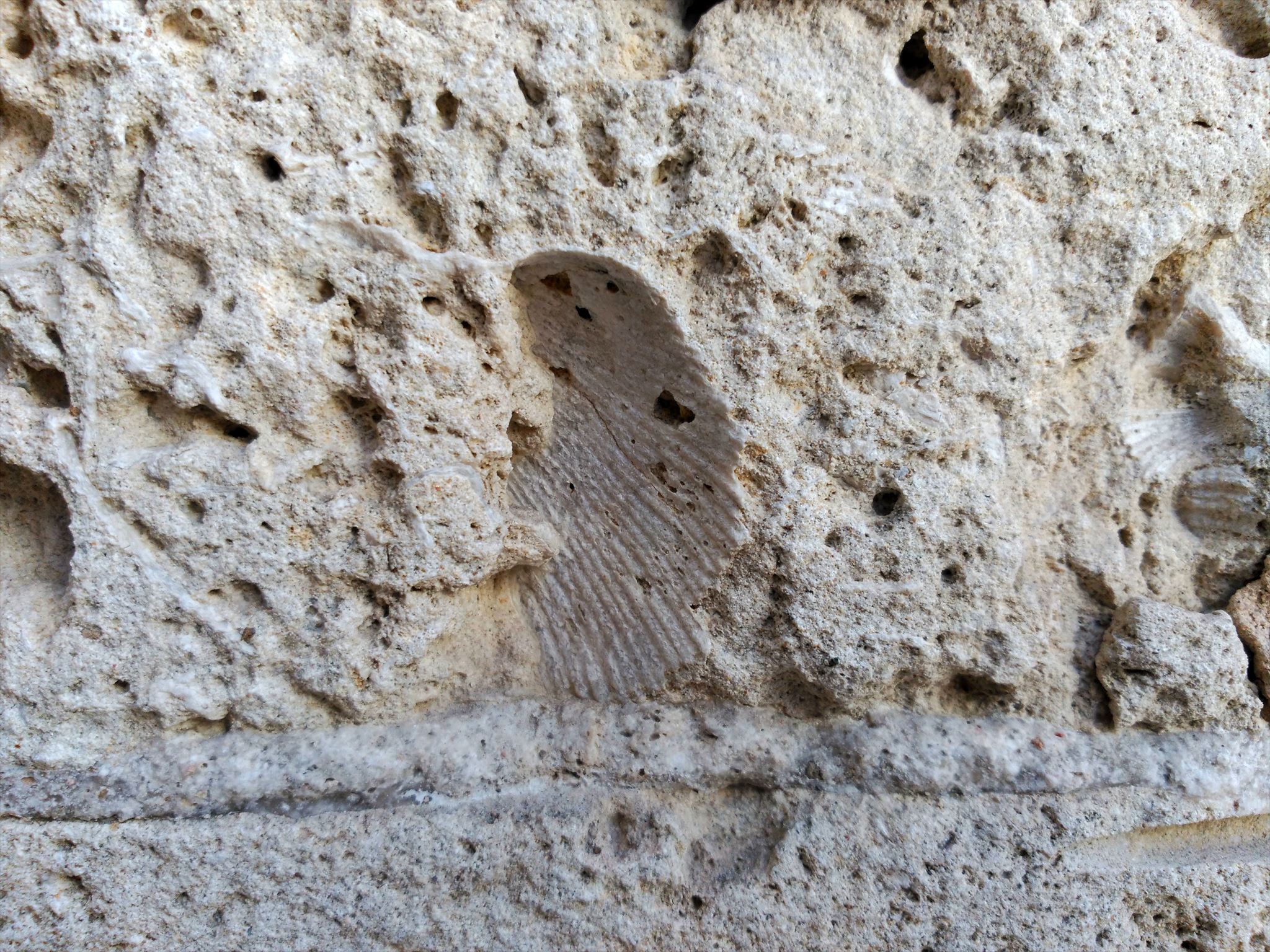
1.- Busca el molde de la concha marina de la foto arriba indicado y ¿dime donde esta ubicado con respecto a la fachada lateral? (Izquierda, Centro o Derecha de la fachada)
2.- Contando desde suelo, ¿en que nº de fila está la concha marina?
3.- ¿Que tipo de concha marina se trata? (Glycymeris, Ostrea edulis o Pecten)
4- ¿Cuanto mide la concha marina de la foto?
5.- ¿En que tipo de roca esta depósitado la concha marina?
6.- Sabiendo el tipo roca, ¿ de que grupo pertenece?
7.- ¿Cual es el mineral principal de la roca?
8- ¿De que cantera se ha extraído la roca?
9- ¿Con que acido en frío reacciona la roca?
10- ¿De que epoca es?
11- ¿Sabrías decirme otro edificio de Alicante construido con el mismo material?
12.- Se agradecerá añadir al log una foto con tu GPS o presencia en la puerta principal, trasera o "Cota Cero" de referencia con respecto al nivel del mar, pero en cualquier caso, no es obligatorio.
BUENA SUERTE A LOS GEOCACHERS, ESPERO QUE LO DISFRUTEIS
------------------------------------------------------------
ALICANTE CITY COUNCIL
"JULIAN STONE"

The building of the Alicante City Council is a baroque palace from the 18th century. The building period of the building for the city council of the city comprises from 1,699, when V. Soler wrote the project, until 1,780, when the works were completed (BEVIÀ and VARELA: 1994, 63).
It is a singular building with towers at the ends and divided in height in three plants that finish in a balustrade. On the main facade, of 49m. of length, it emphasizes the horizontality by the balcony of the first floor and the distribution of hollows and massifs.
The main door is located in the City Council Square and the back door, in the Santa Faz square or called, formerly, the Fruit. The building adjoins a building annexed to the City Council of the streets Jorge Juan, esq. Lonja de Caballeros, esq. Mayor, where the archaeological excavations have exhumed remains of the medieval defensive system of Alicante, whose route is directed towards the building of the Town Hall.
Entering the main door, we will find in front a pillar where the railing of the main staircase starts, where is the "zero level", reference point from which the height above sea level of all points from Spain. Inside the building stands the Blue Room, Royal Chamber of Isabel II in 1885, with a side chapel presided over by an Immaculate of Lucas Espinós and in which it is possible to celebrate mass thanks to a papal bull of Pius VI subscribed in 1775.
The stone used for the construction of the City Council came from the quarry of the Serra Grossa or Cerro de San Julián. The abundance of calcarenite brings a powerful and majestic luminosity to the building. This stone was known by the stonecutters and "Alicantinos" at the time of its maximum extraction as "Stone Juliana", being this a local denomination, as it happens in the zone of Cadiz that denominates "Stone Ostionera".
Cultural assignment: Modern - Contemporary
Chronology: Centuries XVIII, XIX - XX.
=> WHAT IS A JULIAN STONE?
The "Julian Stone" is the local name of a Calcarenites, to be more colloquial, a porous limestone with a lot of sea shell remains (Glycymeris sp. Ostrea edulis and Pecten sp.) and stones eroded by the sea. Stone widely used as building material.
Well carved is a constructive element of great beauty for its color and texture. With her, it has built a large number of works in the city of Alicante and its surroundings.
Its different shades of brown - ranging from honey to dark brown -, its very porous appearance, its peculiar texture, and the presence of shells on its surface, makes it unmistakable to the naked eye. In the picture on the right you can see a Pecten
The Stone Juliana, forms the main outcrops of the hills that surround the urban perimeter of the city of Alicante. These outcrops have acted as quarries for centuries and have provided the sillares of the main historical buildings of the city. One of them was the quarry that existed until 1929 in the Serra Grossa or Cerro de San Julian, where the local name comes from the stone.
Ostrea edulis
The Serra Grossa and Cerro San Julián are part of a calcareous massif of steep slopes that is aligned parallel to the sea in NE-SO direction and located in the eastern part of the Betic Mountain range. It has a clear continuation towards the urban nucleus represented by Benacantil mountain or Santa Bárbara Castle.
One of its peculiarities is the large number of fractures (faults and microfallas) presented by the saw. Among the materials that the mountain presents are loamy loams, soft calcarenites, sandy loams and bioclastic calcarenites. These last ones offer spectacular elevations of up to almost 100 meters of almost vertical unevenness.
=> QUE ES UNA CALCARENITES?
COMPONENTS: Calcarenites is a carbonate detrital rock. They are those rocks in which the sandy grains and / or cement that bind them have an abundance of calcium carbonate so that the percentage of this mineral, even less than 50%, is high enough for the rock to give a clear reaction to treatment with cold hydrochloric acid.
ORIGIN: They are often formed in freshwater or marine waters (prefosa), being a limestone of the Neogene of the Prebetic.
ASPECT: The color depends on the impurities in the cement and the grains, being able to vary from light colors to brown or reddish brown.
=> WHAT IS A CARBONATE DETRITAL ROCK?
Carbonate rocks (colloquially carbonates) are a type of sedimentary rock composed mainly of calcium carbonate (CO3Ca) or other carbonate minerals. They constitute 25-30% of the Earth's sedimentary record.
The main carbonate rocks are:
-Limestones, composed of calcite or aragonite (different crystalline forms of calcium carbonate).
-Dolomites, mainly composed of dolomite, a calcium and magnesium carbonate [(CO3) 2CaMg].
-Marls, composed of a mixture of carbonates and clay minerals
Carbonate rocks may form or dissolve in both continental and marine waters, depending on numerous factors, including temperature, pH or ion concentration.
=> WHAT IS A SEDIMENTARY ROCK?
Sedimentary rocks (from the Latin sedimentum, settlement) are formed by the precipitation and accumulation of mineral matter of a solution or by the compaction of vegetable and / or animal remains that are consolidated in hard rocks. The sediments are deposited, one layer on the other, on the surface of the lithosphere at relatively low temperatures and pressures and may be composed of preexisting rock fragments of different sizes, resistant minerals, organism residues and products of chemical reactions or evaporation.
A preexisting rock exposed on the surface of the earth passes through a sedimentary process (erosion or weathering, transport, deposition, compaction and diagenesis) with which it becomes a sedimentary rock; this transformation is known as lithification. Because sedimentary rocks are formed near or at the surface of the earth their study informs us about the environment in which they were deposited, the type of transport agent and, sometimes, the origin from which the sediments were derived.
Sedimentary rocks are generally classified, according to the way they occur, in detrital or clastic, and chemical or nonclassic; within the latter, is a subcategory known as biochemical.
=> ACTIVITY PROPOSED TO BE APPROVED THE EARTHCACHE:
To can logging this earth cache, you must visit the proposed UPWELLING the coordinates of this Cache and send to my email listed in my profile, the answers to the following questions. I will delete any log that does not fulfill that formality before:
1.- Look for the mold of the sea shell of the photo above and tell me where it is located with respect to the side facade? (Left, Center or Right of the facade)
2.- Counting from ground, in what number of row is the sea shell?
3.- What type of seashell is it? (Glycymeris, Ostrea edulis or Pecten)
4- How measures the sea shell, of the photo?
5.- On what rock is the sea shell deposited?
6.- Knowing the rock type, which group does it belong to?
7.- What is the main mineral of the rock?
8- From what quarry has the rock been extracted?
9- With what cold acid does the rock react?
10- What period is it?
11- Could you tell me another building in Alicante built with the same material?
12- It will be appreciated to add to the log a photo with your GPS or presence in the main door, rear or "Zero Level" of reference with respect to sea level, but in any case, it is not obligatory.
GOOD LUCK TO ALL GEOCACHERS, I HOPE YOU ENJOY