Los Arcos

Con este earthcache os queremos mostrar una zona de La Graciosa que no es muy conocida y que mucha gente se pierde. Esta zona está situada en el norte de La Graciosa. Como seguramente tenéis el tiempo justo (la mayoria de turistas visitan la isla solamente un día), este earth lo hacemos corto y fácil para que lo podáis hacer rapidito y así seguir vuestro camino. Os queremos mostrar unas formaciones basálticas, especialmente un arco y una baja.
Seguramente os preguntáis que es una baja. Una baja es una roca eminente cercana a la costa que queda al descubierto en marea baja. Es topónimo frecuentísimo en Lanzarote, como por lo general en todas las Islas Canarias. La baja que podéis ver en el oceano es conocida como la Baja de las Majapalomas.
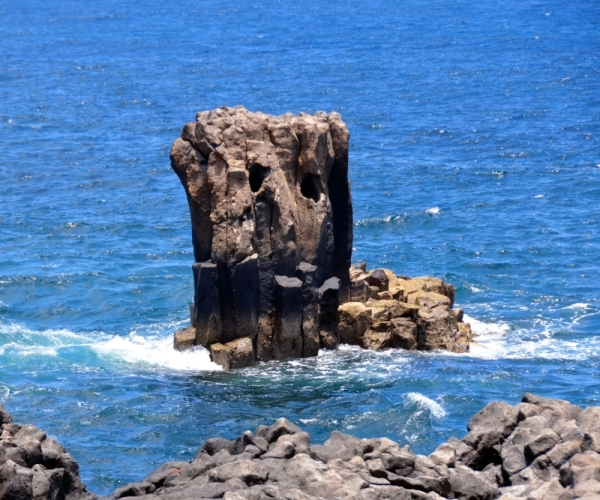
Entramos en materia. Las rocas basálticas son rocas formadas especialmente por acumulación de lava y enfriada con gran rapidez. El basalto se caracteriza por tener un color oscuro, producto de su alto contenido en hierro y magnesio. Se constituye principalmente de óxidos metálicos como el oxido de hierro, oxido de silicio y de magnesio, entre otros. Pueden presentarse pequeños fenocristales en su composición, aunque también se presenta en forma de cristal sin o con muy pocos cristales de forma visible. Presenta una alta dureza (8 en la escala de Mohs) y manejo fácil, en cuanto a su explotación. Por sus características físico-mecánicas, es un material idóneo para la construcción, para revestimientos y pavimentos exteriores, incluso los de circulación intensa (adoquines, piezas estándar, etc.). También es usado como elemento decorativo por su estética y al poder ser tratado en forma, corte, molde y color. De forma inusual, también es utilizado en tratamientos de spa como son los masajes. El basalto en forma natural se encuentra característicamente como grandes columnas y, según su ubicación y formación, se pueden derivar algunas formas peculiares del basalto, como por ejemplo arcos basálticos o prismas basálticos.
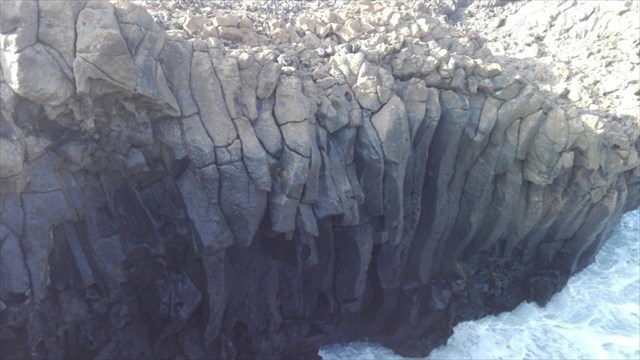
Para poder registrar como encontrado este earth, nos tenéis que mandar un correo (podéis hacerlo desde nuestro perfil de usuario) con las respuestas a las siguientes preguntas. Podéis loguear el earth sin haber recibido nuestra respuesta pero si no recibimos el correo con las respuestas correctas, el log podrá ser borrado sin previo aviso.
A) Cuál de las siguientes afirmaciones es cierta:
- El basalto es considerada una roca sedimentária.
- El basalto es una roca magmática y tiene un alto contenido de cuarzo.
- El basalto cubre cerca del 70% de la superfície terrestre.
- El nombre "basalto" viene del rey Baltasar (Rey mago de oriente).
B) Situate en las coordenadas. Cuantos arcos basálticos puedes ver desde este punto?
C) Desde las coordenadas, puedes ver la Baja de las Majapalomas?
D) OPCIONAL: Colgad en vuestro log una fotografía donde aparezcáis vosotros y/o vuestro GPS con el arco principal. Si tenéis pensado subiros a él id con mucho cuidado. Puede ser peligroso, sobretodo si está mojado.
Por favor, sed respetuosos y no alteréis el entorno.
Gracias por vuestra comprensión y esperemos que disfrutéis del lugar

ENGLISH VERSION (PROVISIONALLY GOOGLE TRANSLATE)
Los Arcos (ENG)
With this earthcache we want to show you an area of La Graciosa that is not well known and that many people don't visit. This area is located in the north of La Graciosa. As you surely haven't many time (most tourists visit the island only for one day), this earth is short and easy so you can do it quickly and follow your visit. We want to show you some basaltic formations, especially an arc and a "baja".
Surely you ask yourself what is a "baja". A "baja" is an eminent rock near the coast that is exposed at low tide. It is a frequent place name in Lanzarote, as usually in all the Canary Islands. The "baja" that you can see in the ocean is known as the "Baja de las Majapalomas".
We are going to enter into subject-matter. The basaltic rocks are rocks formed especially by accumulation of lava cooled very quickly. Basalt is characterized by a dark color, product of its high content of iron and magnesium. It is mainly composed of metal oxides such as iron oxide, silicon oxide and magnesium oxide, among others. Small phenocrysts may be present in its composition, although it also occurs in the form of crystals without or with very few crystals in a visible form. It has a high hardness (8 on the Mohs scale) and easy handling, in terms of its exploitation. Due to its physico-mechanical characteristics, it is an ideal material for construction, for exterior coatings and floors, even those with intense circulation (paving stones, standard pieces, etc.). It is also used as a decorative element for its aesthetics and because of to be able to be treated in shape, cut, mold and color. Unusually, it is also used in spa treatments such as massages. Basalt in its natural form us characteristically found as large columns and, depending on its location and formation, some peculiar forms of basalt can be derived, such as basaltic arches or basaltic prisms.
In order to register as found this earth, you have to send us an email (you can do it from our user profile) with the answers of the following questions. You can log the earth without having received our answer but if we do not receive the email with the correct answers, the log can be deleted without previous warning.
A) Which of the following statements is true:
- Basalt is considered a sedimentary rock.
- Basalt is a magmatic rock and has a high content of quartz.
- Basalt covers about 70% of the earth surface.
- The name "basalt" comes from Balthazar king (One of the biblical Magi along with Gaspar and Melchior who visited the infant Jesus after he was born).
B) Go to the coordinates. How many basaltic arches can you see from this point?
C) From the coordinates, can you see the "Baja de las Majapalomas"?
D) OPTIONAL: You can add a photo to your log where you and / or your GPS appear at the principal arch. If you plan to up the arch, be carefully. It can be dangerous, specially if it's wet.
Please be respectful and don't modify the environment.
Thank you for your understanding and we hope you enjoy the place.
