To log this earthcache, please don’t stress about answering the questions. Simply send your best attempts in a private message to me, (the cache owner), and then go ahead and log it as found.
You don’t need to wait for my approval. All attempts will be accepted.
Go ahead and have fun learning! 
- [REQUIRED] Please post a photo in your log of yourself or a personal item at the bog to prove you visited the site.
- There are five types of bog habitats. What type of bog is this?
- What do you expect this bog will look like in 100 years?
- What are the four surface layers of this bog?
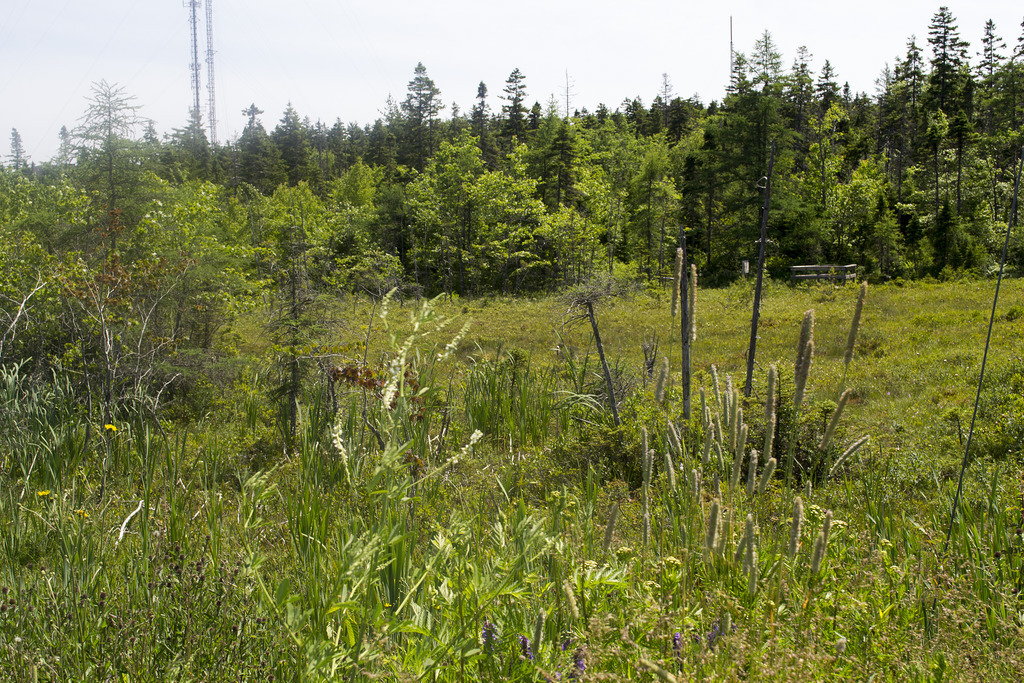
The Mainland Common Bog can be found on a family-friendly woodland trail called the Mainland Common Loop in the Mainland North Common Park. Along the trail, you will find the bog with an interpretive panel on the inner loop.
A bog is a wetland that accumulates peat, a deposit of dead plant material—often mosses, and in a majority of cases, sphagnum moss. It is one of the four main types of wetlands. The other kinds of wetlands are marsh, swamp, bog and fen.
(1) Based on location and water source, there are several distinct types of bog habitats. Blanket bogs develop in highland areas with significant rainfall: the bog "blankets" an entire area, including hills and valleys. Cataract bogs are ecosystems that feature a permanent freshwater stream. Quaking bogs develop over a lake or pond, with bog mats (thick layers of vegetation) about a meter (3 feet) thick on top. Quaking bogs bounce when people or animals walk on them, giving them their name. Raised bogs are vaguely dome-shaped, as decaying vegetation accumulates in the center. String bogs have a varied landscape, with low-lying "islands" interrupting the saturated bog ecosystem. Valley bogs develop in shallow valleys.
(2) All bogs take hundreds or thousands of years to develop. A bog is formed when a lake slowly fills with plant debris. Sphagnum moss, as well as other plants, grow out from the lake's edge. The vegetation eventually covers the lake's entire surface. Plants decay slowly in bogs, because flooding prevents a healthy flow of oxygen from the atmosphere. Bog soils are oxygen- and nutrient-poor and are much more acidic than other soils. Eventually, watery bogs become choked with living and decaying plants. These slowly decaying plants become the main components of the bog's soggy soil, called histosol. Fungi and low-lying shrubs, such as heather, grow in histosol. Heather can grow directly on sphagnum moss.
(3) Once bogs are formed, they retard the development of efficient drainage by inhibiting water movement and slowing erosion of the soil or rocks on which they rest. Thus, bogs tend to be long-lived if temperatures remain low and sufficient excess of rainfall over evaporation exists to prevent their drying out. If they do dry out, upland plants will colonize the former bog.
(4) From the surface down, the layers are (1) floating bog, (2) clear water, (3) false bottom, and (4) true bottom. With the continued thickening of the mat there is less influence of the lake water on plant growth, and Sphagnum usually begins to invade the surface of the mat even if it was previously dominated by grasses. With the growth of the moss a true bog is formed and various heaths invade the mat, especially Chamaedaphne. With continued thickening, trees may begin to grow, the first usually being larch (Larix). Black spruce may invade in the last stages of bog development. From a distance it may be difficult to detect the original boundary between the upland and the now filled lake.