Welcome to the LaVerkin Overlook. Here, you can get great views of the St. George Metro Area on the way to Zion National Park. I stoped here while on a geology field study with my college in Southern California and thought it would be a great place for an earthcache. What many people don't realize is that there are half a billion year old sponge fossils here which formed in an ancient sea.
These sponges are preserved at the top of the cliffs here in the Wheeler Formation within the Wheeler Shale. Sponge fossils are visible here at the surface, but are very easy to miss if you don't know what you are looking at since they are mainly composed of soft tissues. As you know, soft tissues do not preserve well in the fossil record. However, this is one of those rare exceptions. Lets talk about the geology of the sit here and how sponge fossils ended up in the middle of the Utah desert and on top of a cliff.
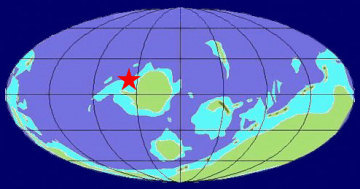
About 507 million years ago, an ancient shallow tropical sea existed here. The western United States was similar to that of the present day Caribbean where only the mountain peaks were above the water. The position of Utah was near the equator at this time. Here, sponges lived and died and eventually fell to the bottom of the seabed. normally, hard tissues such that of bones preserve well in the rock and create fossils. Due to the thick outcrop of the Wheeler Formation (about 1600 to 2000 feet), it seems that sediment deposition was at a higher rate than normal.
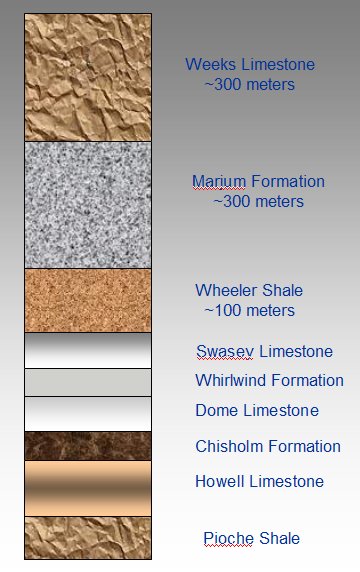
Shale is the rock that is abundant in the Wheeler Formation. It can only form only a few miles offshore, where the water is relatively calm and silt can settle to the bottom. Large amounts of rain (due to the tropical environment) and ocean currents likely brought large amounts of sediments here and made the outcrop as thick as it was. This would give little time for any organic materials to decompose, helping to preserve soft tissues in fossils. 500 million years ago was the upper end of the Cambrian Explosion. This period of time was where life really took off and diversified. Sponges are simple creatures, however they do evolve. The sponges 500 million years ago are not the same sponges as we see today. Their fossils here prove that.
Utah Today
 Utah 507 Mya
The sponge fossils here are very distinctive. They are only a few centimeters to two inches in size. Because sponges are composed mostly of soft tissues, their fossils look more like xenolith inclusions than actually fossils. See the photo below of what they look like here. Xenoliths can only form in metamorphic rocks like granite. These rocks are a type of shale, which are sedimentary.
 Works Cited
http://www.fossilmuseum.net/Cambrian-Explosion/Utah-Cambrian-Explosion.htm
https://en.wikipedia.org/wiki/Wheeler_Shale
TO LOG A FIND ON THIS CACHE YOU MUST GIVE ME THE CORECT ANSWERS. YOU CAN CONTACT ME THROUGH MY EMAIL OR THE GEOCACHING MESSAGE CENTER. ANY INCORRECT ANSWERS WILL RESULT IN A DELETED LOG
1. "LaVerkin Sponge Fossils" on the first line of your email AND list all geocaching names of your party so I can match your answers to them.
2. Examine the Wheeler Shale rocks and describe the (a) texture, (b) approximate weight, (c) colors, and (d) average sizes.
3. Using the view, and the rock layer diagram, (a) how far is the range of the Wheeler Formation from this vantage point and (b) what other rock outcrops are visible?
4. Locate a few sponge fossils. Use the photo on the cache page to help you find them. They are very easy to miss. Describe the (a) textures, (b) colors, (c) sizes, (d) abundance or number of fossils per average sized rock.
5. After finding a few sponge fossils, do you think they all formed at roughly the same time? How can you tell? Are there any similarities or differences among the fossils here that would make you think otherwise? Explain and expand on your answer.