This earthcache will bring you to a roadcut along SR 37 to observe stylolites in the seams of the Upper Harrodsburg Limestone. You can pull off the highway just past the yellow Ice sign and be away from traffic. Please make sure littles ones are next to the limestone.
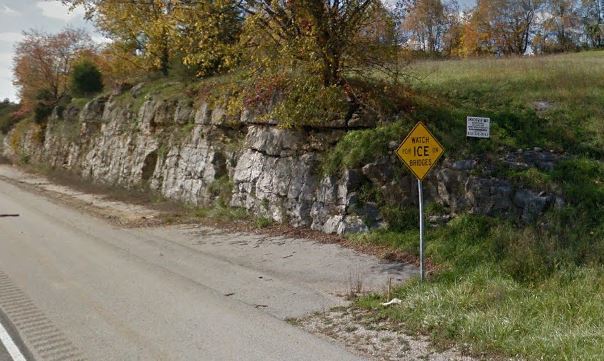
The upper Harrodsburg is much more pure limestone that the lower Harrodsburg. So you won't see the shales mixed in, rarely see geodes, and will notice it is much more compact than the lower Harrodsburg at the southern end of this roadcut. It is much more compacted and very suitable for building. The upper Harrodsburg will be define by having stylolites and finestrate bryozoans. We are going to focus on the stylolites here since they are easier to see.
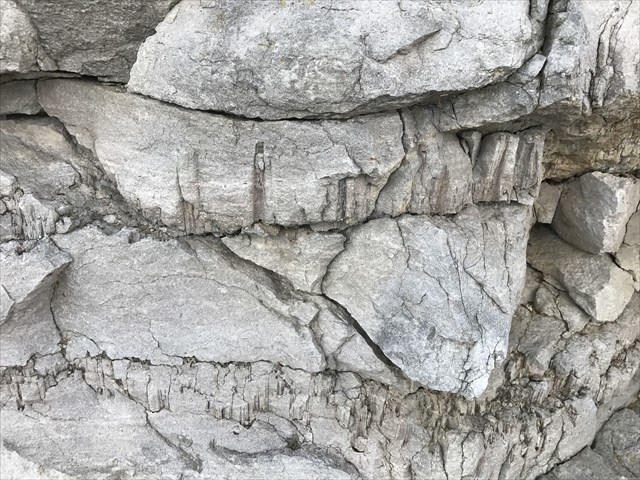
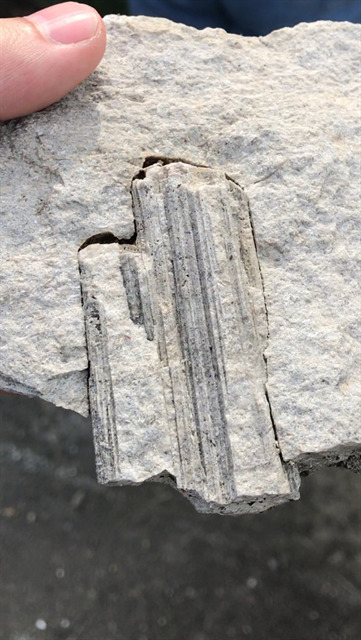
If you look at the seams at the beginning of the roadcut, you will notice the stylolites. They will look like "little ups and downs" and seem to look like a piece of fossilized wood showing the grains. But stylolites are not fossils at all. They are created by a chemical process.
When a sufficient load is applied to a rock or other structural material, it will cause the material to change shape. This change in shape is called deformation. A temporary shape change that is self-reversing after the force is removed, so that the object returns to its original shape, is called elastic deformation (similiar to stretching a rubberband and releasing it). In other words, elastic deformation is a change in shape of a material at low stress that is recoverable after the stress is removed. This type of deformation involves stretching of the bonds, but the atoms do not slip past each other.
When the stress is sufficient to permanently deform the rock, it is called plastic deformation. Plastic deformation involves the breaking of a limited number of atomic bonds by the movement of dislocations. Recall that the force needed to break the bonds of all the atoms in a crystal plane all at once is very great. However, the movement of dislocations allows atoms in crystal planes to slip past one another at a much lower stress levels. Since the energy required to move is lowest along the densest planes of atoms, dislocations have a preferred direction of travel within a grain of the material. This results in slip that occurs along parallel planes within the grain. Plastic deformations will occur at high temperatures and under a lot of pressure! You will see the individual grains and crystals will move independently from the rest of the rock. It is called intergranular movement. It will move along a glide plane.
If you look along the horizontal seams of the rocks, you will notice the stylolites. This is because the rocks are at the most pressure at these seams. And the upper Harrodsburg is a much more compacted rock because of the intergranular movement. As they grains move, they will fill in the pores and gaps. It almost functions like a glue and holds the rock together.
In order to get credit for this earthcache, please send the answers to the following questions to my account.
1. Explain in your own words how stylolites form.
2. Find an example and describe what you see (height, length, etc).
3. Did you see any other fossils in these rocks while you were looking?
4. Post a picture of yourself (face not required) or a personal item at the stylolites.
Sources: Jill Vance, State Parks and IGS
Congrats to dtmtndew for the FTF!