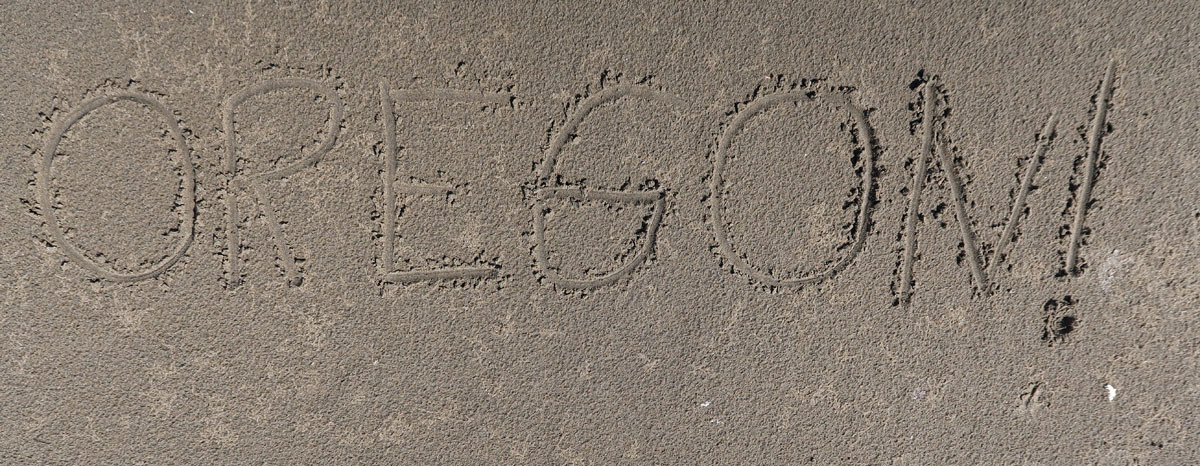
Beach Sand EarthCache
Cannon Beach Sand (Click the images to enlarge)
This is an EarthCache, a special type of geocache. There is no physical container to find or logbook to sign. Instead, the object is to read the information below, visit the listed coordinates and answer some questions based on your experiences. To get credit for "finding" the cache, you will need to email your answers to the cache owner, which you can do from my Profile ("Send message" or "Send e-mail").
The coordinates of this cache will take you to the beach near downtown Cannon Beach. Haystack Rock is the obvious attraction along this beach, but what you are standing on is also very amazing...sand!
Everyone loves visiting the beach, but what would a beach be without sand? Have you ever been curious about all that sand? Read on for some questions and answers about sand and consider what you read as you walk on beautiful Cannon Beach beach!
What is Sand and Where Does it Come From?
The sandy beach you are standing on is made of countless grains. Each grain is a tiny piece of solid rock. The grains are finer (smaller) than gravel and coarser (larger) than silt (silt is a dirt-like material composed of very tiny sand particles and earthy matter). Sand covers most of the beaches, riverbeds and deserts of the world.
Beach sand is composed of the results of erosion, the wearing away of larger rock, mostly by wind and water. It may also include tiny pieces of the shells of ocean life. The weathering and decomposition of rocks occurs over millions of years. You are standing on ancient history!
Most of the sand on the North Oregon Coast originated in the Coast Range Mountains and was carried to the beach in streams and rivers. The Coast Range are the mountains you drive through on your way to the beach from Portland. Sand on the southern part of the Oregon Coast comes from the Klamath Mountains. The erosion of rocky areas along the shoreline, such as headlands and off-shore rocks, also contributes sand to the beaches.
The lighter colored sand is quartz and feldspar. Darker sand is mostly basalt, which is volcanic rock, such as...Haystack Rock itself!
Cannon Beach Sand Up Close (Note the variety of color and texture)
Is Sand a Solid or a Liquid?
Surprisingly, neither! If you pour some sand out of a bucket or glass, it flows a lot like water does. And, like a liquid, it will take the shape of whatever container you pour it into. But...you can walk on it, which you can't do on water! So, sand is neither solid nor a liquid.
The answer is, sand is a granular material - a mass of solid particles bunched together and touching each other. How the individual particles of sand you are standing on touch each other and interrelate can be compared to the cells in a colony and is the subject of very complex research.
Why Does Some Sand Squeak?
Have you ever walked on sand and heard it squeaking under your feet? There are YouTube videos of such sand in Cannon Beach. The squeaking sound is caused by the friction of sand particles rubbing against each other. But, not all sand particles produce sound. Studies have shown that the most likely sand to squeak is that composed of silicate or feldspar and the more round the grains are, the better. Grains of sand with sharp edges are much less likely to produce sound. Since water acts as a lubricant, it decreases the creation of sound, so dry sand is best and humidity is also a factor.
Much less common are singing sand and roaring sand, conditions which some feel are more common to Cannon Beach than elsewhere. These can occur when sections of sand slide in an area of dunes or when wind blows sand under just the right conditions.
Does Sand Move?
Yes, it moves quite a lot! In the winter, especially during storms, sand is pulled off the beaches and built up into large banks offshore out where the waves begin to break. Then, in the summer, the gentler waves slowly move sand back onto the beach. In stormier years, this process happens even more and in mild winter years, the beach may actually gain sand overall.
On the Oregon Coast, sand also travels north and south as well as in and out. The prevailing winds from the southwest in the winter and from the northwest in the summer help with this north/south movement. However, large migrations of sand north and south are very limited, and usually restricted only to the areas between headlands. The movements of sand are referred to as littoral drift. However, the Oregon Coast is considered what is called a zero net littoral drift zone, which means that although the sand moves around quite a lot, the net results are that it stays in pretty much the same area.
Are there Living Creatures in the Sand?
The previously described movement of the sand and the constant wave action create a pretty tough environment to live in! This is known as an unstable habitat. The only larger animals that can live in the area of sand affected by wave action are those that can burrow under the sand. The wave action also makes it nearly impossible for plants to take root. However, microscopic life does live in the sand, and even attaches itself to individual grains of sand. These include diatoms and protozoans, along with many others. These tiny life forms are known as interstitial organisms.
As many Coast visitors know, razor clams are a good example of larger types of life that exist in the sand. These clams live on the lower parts of the beach and a few inches under the sand.
In Spring and Summer, huge numbers of "Sail Jellyfish" (Velella velella) can sometimes be encountered on the beach and can be several inches deep. They don't live on the sand, however. In fact, they die there after being blown onto the beach from the ocean.
Now, Some Questions for You to Answer:
1 - Scoop up some sand in your hand and study it very closely. Describe what you see. Can you see anything that might be bits of shells or animals or plants living in the sand?
2 - Can you find any areas of darker sand nearby? Where do you think it might have come from?
3 - As you walk, try to find some dry sand and see if you can make it squeak under your feet or hands. Describe what you find. What are the current conditions that may cause the sound, or if you are unsuccessful, what may be preventing it?
4 - Can you think of other ways that sand is like a liquid? Like a solid?
5 - From your position on the beach, study Haystack Rock and its size. Imagine the forces of erosion (wind and water) wearing away at the rock and slowly turning it into sand. If all the sand that Haystack Rock will eventually become were piled up nearby, how do you think the size of the pile would compare to the size of Haystack Rock?
Completely optional but encouraged: Try to find some interesting feature of the sand nearby, and take a photo. Post your photo with your online log along with your idea of what it is you have found.
Sources of Information Used:
American Physical Society: Granular Materials, 2018
Beach Connection (staff): Oregon Coast's Weird Singing Sands, 2015
Castro, Joseph: What Is Sand?, 2013
Henderson, Bonnie: Strand, An Odyssey of Pacific Ocean Debris, 2008 (book - Seaside Public Library)
Kozloff, Eugene N.: Seashore Life of the Northern Pacific Coast, 1996 (book - Seaside Public Library)
McKay, Rodney H.: Texture and mineralogy of Oregon beach sand, 1962
All photos: Seawind, taken in Cannon Beach