A companion series to my NZ Native Trees series, this series helps you to identify trees that are NOT indigenous to New Zealand that you may come across on your Geocaching travels. The third in the series is a far less common tree in New Zealand than the first two and is grown primarily for furniture making. It is the most commonly planted Acacia in New Zealand, out of the few that have been introduced here from the more than 700 species of Acacia that grow in Australia.
Finding this cache requires a bit of an uphill walk from the nearest car park.
Tasmanian Blackwood
Common names: Blackwood, Tasmanian Blackwood, Australian Blackwood
Botanical name: Acacia melonoxylon
The Blackwood grows faster in New Zealand than it does in its native habitat and can provide a suitably sized millable trunk for commercial purposes within 35 years, which is not much more than for Pinus radiata. It can grow to 20 metres high and 10 metres wide. Like all Acacias (wattles) it is a legume (in the same family as peas, beans, gorse and our native kowhai) with roots that fix nitrogen in the soil and as it has an extensive root structure it is also good for stabilising hillsides. To grow well it needs good shelter, a warm location (no heavy frosts, especially when young) and reasonable moisture: growth will be inhibited by dry summers. It therefore grows best on lower valley slopes and in moist gulleys in areas with moderate to high rainfall...such as Kaitoke, where this cache is located.
Timber properties and uses
The highly decorative hardwood of blackwood surpasses almost every other timber in its range of colours. It is classed with an elite group of woods for fine furniture, such as mahogany, teak and walnut. The heartwood is a rich golden brown through which there may be streaks of reddish brown or can be almost black. There is little sapwood (only 30 to 50 mms) which is a pale cream-brown, contrasting strongly with the heartwood.
For furniture making blackwood is a good substitute for rimu and commands similar high prices. It was promoted as a species worth special attention by Forest Research in 1980 and after some trials in the early days and initial frustration learning how to grow it with straight trunks there are now a number of plantations that have reached maturity for their first crop for commercial harvest.
Foliage
The tree is evergreen and has a fairly long leathery dull green 'leaf' with 3 or 5 prominent parallel ribs running the length of the leaf. In botanical terms it isn't a leaf at all, but a phyllode: a modified stem that has taken on the appearance and photosynthesis duties that are normally carried out by a leaf. This is quite common with Acacias.

Foliage is phyllodes, not leaves
True leaves can, however, be found on seedling trees, and can occasionally appear on mature trees as well, growing from the ends of some phyllodes.
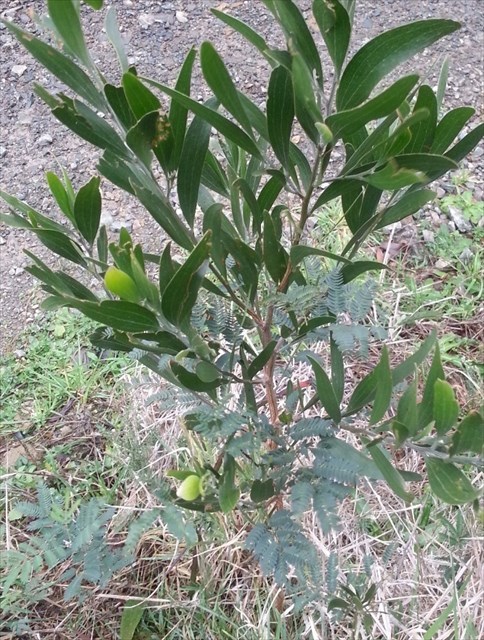
Seedling tree - phyllodes on this year's growth at top, true leaves on last year's at bottom
At time of placement of this cache there were some seedlings on the opposite side of the track that showed the leaves growing as well as the phyllodes.
Flowers
The flowers are produced in clusters and are pale yellow. They open in late winter / early spring, so providing an early source of nectar for bees. After pollination they produce seed pods
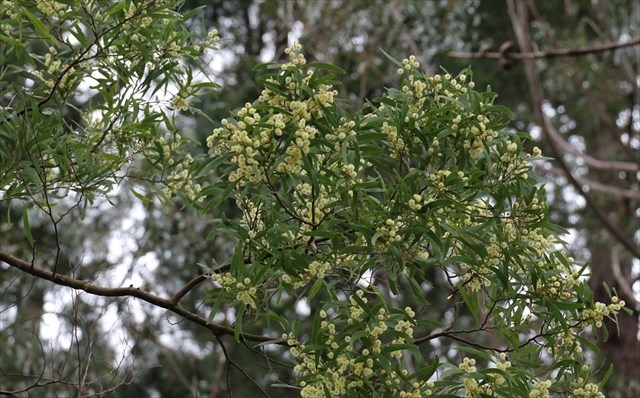
Flowers on a blackwood in CO's garden, end of August
Bark
The bark on older trunks is grey in colour and deeply fissured.
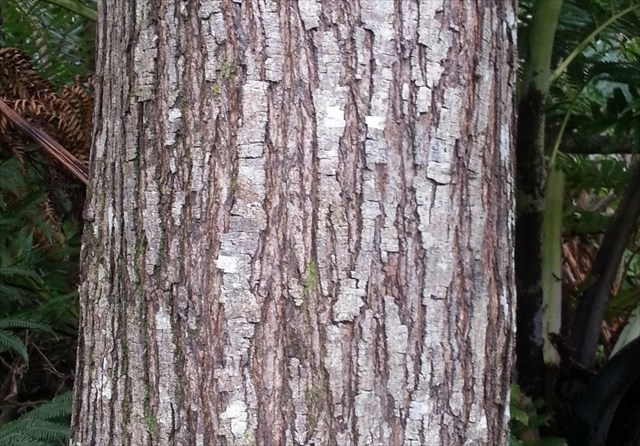
Bark on an old trunk (the tree at GZ) showing deep fissures
On young trees and small branches it is greenish brown and quite smooth.
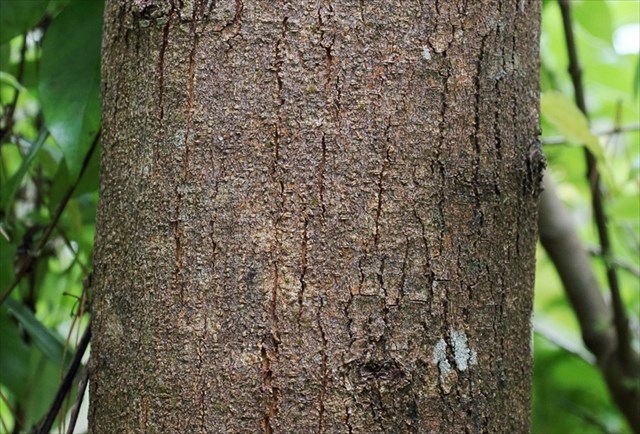
Bark on young tree in CO's garden, <10 years old - fissures starting to form
The blackwood at GZ
The tree at GZ is a fair size and one of several in the vicinity. How this small stand came to be in this location I have no idea and would love to know, because they are on the 'native bush' side of the forestry track, with the other side of the track containing a pine plantation.
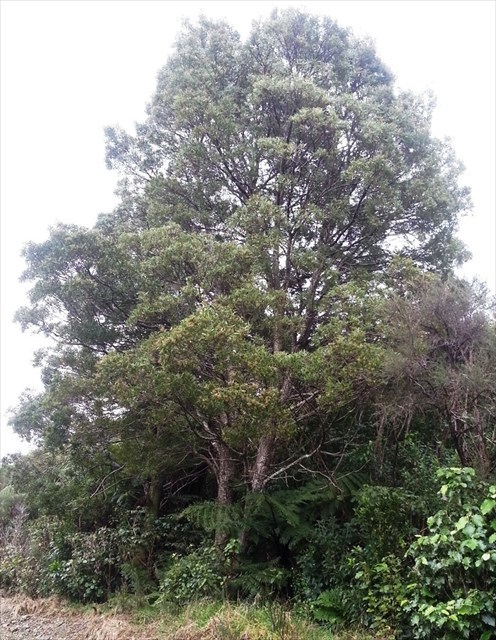
The blackwood at GZ
The cache
The replacement cache is a 250 ml ClipFresh container. It contains two logs: one is the log book made from waterproof paper (inside a plastic pill container) and the other log is a small cross section of blackwood to show the difference between the heartwood and sapwood colour. Needless to say it came from a tree in CO's garden  . Online log entries that do not have a corresponding entry in the paper log book will be deleted. Please re-hide the cache carefully to avoid it being spotted by passing muggles.