This easy trail is located within Big South Fork National River and Recreation Area near Pall Mall, Tennessee. The Sawmill Trail for which I give you coordinates for offers a double feature: Needle Arch, one of the most unique natural rock arches in the Big South Fork as well as Slave Falls. The total trail loop is 4.2 miles. The delicate Needle Arch is only .2 miles out from the split between Slave Falls & the arch. The natural trail is good for all skill levels & kid friendly. Dogs are also able to use this trail but must be kept on leash. I ran into a black bear cub on the trail here. Thankfully, moma bear wasn't offended. Wearing a bear bell wouldn't be a bad idea here. Do NOT climb on the arch or damage it in any way. Respect your surroundings here and protect this beauty for others to discover.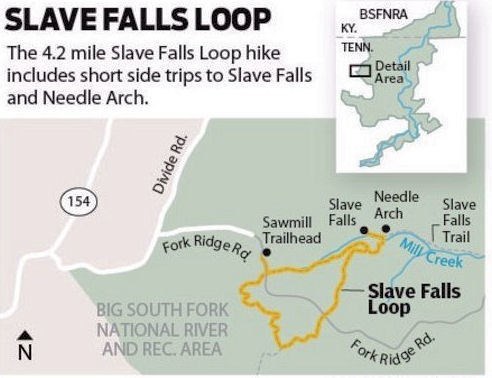
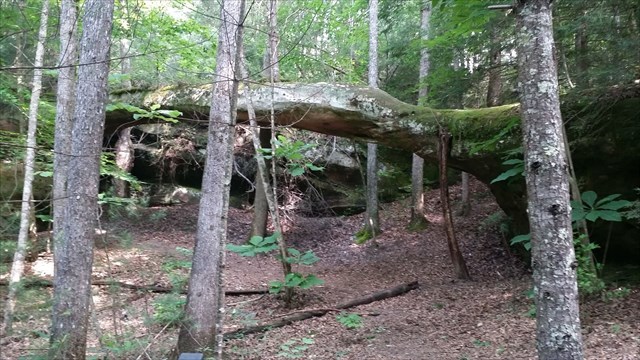
A natural arch or natural bridge is a natural formation (or landform) where a rock arch forms, with a natural passageway through underneath. Most natural arches form as a narrow ridge, walled by cliffs, become narrower from erosion, with a softer rock stratum under the cliff-forming stratum gradually eroding out until the rock shelters thus formed meet underneath the ridge, thus forming the arch. Natural arches commonly form where cliffs are subject to erosion from the sea, rivers or weathering (sub-aerial processes); the processes "find" weaknesses in rocks and work on them, making them bigger until they break through. The choice of "bridge" vs "arch" is somewhat arbitrary. The Natural Arch and Bridge Society identifies a bridge as a sub-type of arch that is primarily water-formed. By contrast, the Dictionary of Geological Terms defines a natural bridge as a "natural arch that spans a valley of erosion."
The natural processes that lead to selective removal of rock from a rock exposure are almost exclusively processes of erosion. Erosion can selectively remove rock both macroscopically and microscopically. Both modes are effective, albeit on different time scales, because of the basic structure of virtually all types of rock. Rock of any type (with the sole exception of a pure crystal) is a complex matrix of small, interlocking, solid particles. These particles are mostly microscopic fragments of various mineral crystals known as grains. Under high temperatures and pressures, some of the crystalline grains fuse, especially the smaller ones, and act as a cement between the larger grains. Macroscopic erosion occurs when joints or fractures are first induced in this rock matrix through some (usually catastrophic) process, and then widened through a variety of other processes. This splits the rock into distinct macroscopic pieces that can then move relative to each other under the forces of gravity or water pressure. Microscopic erosion occurs when certain processes dissolve the crystalline cement, thus destroying the rock matrix and allowing other processes to disperse the remaining loose grains. Both types of erosion occur separately and in combination on all rock exposures. Only under very special circumstances will a natural arch form. These circumstances include the type, or types, of rock that are present, the shape of the rock exposure (especially in relation to the gravity gradient), and the combination of erosional processes that act upon it. Usually a very specific sequence of erosional processes must operate on a specific shape of rock exposure before a natural arch will form. Since some erosional processes are more effective on certain types of rock than others, the type of rock is also an important factor.
Identifying sandstone versus limestone:
Sandstone is created in layers. If you can see horizontal lines through the stone indicating these layers, you can be sure that it is sandstone and not limestone. Limestone is made mostly of calcium deposits from large collections of shell, bone and coral and creates a solid colored stone.
https://www.nps.gov/biso/planyourvisit/tntrails.htm
https://en.m.wikipedia.org/wiki/Natural_arch
https://www.naturalarches.org/archinfo/formation.htm
Of course, I would love to see pictures of you at the arch but it isn't a requirement.
In order to log this cache please message or email me answers to the following:
1)What is the height & length (underneath) dimensions of the Arch?
2)Which force of nature formed this Arch according to the nearby sign?
3)What type of rock is this Arch?
Please do not post your answers in your log & any logs without the required answers will be promptly deleted.