The posted coordinates will take you to the artesian bore, heat exchanger, cooling ponds and storage towers for Birdsville's reticulated water supply. Please heed the warning signs regarding the water temperature.
Nearby is the Birdsville geothermal power station, powered by hot water from the Great Artesian Basin and one of the few low-temperature geothermal power stations in the world.
The Great Artesian Basin
The Great Artesian Basin (GAB) is the largest and deepest artesian basin in the world, underlying 23% of the continent and stretching over 1,700,000 square kilometres. Its depth ranges from 100 metres to 3,000 metres and it is estimated to contain 64,900 cubic kilometres of groundwater.
The basin provides the only source of permanent fresh water throughout much of inland Australia. Heat and pressure from the Basin waters are also important natural geological resources that have been harnessed in some places, including Birdsville, for domestic purposes .

The GAB waters are warmed by the heat produced by the radioactive decay of uranium, thorium and potassium deep in the Earth’s mantle, and by past volcanic activity. Groundwater temperature is generally highest in the deepest areas. At depth and under pressure, the water temperature can exceed 130ºC. The average temperature ranges between 30º and 50ºC at the surface but reaches boiling point in some places.
The temperature variation in GAB water has been plotted and mapped as a ‘geothermal gradient’. It is of interest for ‘hot rock’ technology, which aims to use the hot groundwater for the generation of electricity.
Birdsville water supply and geothermal power station
In 1961, a 1,230 metre deep artesian bore was sunk in Birdsville to augment the water supply from the Diamantina River. The water flows out of the bore at a temperature of 98°C and a pressure of 1,200 kPa.
The pressure from the bore was sufficient to drive a small turbine and generator to produce power for electric lighting in the town. The plant operated from April 1965 until December 1978, when it was replaced by a diesel generator. The diesel generator was in turn superseded by a geothermal power station that draws energy from the bore's near-boiling water.
Hot bore water flows at about 27 L/s to provide a source of heat at 98°C. This heat is transferred to the power station’s 'working fluid' of isopentane through a plate heat exchanger. As it is heated by the hot water, the isopentane boils into a vapour (similar to steam) at about four atmospheres pressure. The high pressure vapour pushes against the vanes of a screw-type expander, converting some of its heat energy into mechanical power, turning the shaft of a generator and producing a net power output of 80kW.
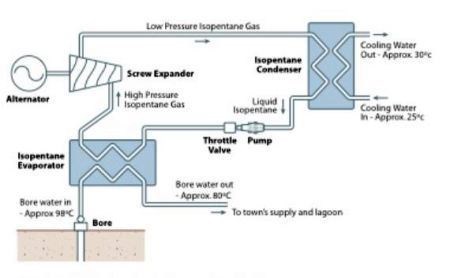
After emerging from the expander at reduced pressure, the isopentane vapour is cooled and condensed back to liquid at about 30°C. The isopentane working fluid is continuously cycled through a closed loop, being sequentially heated, vapourised, expanded and condensed.
The bore water is cooled to 80°C as it passes through the power station, and then further cooled by enclosed circulation through cooling tubes, ponds and heat exchangers before being directed into the town’s reticulated water supply.
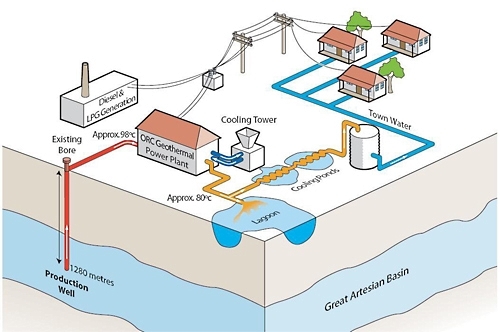
The geothermal power station was operated by Ergon Energy from 1992 to 2017. It was not connected to the national electricity grid and instead supplied directly into Birdsville's isolated mini grid. Geothermal power provided about 30% of the annual electricity needs of Birdsville.
As the power station approached the end of its working life, Ergon Energy began looking into a replacement geothermal system. After some evaluation, and taking into account the rapid changes occurring in the distributed energy market, it became clear that solar photovoltaic and battery storage systems were the best option for the future. Work is currently under way to develop a future energy system for the town.
To log this earthcache...
To log the cache, please send me a message or email with answers to the following questions:
Q1. Describe what you can see at the Artesian bore head and cooling ponds.
Q2. What temperature is the water as it comes out of the artesian bore and why?
Q3. In your own words, explain how the natural heat from the artesian bore water is converted to electric power in the Organic Rankine Cycle (ORC) engine.
The answers can be determined from your observations at the two waypoints and by reading the information in the above cache description.
Please feel free to log your visit as soon as you like after you have submitted your answers to me. I will respond confirming permission to log, or asking clarifying questions if I feel that you have not answered the questions correctly. Logs with no answers sent will be deleted. Please do not post your answers in your log.
Enjoy your visit!