In continuation of the HIDDEN CREATURES theme:
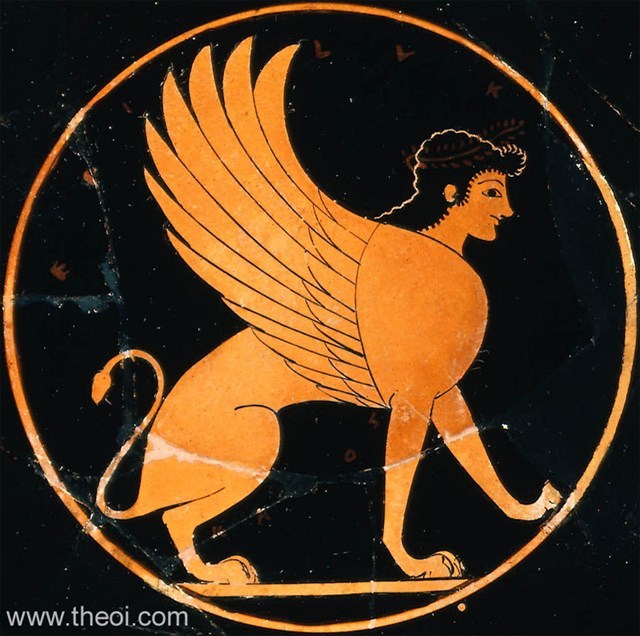
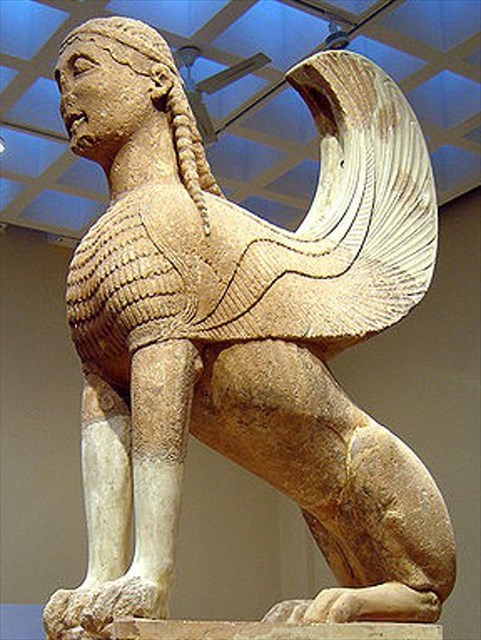
SPHINX: mythological creature with a lion’s body and a human head, an important image in Egyptian and Greek art and legend. The word sphinx was derived by Greek grammarians from the verb sphingein (“to bind” or “to squeeze”), but the etymology is not related to the legend and is dubious. Hesiod, the earliest Greek author to mention the creature, called it Phix.
The winged sphinx of Boeotian Thebes, the most famous in legend, was said to have terrorized the people by demanding the answer to a riddle taught her by the Muses—What is it that has one voice and yet becomes four-footed and two-footed and three-footed?—and devouring a man each time the riddle was answered incorrectly. Eventually Oedipus gave the proper answer: man, who crawls on all fours in infancy, walks on two feet when grown, and leans on a staff in old age. The sphinx thereupon killed herself. From this tale apparently grew the legend that the sphinx was omniscient, and even today the wisdom of the sphinx is proverbial.
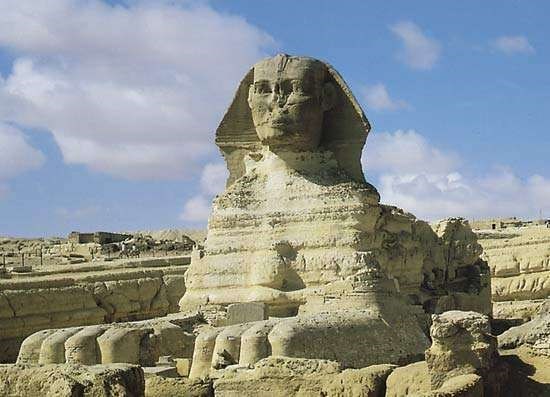
The earliest and most famous example in art is the colossal recumbent Great Sphinx at Giza, Egypt, dating from the reign of King Khafre (4th king of 4th dynasty, c. 2575–c. 2465 BCE). This is known to be a portrait statue of the king, and the sphinx continued as a royal portrait type through most of Egyptian history. Arabs, however, know the Great Sphinx of Giza by the name of Abū al-Hawl, or “Father of Terror.”
Through Egyptian influence the sphinx became known in Asia, but its meaning there is uncertain. The sphinx did not occur in Mesopotamia until about 1500 BCE, when it was clearly imported from the Levant. In appearance the Asian sphinx differed from its Egyptian model most noticeably in the addition of wings to the leonine body, a feature that continued through its subsequent history in Asia and the Greek world. Another innovation was the female sphinx, which first began to appear in the 15th century BCE. On seals, ivories, and metalwork the sphinx was portrayed sitting on its haunches, often with one paw raised, and was frequently paired with a lion, a griffin (part eagle and part lion), or another sphinx. Info. courtesy from: https://www.britannica.com/topic/sphinx

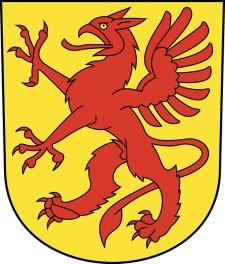
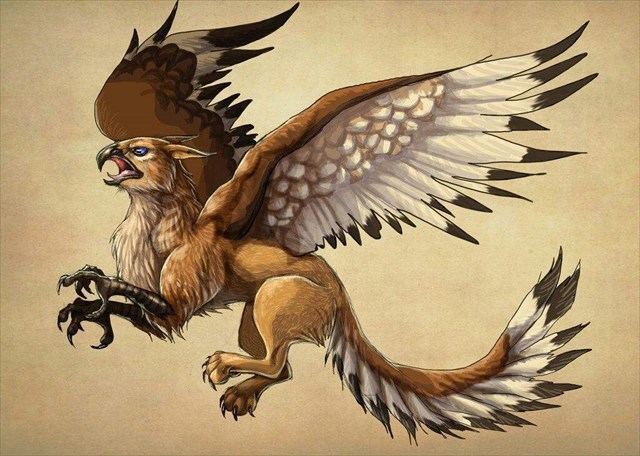
GRYPHON: More commonly known as "GRIFFIN": a fabled monster, usually having the head and wings of an eagle and the body of a lion.
he griffin is a fascinating mythical creature whose roots reach from western Europe to the Eastern edges of India and beyond. In any mythology, the griffin is portrayed as a mix between an eagle and a lion. In all cases, this creature is shown as having the head of an eagle and the body of a lion, but from there the other specific features are in debate.
The most common portrayal of the griffin in mythology is a creature with the body and regal, kingly mythical creature who commanded deep respect.
Griffin mythology reads a lot like dragon mythology in that griffins were thought to be very wise and wily characters who spent a good deal of time seeking out and guarding gold and treasures. Other legends have the griffin as a trickster, much like the Sphinx, who would challenge people with riddles in a contest of wits. The winners would get to keep their lives and treasures, and the losers... wouldn't. The Sphinx also has the body of a lion.
Historian and folklore expert Adrienne Mayor has suggested a possible origin of griffin mythology that I find quite compelling. She points to several fossil findings of the pentaceratops - a dinosaur from the Cretaceous period - that were located near known gold veins as being influential in the belief in griffins. The pentaceratops had a beaked face with a four-legged body. Anyone digging for gold in an area with these bones would find a creature whose bones looked very much like what one would imagine a griffin's bones to look like located near their gold vein. From there, it's not hard to figure out why people would imagine a griffin looking as it does and being known for digging for and hording gold.
As they represented both wisdom and power, griffins were commonly associated with strength in war, thus being an obvious choice for many coats of arms from ancient to medieval families and armies. The Republic of Genoa used the griffin as a symbol of its seafaring power on all of its ships in the Middle Ages.
As with most monsters, the griffin has ties to ancient Greek mythology. Specifically, it was said that a griffin pulled the chariot of Apollo (Greek mythology), the sun god. This would be appropriate, as the griffin was thought to be stronger than an ox or a horse, and had the ability to fly, thus carrying the sun god to and from the sun and earth. Apollo often also represented wisdom in the form of knowledge, which is also a characteristic of the griffin.
Information courtesy of: http://www.gods-and-monsters.com/mythology-griffin.html
Date: Thursday, 19 July 2018
Time: 07h00 to 08h00
Place: Stickywaffle, Grosvenor Crossing, Cnr Grosvenor & Main Roads, Bryanston
We look forward to seeing you there!